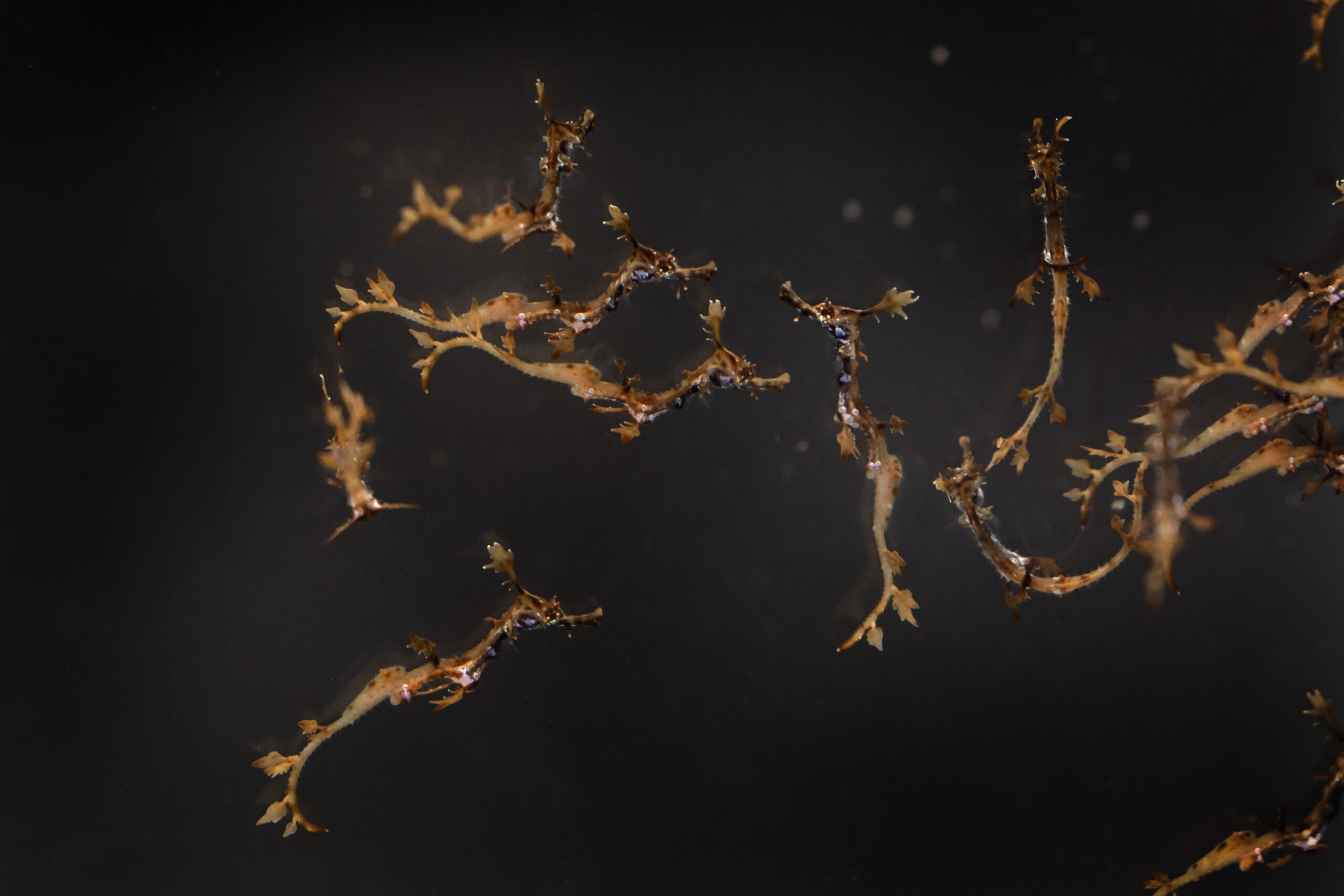
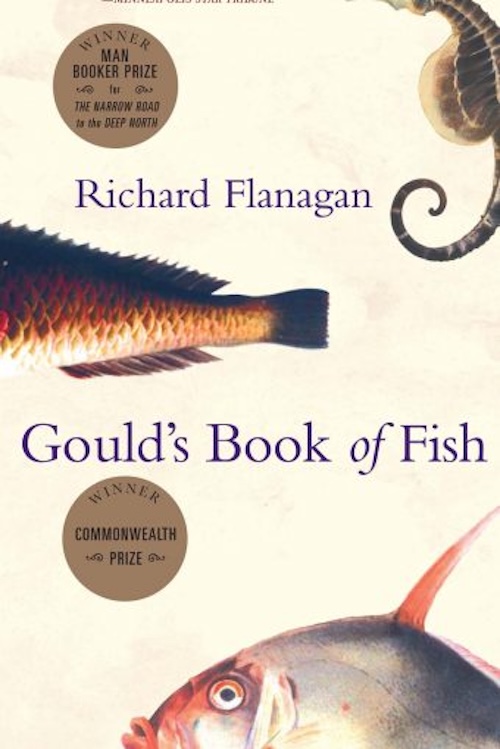
Two nights ago I finished reading the marvelous and peculiar 2001 novel—Gould’s Book of Fish: A Novel in Twelve Fish—by Australian author Richard Flanagan. In his pages of colorful prose, I learned about all sorts of odd fish and fishy people, including Mr. Gould—William Buelow Gould—a 19th century artist and convict who painted pictures of these fish. I had never heard of some of them, including the weedy seadragon, the title and topic of one of Gould’s chapters.
The special characteristic of the weedy seadragon is that the male gives birth to the babies. (So does the pot-bellied seahorse, a related species, which I also learned from Mr. Gould.)
Imagine my surprise when I received an email from the Shedd Aquarium the next morning announcing that they are celebrating the arrival “just in time for Father’s Day – and for the first time ever—of over a dozen weedy seadragon babies, or fry, that hatched to a male seadragon.” The expectant dad at Shedd Aquarium fertilized and carried eggs on the underside of his tail. After hatching, the inch-long weedy seadragon fry are fully independent, feeding and fending for themselves. For now, the baby weedy seadragons will remain behind the scenes.
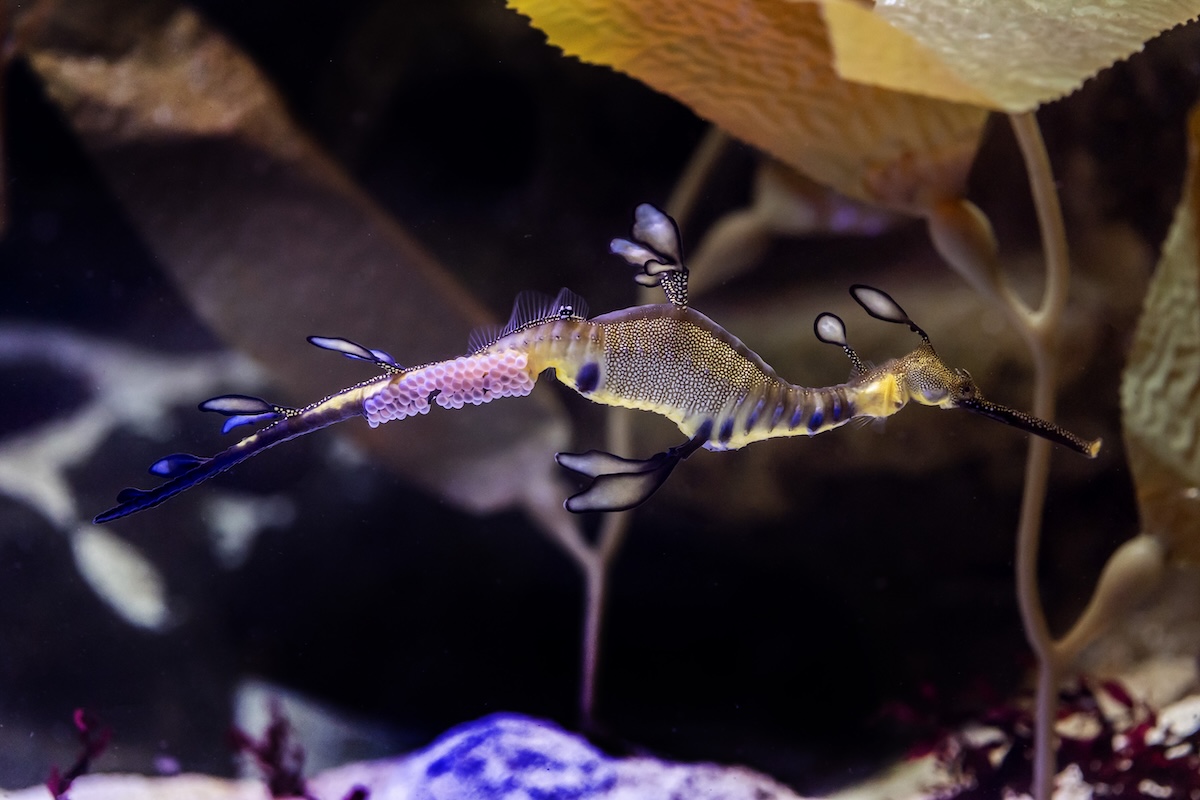
Male weedy seadragon with fertile eggs on the underside of his tail marking only the
second time Shedd Aquarium had a successful egg transfer. Photo ©Shedd Aquarium/Brenna Hernandez.
Aquarists at the Shedd monitor the babies and ensure plenty of food is available. Even with the small size of the inch-long hatchlings, and even smaller tube-like snouts to catch and consume minuscule prey, the new arrivals are picky but mighty eaters. Luckily, the Shedd specializes in growing live foods like tiny brine shrimp, copepods and mysis shrimp that sustain seadragon fry. The aquarium’s care team remains cautiously optimistic about the delicate seadragon babies, as it could take up to two years to grow to adult size. Weedy seadragons are found in shallow coastal waters among kelp forests, seaweed beds and rocky reefs of southern and western Australia (and Tasmania, its island state).
Gould’s Book of Fish— a fictionalized story of the life of convict/artist Gould—takes place on Sarah Island, a penal settlement in Tasmania (or Van Diemen’s Land, as Tasmania was known until 1855). Gould was imprisoned for life in what was considered the most feared penal colony in the British Empire; when he arrived in 1818, he was ordered by the prison surgeon to paint all the fish caught there. Flanagan’s book begins with the narrator’s story of finding a draft of Gould’s book, hand-drawn and heavily notated, in an old galvanized-iron meat-safe in an antique store in Hobart, Tasmania. (The narrator and his two partners are engaged in the business of turning junk furniture into saleable fake antiques.) Most of the book is made up of Gould’s phantasmagorical tale of painting fish (and fake Constables) for the turnkey Pobjoy, and his own reflections on how he might become a fish—which he does, by book’s end. ‘I like my fellow fish,” he says. “They do not whinge about small matters of no import, do not express guilt for their actions”—nor do they seek to get ahead or own things.
We can look forward to the time when the weedy seadragon fry are grown to adult size so they might be safely exhibited to aquarium visitors. Until then, I recommend finding a copy of Gould’s Book of Fish to ease your curiosity about the world of male fish daddies.
Richard Flanagan, a native of Tasmania, is the author of eight novels and nine non-fiction works, including his latest memoir/novel, Question 7 (2025, 280 pp, Vintage). Question 7 tells Flanagan’s story through H.G. Wells’ prescient 1914 novel, The World Set Free, and his affair with Rebecca West, Leo Szilard and the development of the atomic bomb, the Tasmanian genocide of its indigenous population, and his parents’ lives.
His novels defy classification; each is very different from the last. His novel, Narrow Road to the Deep North, won the 2014 Booker Prize and was recently adapted for an Amazon Studios mini-series directed by Justin Kurzel and starring Jacob Elordi. The story primarily focuses on his father’s harrowing experiences as a Japanese POW in WWII, working as slave labor on the Burma Railway through the jungle.
Flanagan is a descendant of Irish convicts transported to Van Diemen’s Land during the Great Famine. His work has won many awards and has been translated into 26 languages. He lives in Tasmania with his family.
Gould’s Book of Fish by Richard Flanagan (2001, 404 pp) is available from the publisher and from your favorite bookseller.
The Shedd Aquarium, 1200 S. DuSable Lake Shore Drive, is open daily. Check their website for tickets and information.
Support arts and culture journalism today. This work doesn't happen without your support. Contribute today and ensure we can continue to share the latest reviews, essays, and previews of the most anticipated arts and culture events across the city.
