Third Coast Review contributor Tory Crowley is a native Midwesterner currently living in Budapest, Hungary. Please enjoy her European cultural notes.
For spring break, I travelled to Santorini, Greece. I went on a solo trip, not for its cultural significance or history, but because the beaches are pretty and I wanted to see the white buildings with blue-domed tops. Sometimes, you do it for the aesthetic.
I had had a rough few weeks, after going through a breakup, and I felt entitled to go to a Greek island and pretend I was living a real-life version of Mamma Mia for a couple of days. No museums on this trip. No pretentious cultural attractions to make me feel like I was getting smarter. Just starting every day with a belly full of baklava, sustaining myself with gyros, and ending the night with a glass of wine or ouzo.

As it happened, my visit to Greece coincided with Orthodox Holy Week (this year, a week after Roman Catholic/Protestant Easter). I arrived on Monday evening. The sun had already set. As I walked down the street to find my Airbnb, I came upon a large cross, probably 12 feet high, on display in a park. The cross itself was made of white lights, like Christmas lights, flanked by evergreen branches. I would see this cross every night that week on my walk home, and later learn people called it a Lazarus cross, referencing the Biblical resurrection of Lazarus and hinting at Jesus’ imminent resurrection. Soon, I discovered that every town in Santorini had its own Lazarus cross on display.
The Lazarus cross prompted me to do some research on what sorts of Holy Week festivities existed in Santorini. On Good Friday, I went to the Catholic church in Fira, Santorini’s capital. A notice outside the church indicated they had a noon mass every day. I thought this would be a cool experience to take part in. I waited outside with an older man for the doors to open. He paced around the entrance, taking photos of everything with a professional camera. A few other people walked by, mostly American tourists, also looking for mass, but they all quickly moved on.
By 12:20, the man waiting with me said, “Maybe no mass today.” I rolled my eyes. After living in Europe for over a year and a half, I was frustrated that you could never trust a schedule to line up with reality.
“Come back at 10 pm,” he said. There will be a big Good Friday processional here. And then one at midnight at the Greek Orthodox church, if you want to stay up that late.” He explained, quite proudly, that he lived in Athens and worked as a photographer. The Catholic Church had hired him to take photos of Santorini's Easter celebrations. (The Catholic Church in Greece celebrates Easter at the same time as the Greek Orthodox Church, in solidarity.)
“I was thinking about going to Pyrgos,” I replied, slightly annoyed at the thought of giving this church another chance to ruin my Friday plans.
“Oh, go to Pyrgos,” he said with an excited smile. “There’s nothing like it.”
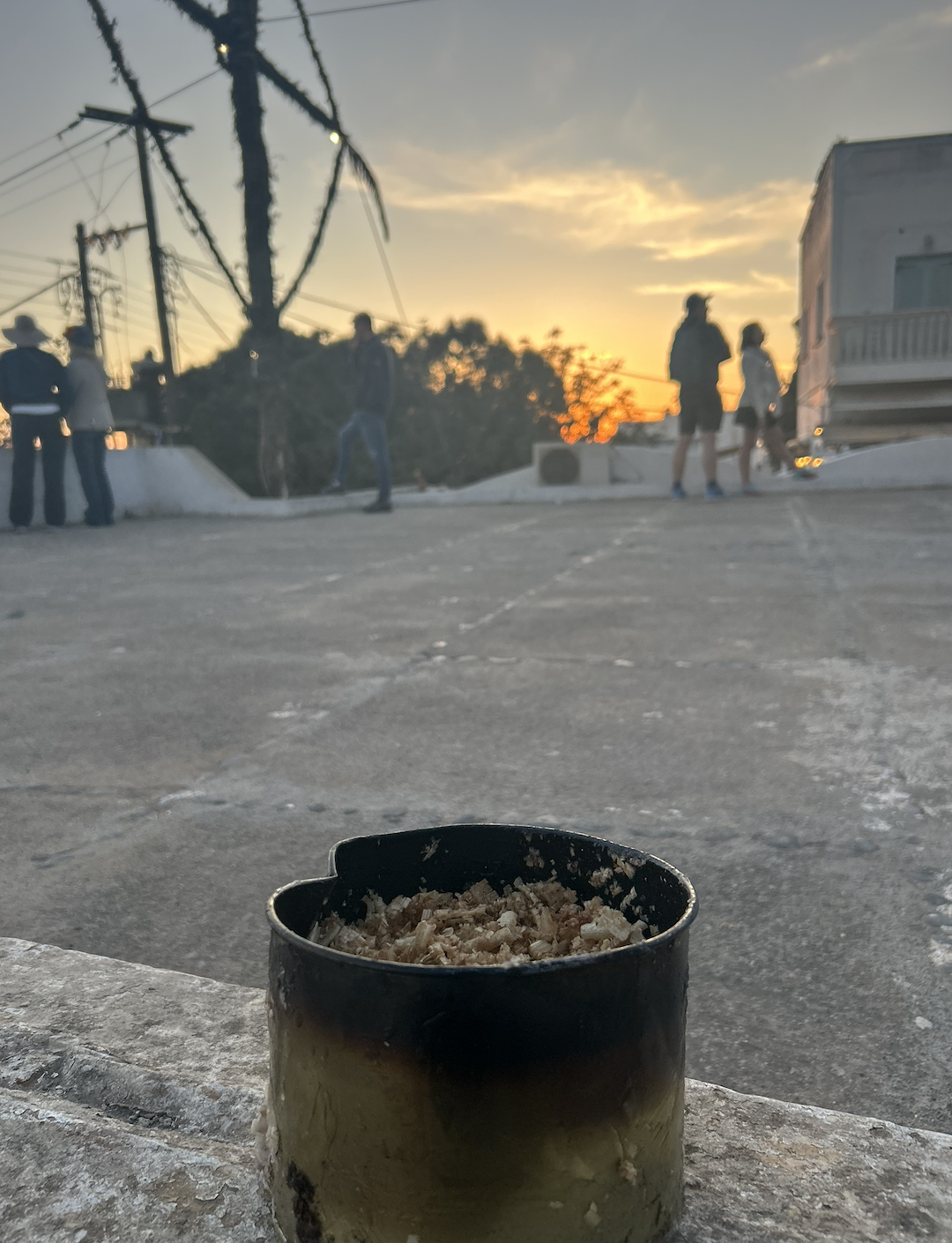
With that endorsement, I boarded a bus later that afternoon to the town of Pyrgos Kallistis, population: 1,078. On the drive in, I saw a dozen men in a parking lot outside the village preparing hundreds of lanterns for the evening. The festivities started after sunset. I arrived at 6 pm—way too early.
I sat in a park in the center of the village and listened to an audiobook, then treated myself to a giant Greek salad at a nearby fast casual restaurant. As the hours passed, the park I sat in grew more lively. Kids played football in the square and set off small fireworks. Parents chased their toddlers around while we all waited for the sun to set.
The sun fully went down at 8:45 pm. I was tired and a little nervous about being out after dark in this strange town, dependent on a haphazard bus system. My Airbnb concierge claimed the bus had extended hours that day, which was completely unverifiable. I just prayed that he was right and I wouldn’t have to walk home in the dark on Santorini’s windy, unpaved roads.
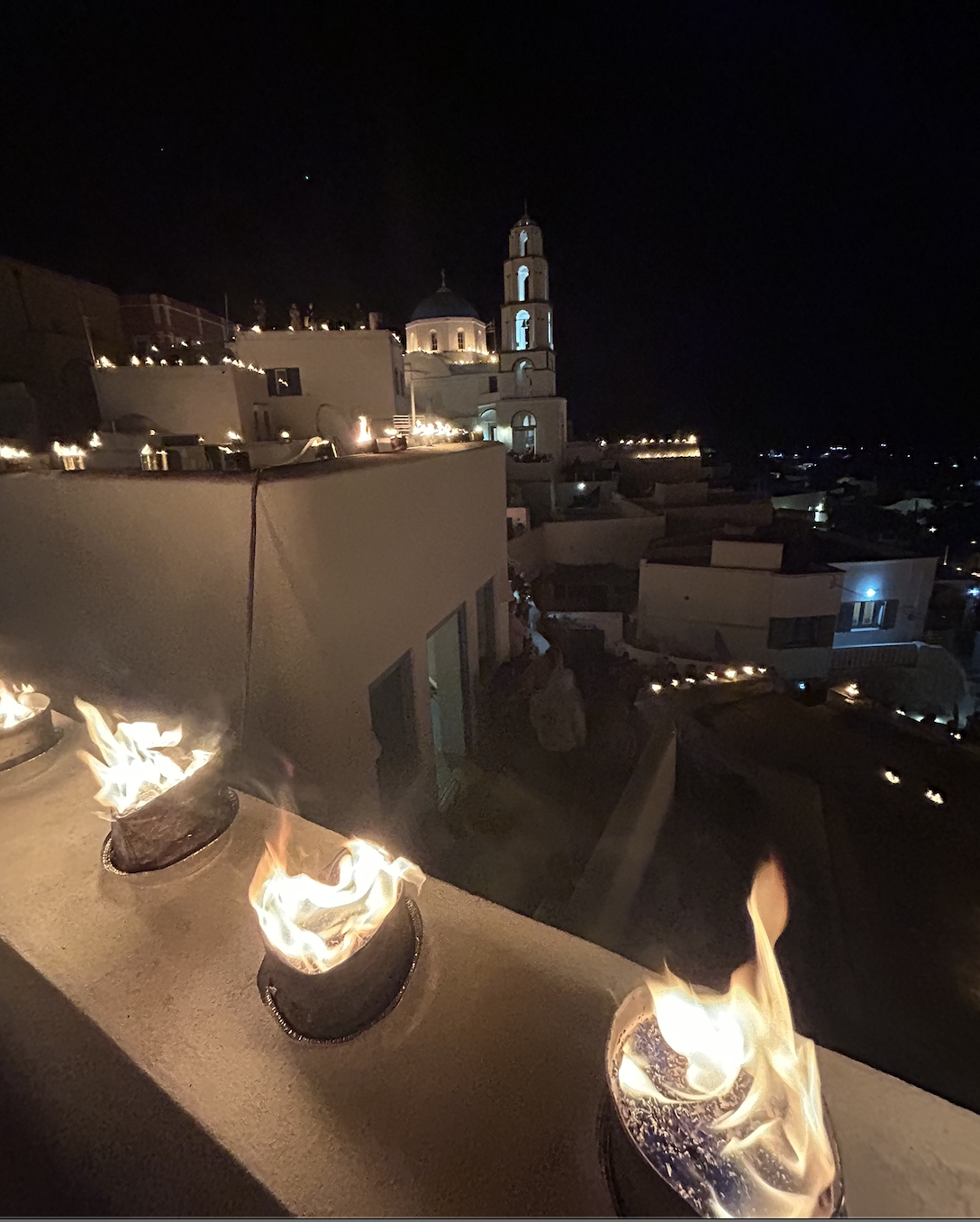
So I waited as the night grew darker. And I waited. “The sun set almost an hour ago,” I thought to myself. “When will this start?” And at about 9:30 pm, someone lit the first lantern. And then another and another, until all 7,000 lanterns in the small town of Pyrgos were aflame. They covered the hill on which the village was built. They were in the park, on city walls, on people’s back porches, around churches, each lantern no more than a few feet away from the next. It was like the whole town was on fire.
I had walked around the village earlier. The tins were about the size of a coffee can, full of wax and sawdust. Once lit, they’d be able to hold a flame for hours. I passed through the village walkways again, ascending to the top of the hill. Houses on the hill were full of people celebrating, families eating dinner, friends drinking, playing games, and watching the festivities. People crowded the streets, filling them with the excited buzz you might feel on the Fourth of July, except everything was covered with a layer of reverence and awe.
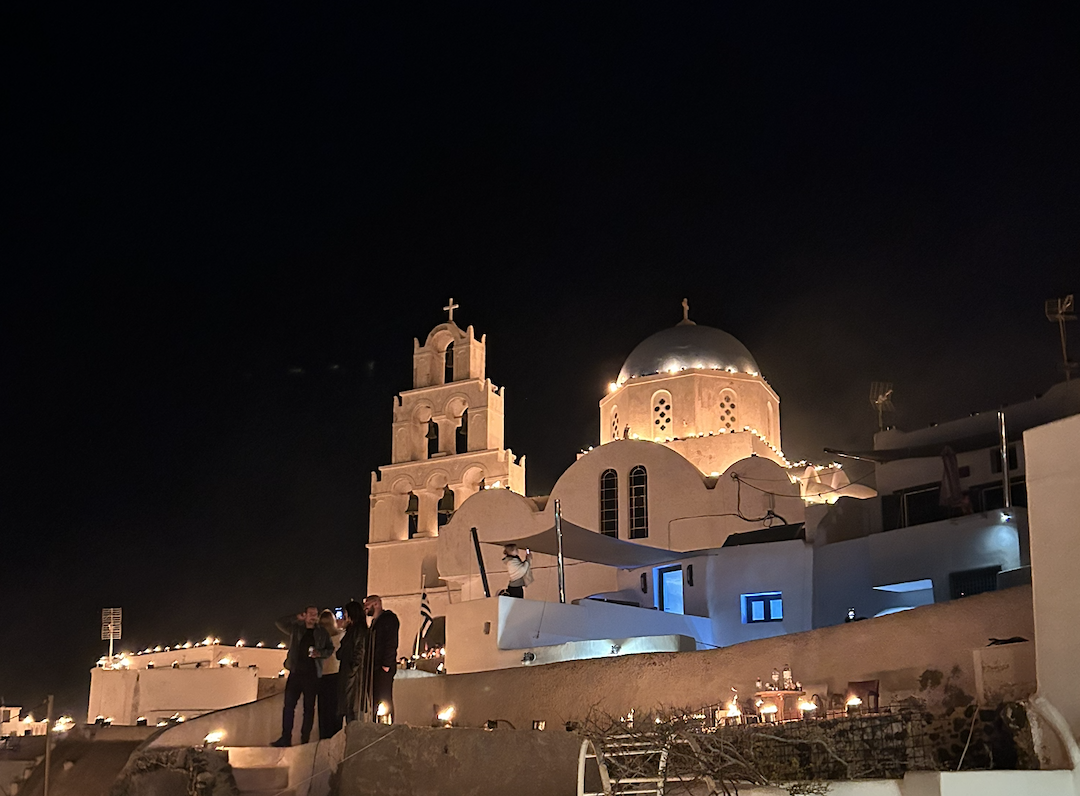
In that moment, all of my annoyances and frustrations from the day melted away. It was a beautiful sight. It felt holy. Pyrgos is a tiny village on a small island in a quiet country, and yet, this display felt larger than life. The people of this village came together to create this experience, fueled by faith, tradition, and hard work. I took the bus back to my Airbnb (it did come as scheduled, after all). When I got off, I looked back at the town of Pyrgos, fully lit up, visible from miles away.
The next night, Saturday, fireworks woke me up at midnight, signaling that Easter had arrived. I went onto the balcony and looked out across the island. Each village, as far as the eye could see, was simultaneously putting on its own fireworks display. It was loud and celebratory, and in your face in just the right way. It was an incredible sight. But I couldn’t help noticing how hollow it all felt compared to the richness of the night before.
Santorini gave me what I wanted: the beaches, the food, the gorgeous views. But it also gave me something unexpected: a reminder that beautiful things aren’t beautiful because they’re seen or appreciated by many people. Beauty is not dependent on being beheld; it is innate. And that is enough.
Photos by Tory Crowley.
Support arts and culture journalism today. This work doesn't happen without your support. Contribute today and ensure we can continue to share the latest reviews, essays, and previews of the most anticipated arts and culture events across the city.
