
Life is not remembered in a straight, unbroken line; we remember moments: the best and the worst can be recalled vividly in most cases, but our brain holds onto what we feel are unimportant details that pop out to greet us in dreams, or perhaps as we’re on the verge of shuffling off this mortal coil.
This is the fuel that drives The Life of Chuck, the latest from writer/director Mike Flanagan, who has made a career of adapting works by author Stephen King that many believe are unfilmable (Doctor Sleep, Gerald’s Game), as well as quality television series for Netflix (The Haunting of Hill House, Midnight Mass).
Chuck is a novella by King that is more akin to Stand By Me and The Shawshank Redemption than The Shining or It. It’s meant to be contemplative and celebratory, depicting its three-act structure in reverse—beginning with nothing less than the end of the world.
But as the movie progresses, we learn about the adult life and childhood of Charles “Chuck” Krantz, played by four different actors at different ages, ending with Tom Hiddleston as adult Chuck. But before we meet our title character, we hear about him during a story about the world collapsing upon itself. The internet and cell service is down; climate change has taken its toll around the world (California has essentially fallen into the ocean). But a schoolteacher (Chiwetel Ejiofor) is still encouraging parents to keep their kids coming to school. Meanwhile all around him, suicide rates are soaring, leaving a local doctor (Karen Gillan) barely able to deal with this crisis. It turns out the two were once a couple, and by the end of their introductory chapter (which is actually Chapter 3), they have chosen to spend their last remaining hours together. But all around the town where they live are billboards and other ads, thanking a guy named Chuck for 39 great years… of what, we don’t know.
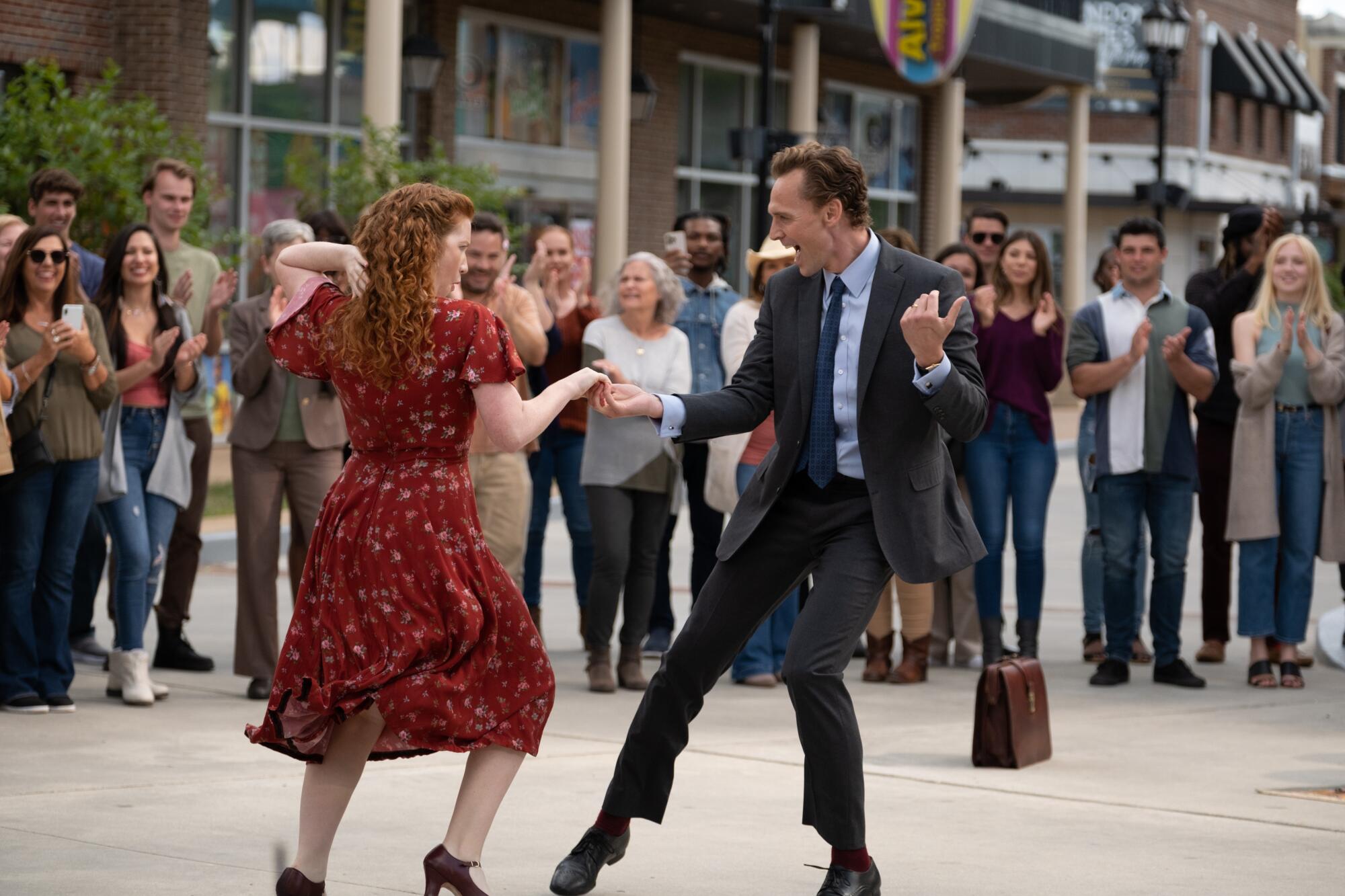
The second chapter involves Hiddleston’s Chuck, and the centerpiece of the segment is an extended dance number in which Chuck, seemingly out of nowhere, begins a well-choreographed routine while a busking drummer pounds out a funky beat. Soon, a crowd gathers around him in the town square, and a young woman (Annalise Basso) joins him in the dance. It isn’t until later that we find out that his skills as a dancer are well earned and his way of honoring the people that raised him and taught him. We also discover in this segment that Chuck is ill, and the mystery deepens about the connection between these seemingly unrelated chapters.
As one might expect, The Life of Chuck considers life experiences such as love, loss, regret, joy, and other such moments that make life worth experiencing. The film is meant to be a bit of a mystery, so don’t get discouraged if it all doesn’t make sense by the halfway point; it gets there eventually. The first act covers Chuck’s childhood, with Benjamin Pajak and Jacob Tremblay playing the character at different young ages. Mark Hamill plays Chuck’s grandfather, who raised him for part of his life, but also opens his world to a reality in their own house, behind a locked door, that is potentially terrifying and that Chuck has no choice but to examine, even though it means ruining the mystery of his own life to a certain degree. But we also learn about Chuck’s love of dance, his inherent curiosity, and who all of these people are from the beginning of the movie, and it flows into the same narrative river beautifully.
The film’s supporting players include Mia Sara, Carl Lumbly, David Dastmalchian, Harvey Guillén, Matthew Lillard, and Nick Offerman providing a silky smooth narration of all of Chuck’s life events. It may feel like overkill to have actors so talented occupy sometimes tiny roles, but it also adds to the wonder of what this film has to offer. At times, The Life of Chuck drifts into the saccharine, but I think Flanagan earns it (the film won the Audience Choice Award at the Toronto International Film Festival last year, and it’s easy to appreciate its crowd-pleasing leanings). The emotional apex of the movie might occur earlier in the film than one might like, but I still believe that what comes after it is charming and magical in its own way, even if it feels a little anticlimactic as well. Even with its one supernatural element, the real magic of The Life of Chuck is firmly grounded in reality.
The film is now playing in theaters.
If you enjoyed this post, please consider supporting Third Coast Review’s arts and culture coverage by making a donation. Choose the amount that works best for you, and know it goes directly to support our writers and contributors.
