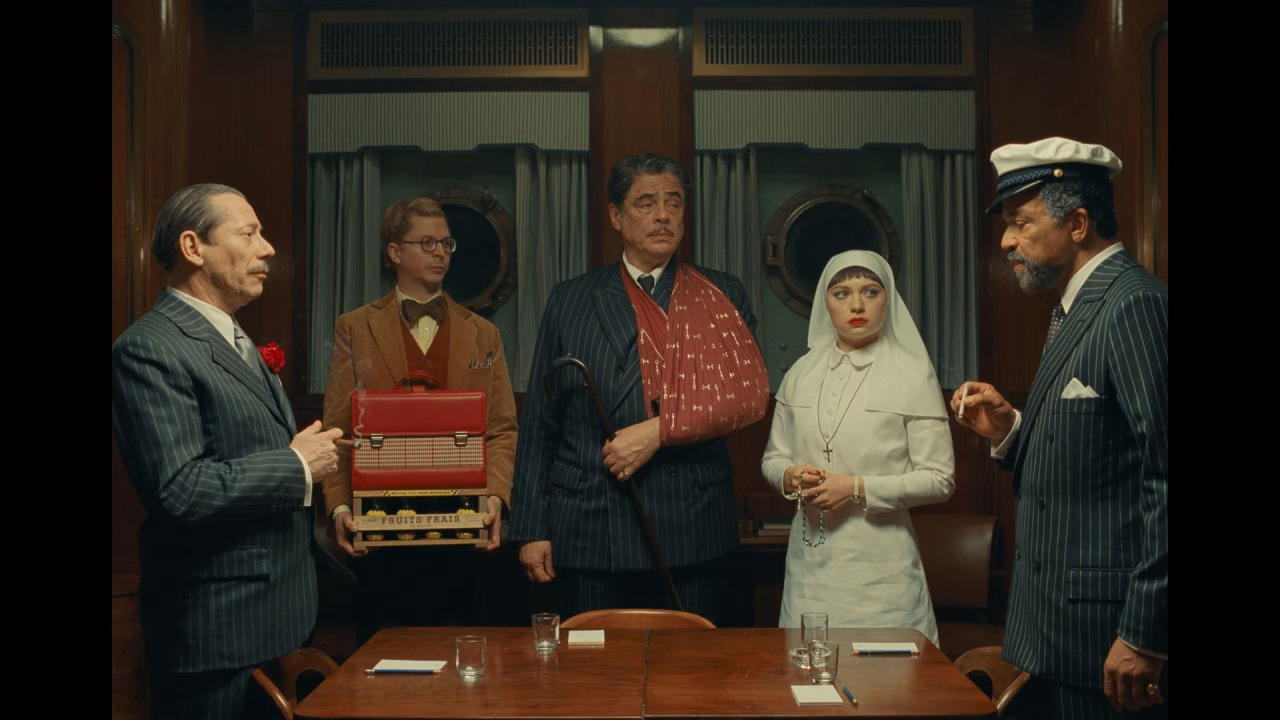

By this point, if you don't know at least a bit of what to expect—the color schemes, the deadpan dialogue, the kooky costumes and haircuts—when going into a Wes Anderson movie (Asteroid City, The French Dispatch, The Grand Budapest Hotel), you may just be living under a rock. The filmmaker has carved out a cinematic milieu more defined and recognizable than anyone in recent memory, second only perhaps to Martin Scorsese's New York gangster era.
Anderson's latest, The Phoenician Scheme, is for better or worse more of the same. One goes to a Wes Anderson movie to get a Wes Anderson movie, and he delivers yet again with this funny family dramedy about an unscrupulous businessman who's trying to reconnect with his grown daughter and launch a massive development plan in the desert, all at the same time.
Benicio del Toro is Zsa-zsa Korda, a dealmaker who's made his fortune bringing other businessmen together and profiting 5% off everything he facilitates; this has made him a friend to few and enemy of many—a running gag throughout the 80-minute movie is the various assassination attempts he's thus far managed to survive. With his biggest development on the line, Korda is getting nervous about his legacy and who will inherit all his hard-earned profits. That's when he summons his grown daughter, Liesl (Mia Threapleton), who is days away from taking her vows as a nun and renouncing the material world (yes, she's in a white habit most of the film). Arriving at the same time is a new tutor for Korda's many foster-sons (a contingency plan, if you will), Bjorn (Michael Cera), who inadvertently ends up hearing all about Korda's plans and becomes the third in this unlikely trio.
So much of The Phoenician Scheme is familiar territory for Anderson (and us), including the film's chapter structure and on-screen explainers; the plot is driven by a clash between Korda and business regulators who want to make it hard for him to close this latest deal, meaning he must go visit all the investors to ask for more money—and thus, our adventure begins. There's a Sacramento contingency (Tom Hanks and Bryan Cranston) he has to win over with Prince Farouk (Riz Ahmed); a French club owner (Mathieu Amalric); the captain of a naval ship (Jeffrey Wright); and Cousin Hilda (Scarlett Johansson) who may be his best ally as his next wife. The extensive cast and where they play into the film's complicated (but never confusing) plot are both far too cumbersome to list here, but suffice it to say that not a scene goes by where you're not seeing someone new and noteworthy.
If all The Phoenician Scheme was concerned with was Korda's business dealings and the characters he meets along the way, the film would still be perfectly watchable, but it would fall far short of what we expect from Anderson, which is an ability to infuse meaning and reflection into a pretty, whimsical package. And here, Liesl is our conscience and our moral compass, both challenging her father to do business differently and eliciting in him what appears to be an unexpected reckoning with his own mortality. Throughout the film, Anderson cuts to black-and-white scenes in the "afterlife," one where Bill Murray is God (we can only hope!) and Korda is confronting his own dark past and what it all means for his later life and legacy. This added layer of introspection manages to infuse the film with a sense of purpose while, in true Anderson style, never taking us too far from the aesthetic.
There are few filmmakers who can return to such a familiar well again and again and still find new ways to explore these signature quirky stories and unique characters. Not everything here strikes fresh notes, but Threapleton is a welcome addition to the Anderson School of Acting, and the film overall is funny enough, thoughtful enough and Wes Anderson enough to be worth spending an evening with.
The Phoenician Scheme is now playing in theaters.
If you enjoyed this post, please consider supporting Third Coast Review’s arts and culture coverage by making a donation. Choose the amount that works best for you, and know it goes directly to support our writers and contributors.
