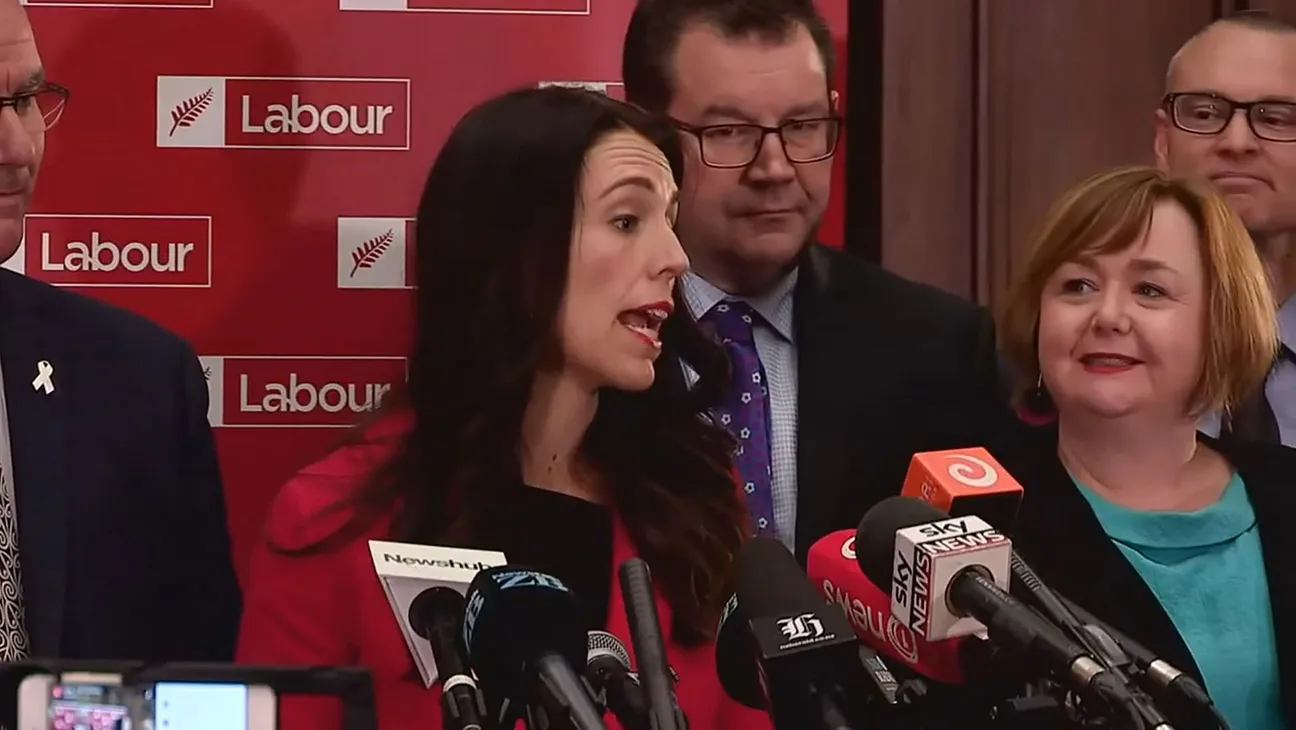

If you're willing to trek to Skokie this weekend, it would be worth it to see Prime Minister, one of the best documentaries of the year and a much-needed salvo when it seems that all the world's leaders are collectively losing their minds.
Directed by Lindsay Utz and Michelle Walshe, Prime Minister follows the unexpected election of Jacinda Ardern to the top office in New Zealand in 2017 and the roller coaster that would follow. At not even 40 years old, Ardern found herself leading a country with no idea what the next five years would bring, both personally and politically.
If you've heard Ardern's name before or have some passing recognition of her, it may be due to the headlines she made early in her tenure when she gave birth to daughter Neve; she was New Zealand's first sitting Prime Minister to have a child while in office. She would go on to bring Neve to legislative meetings and even a UN gathering, making headlines around the globe for something that should, in fact, be quite ordinary. You mean women can walk and chew gum at the same time? They can lead a government and be a parent? Imagine!
The filmmakers certainly address this moment in Ardern's time in office, but the film fills its 100-minute runtime with so much more of what she faced, navigated and overcame that the film begins to feel a bit like a comforting blanket, a reminder that leadership doesn't always look like what we're currently suffering through. Namely, we revisit at great length Ardern's approach to the COVID pandemic, in which she took drastic measures to close her country's borders and keep the disease as quarantined as possible; by some estimations, her efforts saved 20,000 lives. But like the disease itself, even New Zealand was not immune from the effects of negative political rhetoric, seeing an unprecedented uptick in hostile, conspiracy-driven pushback to her policies meant to keep her citizenry safe. The film has the time to deep-dive into these pivotal moments in Ardern's career, and it's fascinating to get an inside look at it all.
Structurally speaking, Prime Minister is not breaking any new ground; the film progresses mostly chronologically as it recounts Ardern's life and experiences, and the filmmakers have firsthand access to many private rooms and personal moments. All of it humanizes Ardern, a woman who generally expected to stay in the background for the duration of her civil service career. It's this humility that shines through with sincerity; here is a woman who is not interested in her own legacy or power or ego if it means putting any of that in front of what is right, logical or moral for the people she is serving. Anyone who watches the sequence chronicling her response to the Christchurch mass shooting without being moved has a heart of stone.
There are establishing shots of beaches and skylines throughout, the only part of the film that feels a bit out of place; but that's only because Ardern is such a captivating subject that these breakaway moments feel unnecessary if it means we're away from the politician and her story. The film's final third is nearly devastating as we watch New Zealand descend into right-wing chaos, a phenomenon Ardern is not at all shy about blaming on American influences like Trump and Bannon. It's a stark reminder that the world is smaller than we realize, especially in the age of internet technology and instant communication.
But, gratefully, the filmmakers ensure that this despair is not what we leave Prime Minister focused on; like Ardern herself, the film is clearly intent on shining a light on the good, on what's possible when leaders lead from kindness and potential not fear and scarcity. Ardern has been on tour in the US in the lead-up to the film's release with her new memoir; between the book and the film and what they collectively tell us about Ardern and her leadership style, one can only hope that her next chapter includes mentoring future leaders and creating more in her mold.
Prime Minister is now in theaters.
If you enjoyed this post, please consider supporting Third Coast Review’s arts and culture coverage by making a donation. Choose the amount that works best for you, and know it goes directly to support our writers and contributors.
