
Twenty-three years after director Danny Boyle and writer Alex Garland brought us the lo-fi, virus-fueled horror favorite 28 Days Later, the creative team reunites for a very different type of horror story in 28 Years Later (the pair were executive producers only on 2007’s 28 Months Later). This latest entry moves from the echoing, empty streets of London to an isolated island populated by a group of survivors whose only connection to the mainland is a single, heavily defended (by man and tides) causeway.
(Just as a reminder, these films are not technically zombie movies; as established in the first film, we’re dealing with people infected by something called the "rage virus," which escaped from a biological weapons lab and has resulted in the United Kingdom being put under a ruthlessly enforced quarantine.)
We meet a family on this island that includes father/husband Jamie (Aaron Taylor-Johnson), 12-year-old son Spike (newcomer Alfie Williams), and severely ill Isla (the remarkable Jodie Comer). As the film opens, Jamie is taking Spike on his first right-of-passage journey to the mainland to kill the infected, both armed only with a bow and arrow and knife. As we follow them during their daylong, slightly terrifying adventure, we get a shorthand tutorial about how the infected have evolved: some are slow, fat, and can only move around by crawling on the ground; others are the more traditional, fast-moving rage monsters from earlier movies; and a small number are “alphas,” which have grown taller, stronger, smarter, and are much tougher to kill (they also have huge, swinging dongs, for those interested—this is a film filled with full-frontal dong).
The father and son have a rough go of it, and even run into signs that survivors living on the mainland have taken to capturing and torturing the infected, perhaps leaving their mutilated bodies as messages for other infected to stay away from their territory. But young Spike is brave, with his arrows mostly aimed straight, and he and his dad make it back to their island safely, where a grand welcome-home party awaits them.
At one point on their trip, Spike spots a man-made fire some distance from where they were, and he eventually finds out that a doctor lives there, whom his father says went mad early on during the pandemic. The doctor, we learn, took it upon himself to collect and burn all the dead bodies in the area—thousands of them. Spike is desperate to get his mother diagnosed and cured, so he foolishly takes Isla (complete with her memory issues and bouts of seeing things and people that aren’t there) back to the mainland to seek this doctor. Once again, the variations of infected they encounter clue us into details about this new reality. We see fully emaciated ones that resemble skeletons with the skin still on them; there’s even a pregnant one on the verge of giving birth (and giving us one of the best sequences in the movie inside an abandoned passenger train).
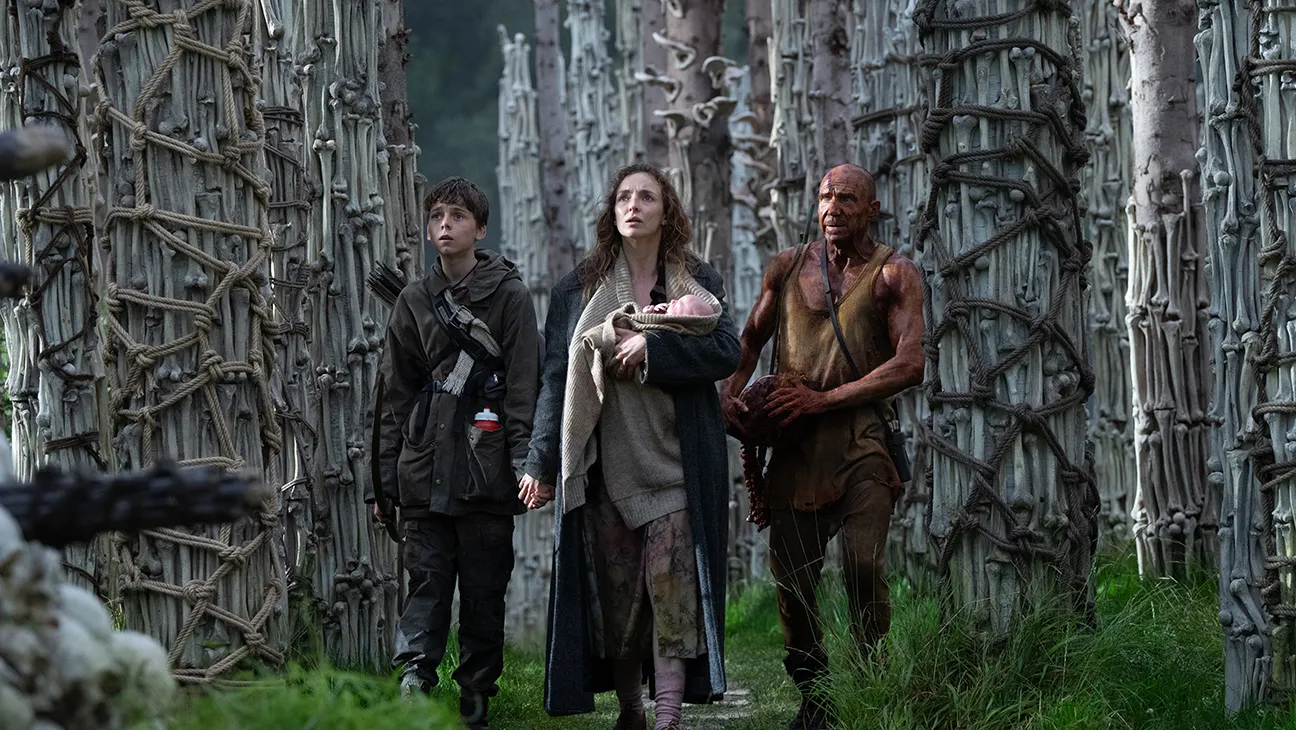
But Boyle and Garland reveal to us during the film’s final act that their real intentions are two-fold. When Spike and Isla finally do find Dr. Kelson (played exquisitely by Ralph Fiennes), it becomes clear that the filmmakers want to make one of the most heartfelt and poetic horror excursions ever committed to film. Needless to say, the doctor is not crazy, but has actually become more human in this time and place when humanity is the endangered species—I’ll say no more, but this section of the film provides some of the most stunning and haunting visuals and production design you’ll likely see all year.
It also becomes clear that the filmmakers are setting up the second and third film in 28 Years Later trilogy (the already-shot next film, subtitled The Bone Temple and directed by Nia DaCosta, was also written by Garland and executive produced by him and Boyle and is set to star several of the cast from this movie). And both of these things only make 28 Years Later a better film, especially when you see the insane ending that introduces a whole new element to this supposedly dying corner of the earth. The movie is tense, leans harder into gore than ever before, and exposes a few secrets while giving us new ones to get excited about for future installments; I for one can’t wait for DaCosta’s film next year or to watch the wonders and horror of this one once again.
The film is now playing in theaters.
If you enjoyed this post, please consider supporting Third Coast Review’s arts and culture coverage by making a donation. Choose the amount that works best for you, and know it goes directly to support our writers and contributors.
