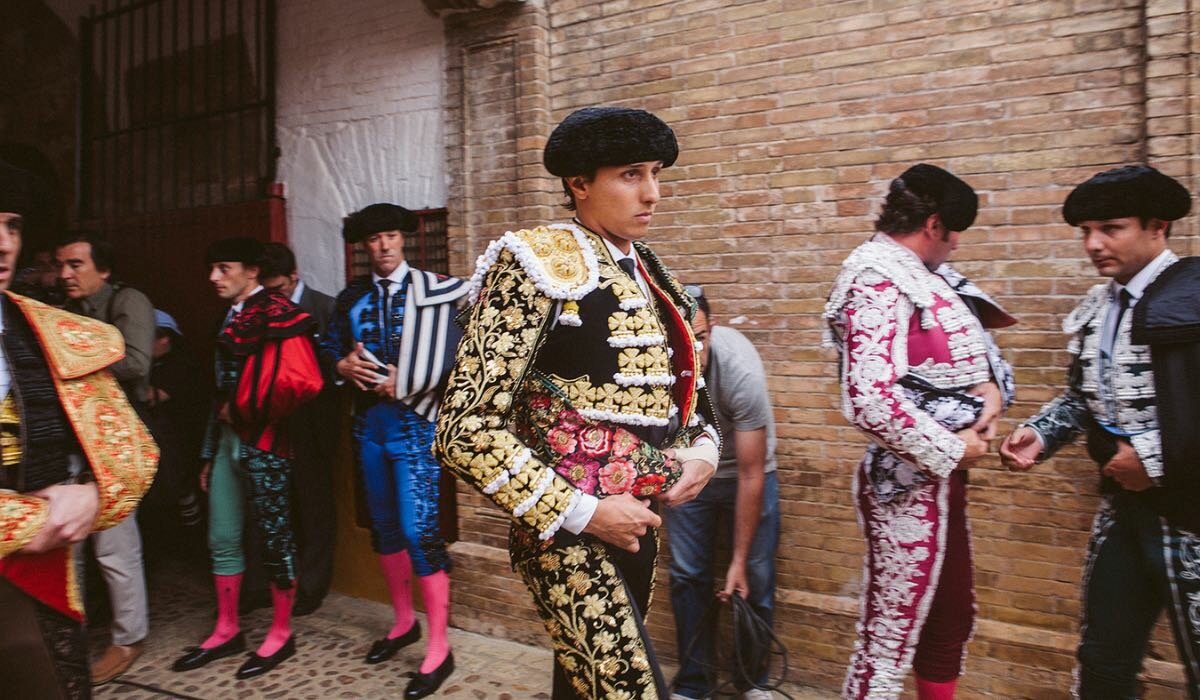

“It is impossible to believe the emotional and spiritual intensity and pure, classic beauty that can be produced by a man, an animal and a piece of scarlet serge draped over a stick,” Ernest Hemingway wrote in Death in the Afternoon, his magnum opus about one of his three favorite sports: bullfighting. “ is the only art in which the artist is in danger of death and in which the degree of brilliance in the performance is left to the fighter's honor.”
Orson Welles, a huge admirer of Hemingway, in an episode of his 1955 BBC series Orson Welles’ Sketchbook declared that “of all creatures in the world, there's certainly nothing more magnificent than a fighting bull.” Bullfighting is also an institution that has come under attack from animal rights activists and Spain’s socialist government. According to a recent poll, 45% of Spaniards think that bullfighting should be banned, 24% that it should be encouraged, and 30.3% voted for neither option.
Catalan filmmaker Albert Serra (Pacifiction, The Death of Louis XIV) is not interested in settling or even debating the issue in his debut as a documentary filmmaker Afternoons of Solitude (Tardes de soledad). He is not even interested in exploring what drives young men like Peruvian matador Andrés Roca Rey, his documentary’s subject, to pursue this deadly sport for both man and animal. He is far more interested in observing, in long takes with very little to no cutaways, Andrés perform the same ritual over and over, risking his life in bullrings across the country, surrounded by his entourage of personal assistants or cuadrilla.
The film opens with a tight shot of a black bull staring defiantly at the camera, at us, possibly one of the many bulls that will meet its fate in the ring on a torrid Spanish afternoon. The bull’s breathing is heavy, the camera occasionally following it as the bull moves from left to right, trying to avoid its gaze. The film then cuts to Andrés inside the van that drives him and his entourage from one bullring to the next. Director of photography (and editor) Artur Tort shoots Andrés at a slight low angle, looking up. Andrés sometimes stares straight at the camera like that bull. He remains mostly quiet, sometimes chewing on a mint, throughout the many rides he and his coterie take in that van, all shot the same way, listening to his crew talk; he will comment on a fellow bullfighter’s performance while asking the occasional question about the quality of the bull he is about to face.
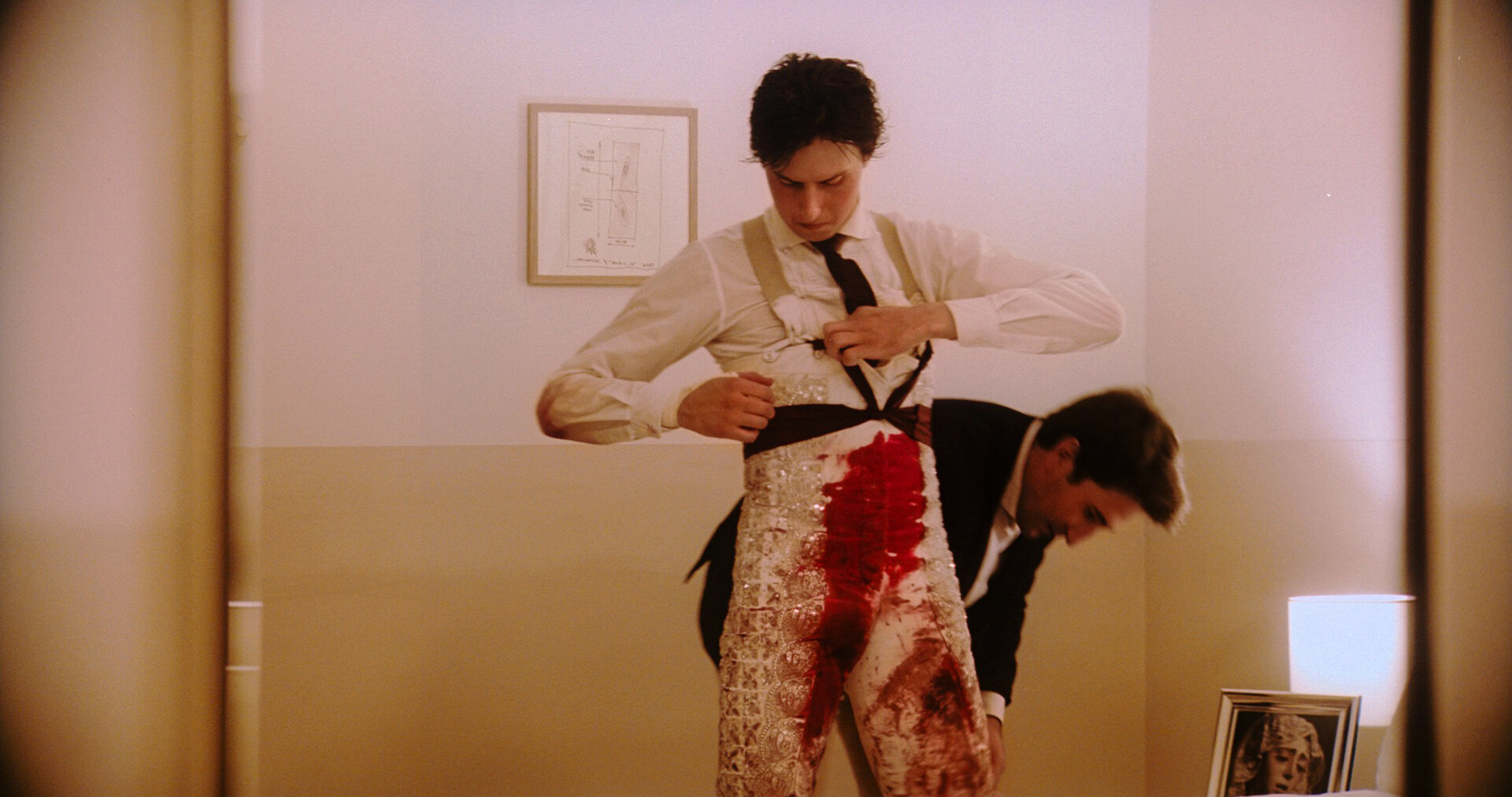
This sequence is followed by another at the hotel as Andrés takes out his bloodied bullfighter suit to then go back into the van, dressed up for another performance. Serra and Tort thus establish the film’s rhythm, one that feels almost like a musical movement of van-hotel-bullfight or any combination thereof. The repetitiveness is the point, life on the road being no different for this bullfighter than it is for musicians, actors and even writers. And yet, no bullfight is the same in much the same way that a concert or a theatrical performance may not be the same every night. The only difference being that bullfighting is a matter of life and death for both man and, mostly, animal. For this is still a very masculine world, one where an assistant will yell in praise of Andrés after a kill, “Your balls are bigger than the whole fucking arena,” and where women are nowhere in sight at least in the arena or backstage.
Afternoons of Solitude is full of reds: the red of the bull’s blood as it flows from its wounds, the red of Roca Rey’s costume, the bright red of the wooden planks surrounding the ring which serve as a shield for bullfighters and picadors alike. The fights are both cruel and hypnotic, not necessarily mano a mano affairs between man and nature but one in which man shows his apparent superiority by numbers, the bull weakened by the wounds inflicted by the picadores on their horses and banderilleros before Andrés steps on stage to face off against it. There are moments when the bull has the upper hand, lifting the picador’s horse with its horns or even pinning Andrés against the wall. But when Andrés takes his cue and confronts the bull, staring it off, taunting it, turning its back on it or when he finally goes in for the kill, you can’t help but be riveted by the performance. You will even feel guilt for admiring this young man’s guts as the bull’s carcass is dragged off field by three horses. And that is Afternoons of Solitude’s greatest triumph: instead of desensitizing us to the violence inflicted by both man and animal, the repetitive nature of these encounters and what goes on around them in and outside the arena, the way they are shot and edited and their unique twists and turns, force us to reckon with bullfighting’s complex nature.
Afternoons of Solitude screens at the Gene Siskel Film Center of the School of the Art Institute of Chicago from July 4-7
If you enjoyed this post, please consider supporting Third Coast Review’s arts and culture coverage by making a donation. Choose the amount that works best for you, and know it goes directly to support our writers and contributors.
