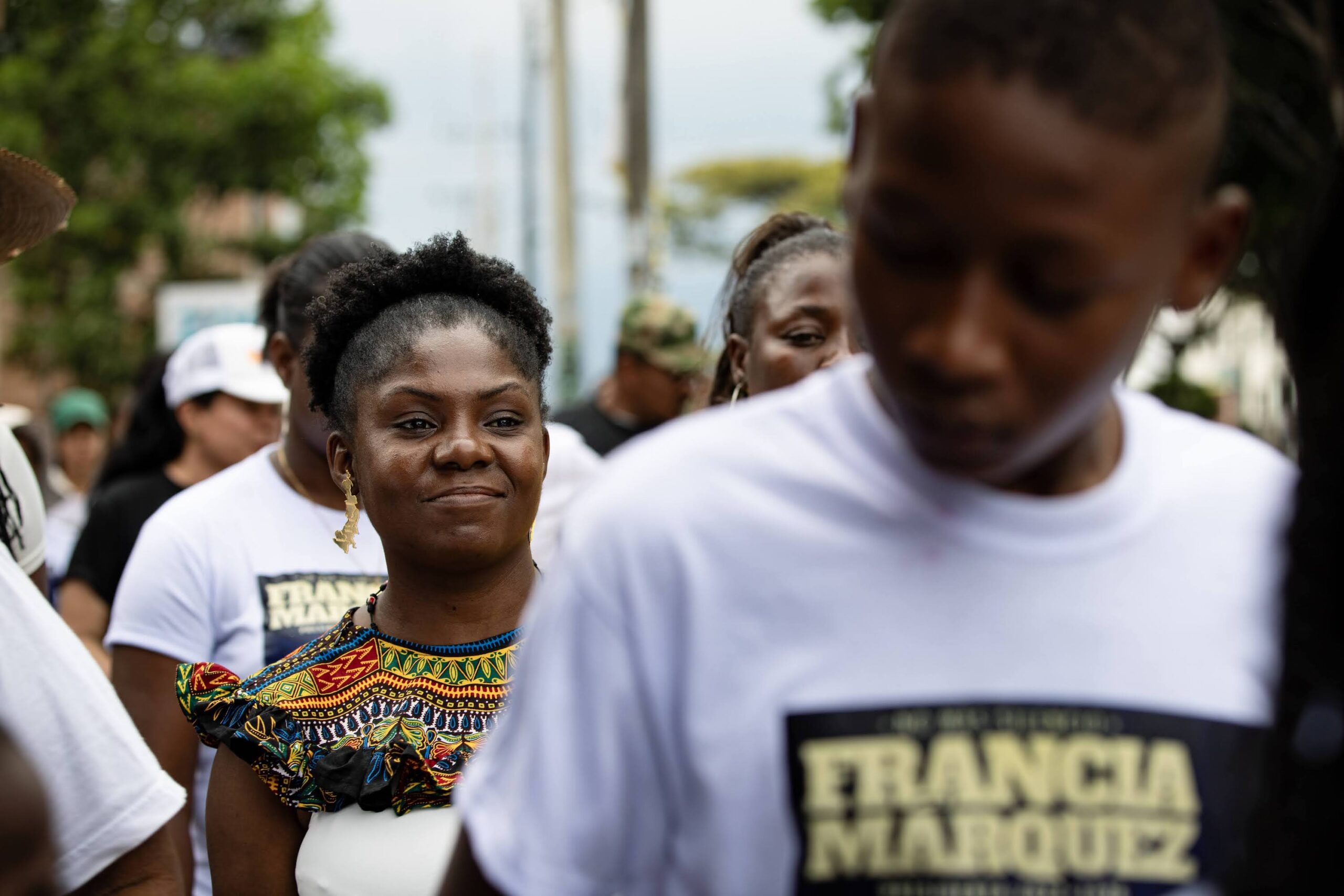

Three years ago two outsiders broke the stranglehold Colombia’s right wing parties had over the country when they were elected president and vice-president: the former M19 guerrilla fighter and senator Gustavo Petro and community activist Francia Elena Márquez Mina. It was a history-making victory in more ways than one: Márquez was the first Afro-Colombian to run for president and the first to be elected vice-president.
Each recently became the subject of their own documentaries: Sean Mattison’s Petro which screened at last year’s Chicago Latino Film Festival (and which as far as I know has yet to be picked up for U.S. distribution) and Juan Mejía Botero’s Igualada: Refusing to Know Your Place, which world premiered at last year’s Sundance and now receives its national broadcast premiere on PBS Monday, July 7 as part of POV and will be available to stream until October 5. (locally, Igualada: Refusing To Know Your Place will air on WTTW, Saturday July 12 at 11:30 pm and on WTTW Prime on Monday July 28 at 10 p.m.)
Mejía Botero has been documenting Márquez Mina’s activism since 2009 when she campaigned against the displacement of the residents of the community of La Toma, in the Cauca region in southwest Colombia. The area is home to half a million descendants of African slaves and La Toma sits over rich gold deposits. Their lives and livelihoods —most of the residents are strip miners including Márquez—, were threatened by transnational corporations and the paramilitaries that protect their interests. More than their lives were at stake; so was the river that gave them nourishment, sustenance and peace of mind as these multinationals went ahead with plans to divert it. In 2014, Márquez organized a more than 200 mile march from the Cauca to Bogotá alongside 80 Afro-Colombian women to protest illegal mining and the impact on the environment, resulting in a government agreement to stop illegal mining in the region. She was forced to flee to Cali, Colombia with her children after receiving threats from the paramilitary. Her activism earned her the Goldman Environmental Prize in 2018.
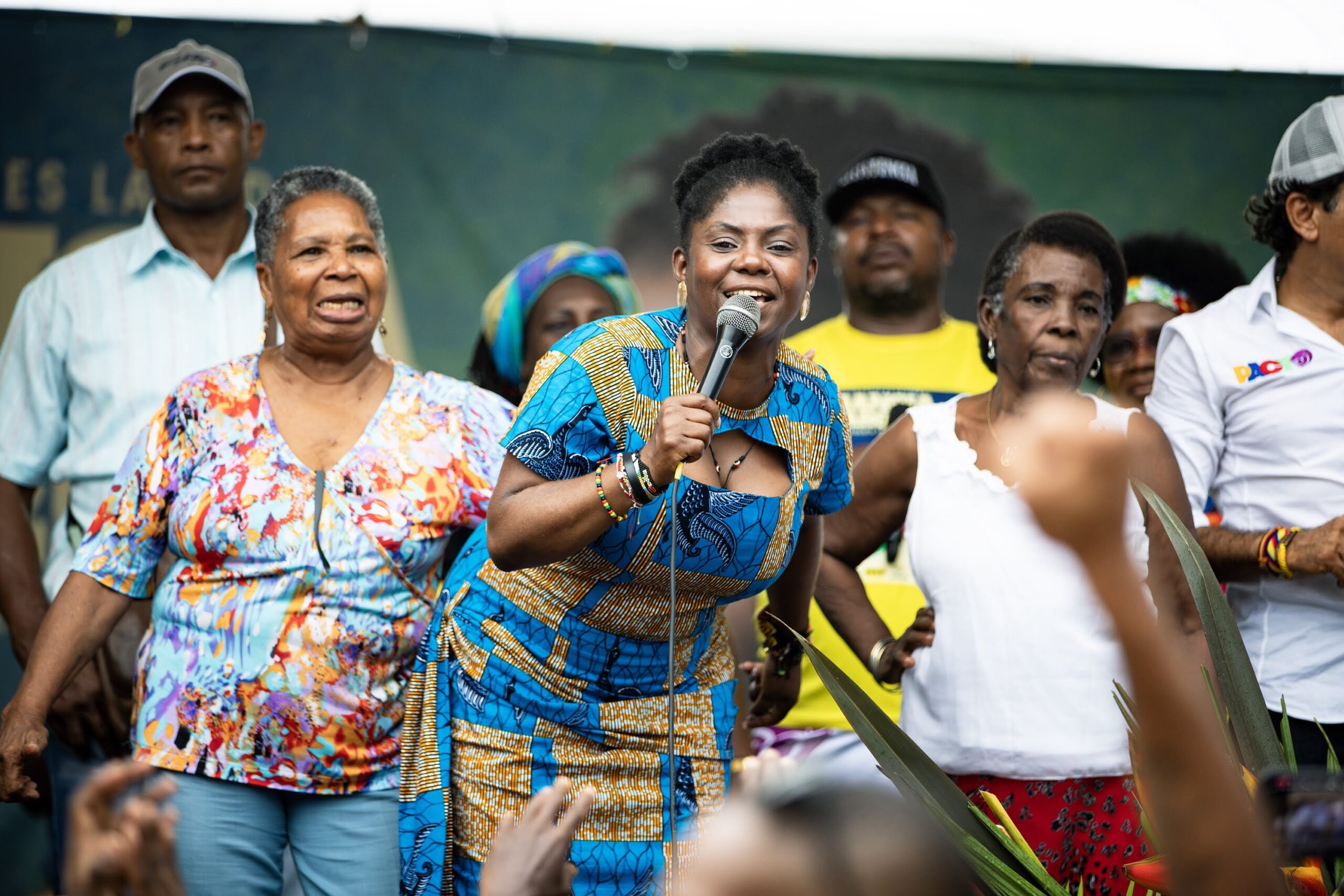
Mejía Botero weaves this backstory with Márquez’s momentous decision to run for president in 2020 at a funeral for five sugarcane workers murdered by the guerrillas. Her campaign is the literal definition of grassroots. If anything, Márquez is aware that the odds are stacked against her but she sees in this campaign an opportunity to give voice to Colombia’s marginalized communities. Granted up close and personal access by Márquez, Mejía Botero captures the excitement her candidacy generates among Colombia’s poor and working classes and people of color, his camera at times fixed on the faces of black women holding back tears as they listen to Márquez. “The children of housekeepers have an option,” Márquez proclaims.
Mejía Botero is also there during a virtual meeting with her security team to assess the risks this campaign has for her and her family, forcing one of her sons to move to Cambridge. He captures the commitment of her team of volunteers, the disappointment in not having secured the number of signatures needed to file her candidacy. Then there’s that fateful moment in 2021 when a coalition of left-wing parties joined forces in what became known as The Historic Pact, giving Márquez’s presidential run another chance leading to her eventual nomination as Petro’s running mate.
There are moments that, given recent developments, hint at things to come. At a rally with Petro she is treated by one of his aides as if she owes everything to the now presidential candidate. “We’ve made ourselves prominent on our own as a people,” she responds once she takes the stage. The pairing may have looked good on paper. But one gets the impression that besides securing the candidacy as vice-president for coming in second place in the primaries per the coalition’s rules, that the college educated Petro needed her more given the close to 800,000 votes she secured. (This becomes even more evident after having seen Mattison’s documentary Petro right after Igualada.) Recent reports out of Colombia point at how Petro consolidated his power at the expense of those who didn’t align with his vision including Márquez.
Igualada follows a by-the-numbers approach to its subject. There are montages galore showing the social media attacks against her (so shocking in their racial hatred you might think the KKK has established a Colombian branch), the favorable new coverage she received afterwards, and the campaign rallies. We do hear from her volunteers whose commitment to her is unquestionable. But I do wish we would have, like Mattison does in Petro, heard from others who could put her campaign in context. The argument could be made that Mejía Botero does that by weaving her backstory and her history of activism into the main story; but the footage is so loosely and haphazardly introduced, that those scenes end up feeling like a list of accomplishments instead of actions that had real consequences. It is in the periphery of Igualada’s story that you find the real heart: the joy of the crowds gathered to hear her speak, the unwavering commitment of her team, Márquez’s sheer determination and honesty (she refuses to water down the reasons why she couldn’t secure the number of signatures, for example).
Even though it is unfair to criticize a documentary for what it isn’t, I still find Igualada’s triumphalist tone at the end disquieting. There is no denying that this was a victory for Colombia’s marginalized communities. But to not even acknowledge the challenges she faces as the country’s vice-president, a role that is traditionally symbolic and that puts her in the shadow of a charismatic, cunning and somewhat egotistical politician, does a disservice to this woman who fought so hard and sacrificed so much. Given how events have caught up to that promise (especially in light of recent secret audio recordings between former Petro ally and former foreign minister Álvaro Leyva seeking support from U.S. officials to bring down Petro’s government, revealed by Spain’s El País), I hope Botero (and even Mattison) follows up with a documentary that places this consequential victory in context and show how difficult it is, for any progressive government, to implement change after years of government corruption; of the difficulties in transitioning from roots-based activism to the decision-making process required by intricate government institutions. Especially since we are one year away from the next presidential elections in Colombia.
If you enjoyed this post, please consider supporting Third Coast Review’s arts and culture coverage by making a donation. Choose the amount that works best for you, and know it goes directly to support our writers and contributors.
