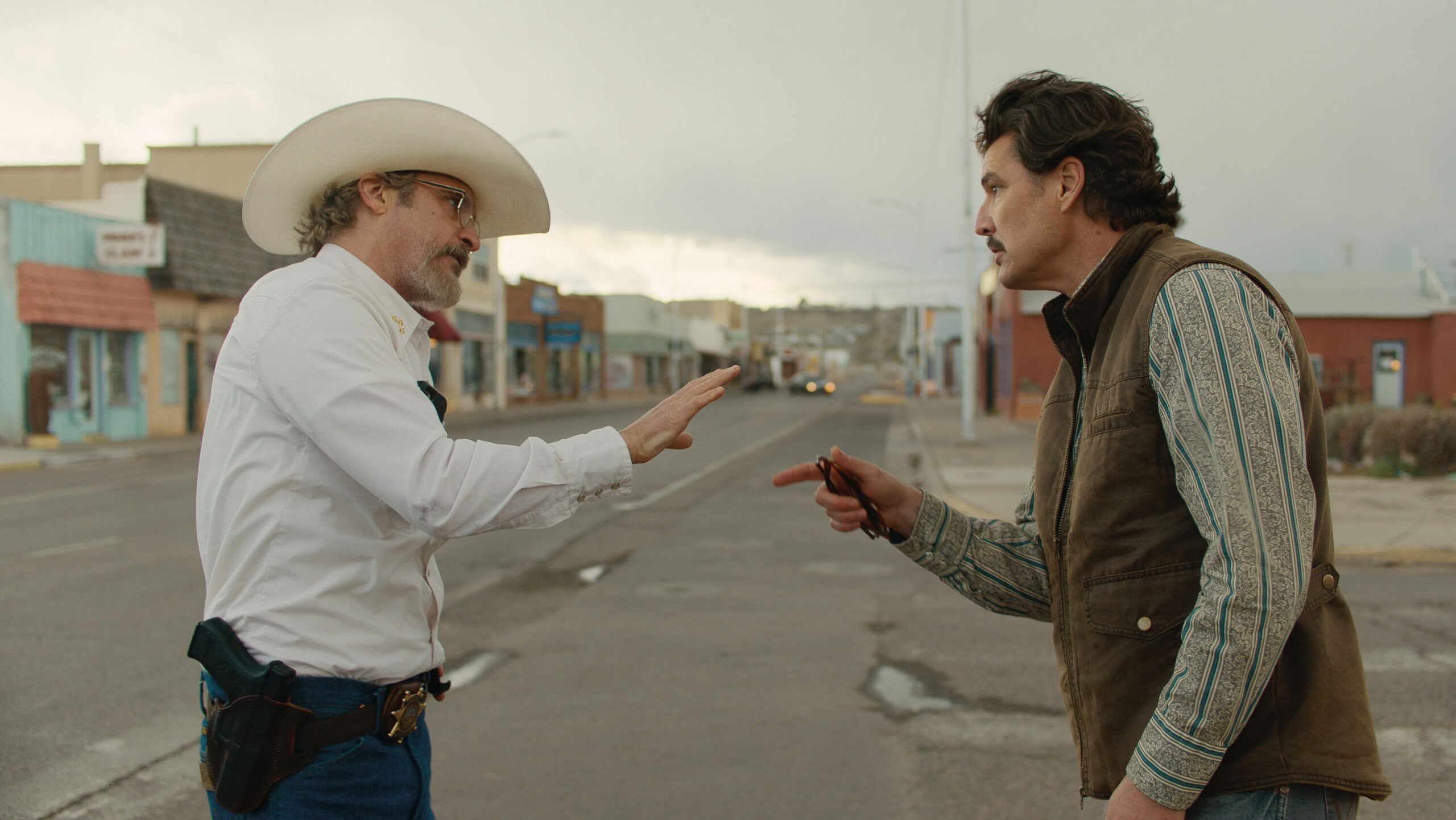
As I said in my review of Eddington, filmmaker Ari Aster is an artist who sculpts nightmares—not just the kind that frequently populate horror film (although his first feature, Hereditary, proved he could do that like a master), but also the kind that take root in our minds and souls and give us the deepest, most troubling type of anxiety, dread, depression, and fear. His nightmares take the form of family drama (Hereditary and Beau Is Afraid, where it was specifically mothers who were plaguing the lead character), relationships (Midsommar), and with Eddington, he brings the source of all uneasiness into focus by holding up a mirror to America itself, specifically during the earliest months of the pandemic.
Beginning his film in May 2020 in the small town of Eddington, New Mexico (Aster’s home state), he populates this community with stand-ins for every type of American, including two men vying for the job of mayor: Joaquin Phoenix’s Joe Cross, the current sheriff; and Pedro Pascal’s Ted Garcia, the incumbent mayor. The film isn’t just about people fighting over wearing masks; it’s fully about the seismic shift in American society in this period that set family members against each other, neighbor against neighbor. It also pushed many citizens deeper down the rabbit hole of the internet where a whole universe of conspiracy theories and junk science created a different, but equally dangerous, type of virus that continues to threaten us today.
The film doesn’t mention political parties, but it’s certainly not apolitical. It’s also a place where conspiracy theories come to life, perhaps only in the fevered brain of one character, but that somehow doesn’t deaden their impact. Eddington is chaotic and will divide audiences more than any other Aster film, and that’s just the way he wants it. I had a chance to sit down with him recently in Chicago to talk about the times and other films that inspired his very modern take on the Hollywood Western. Please enjoy our conversation…
When I introduced the film last night at the Music Box, I told the audience my theory about you being a crafter of nightmares. You make films about the things in our lives that cause us anxiety, and in this film, it’s America. What did you observe in those early months of the pandemic that you wanted to get across? How was society shifting that concerned you?
I was living in New Mexico at the time of writing this, which is where I’m from. I started writing this is late May/early June of 2020, which is when the film is set. And I was feeling what was in the air, and it felt distinct to me; it felt like things had reached a very definitive boil. I didn’t know if things were going to explode or boil over. I didn’t know if what was coming was five years from then or coming tomorrow, but I wanted to write this down, whatever I was feeling then. And I essentially wanted to make a film about people living in the internet, make a film about community that was not a community at all. People were living together, in the same town, in the same rooms, but they weren’t on the same planes. They were completely unreachable to each other.
That’s where it started, and it wasn’t something academic for me: “Oh, this is very interesting. Let me pick at this from a distance.” I’m in this situation; I have people that are very close to me that saw very different things happening in the world and continue to see things happening differently in the world than I do. It’s almost no even worth talking about it with them, but the thing is, if the conversation can’t happen, then I don’t know what hope there is. I think that’s the only way off of this path, to somehow re-engage with each other, and there’s a lot invested in keeping these divisions right where they are.
As a genre film, it also feels like a story about all of the conspiracy theories being true.
That’s right! And it is a genre film. The film is a Western.
But I also think it’s a modern version of JFK, which, even if every fact in that movie is 100 percent bullshit, is still one of the greatest conspiracy theory film ever made.
JFK is a film I showed the crew, and I think that it’s great that you picked up on that. And the reason it’s so good is because it taps into the fever of conspiracy thinking. That’s why JFK is brilliant. It’s been widely discredited, a lot of the theories contradict each other. You could argue, and you’d be right, that the film is pretty homophobic, but for me, it doesn’t really matter because the film is tapping into a mania that is very real. I even think the way the film bathes Jim Garrison in this heroic light is very important, because it’s all how we see ourselves right now. We’re the ones who are onto the truth, we see what’s happening. No one else is seeing what’s happening but see, and we’re read and dug in. We’re all living in JFK right now, and we’re all Jim Garrison, some of us more than others . I think that’s right: Eddington is a Western where everybody is popping the lid off of what’s really happening.
And just to respond to what you were saying about all of the conspiracy theories coming true, somebody mention to me that they thought the film was apolitical, and I thought “Is it?” I think the film is omni-political; it’s trying to more or less give equal weight—I mean, most weight goes to Joe Cross’s perspective—but I was trying to give equal weight to every voice in the cacophony, and by the end of the film, the movie gets gripped by their worldview.
It’s funny you say that about perspective, because even though most of the weight of the film is on these two main characters, you get a lot of voices here—young people, Native Americans, Latino voices, rich, not so rich. I wanted to see an entire movie told from the perspective of that Native American cop, because he is seeing these events in a completely different way.
And the movie, in a very conscious way, keeps pushing him out, in the same way America does.
For sure, and that’s why I think his perspective would be so interesting because he has to work around that.
I completely agree with you.
Your other films have been about individuals or small groups of people who are broken, and this is a whole town of broken people, broken in different ways. Were you going for a more epic quality?
Yeah, I think epic was very much on my mind when I was making Beau Is Afraid. That was the word I was using there. I think I was going for something almost novelistic with this film, kind of layers. But in many ways also…not unfinished, but you have so many different realities bumping up against each other, and none of them fully take over the film. So I was going for something almost abortive…well, not abortive…something almost schizophrenic.
Oh, by the end of the movie, for sure. As you were writing this and shooting this, things were changing in the world and in the news almost daily. Did the film change at all while you were shooting?
Not really, because even as we were shooting, it was still a period piece. We were shooting in 2024, before the election, and ultimately, the film has changed more since the election and since Trump has taken office. The film somehow now feels like it’s living in a different light. I’ve never made a film that feels like it changes day to day so much. What if Kamala had won? It would be a very different film if it had been coming out in that environment.
Ari, it’s great to finally meet you. Thank you so much.
Thank you. I love that theater, god. I’d love to come back to see a movie there. I’ll program a movie I’d like to watch there.
If you enjoyed this post, please consider supporting Third Coast Review’s arts and culture coverage by making a donation. Choose the amount that works best for you, and know it goes directly to support our writers and contributors.
