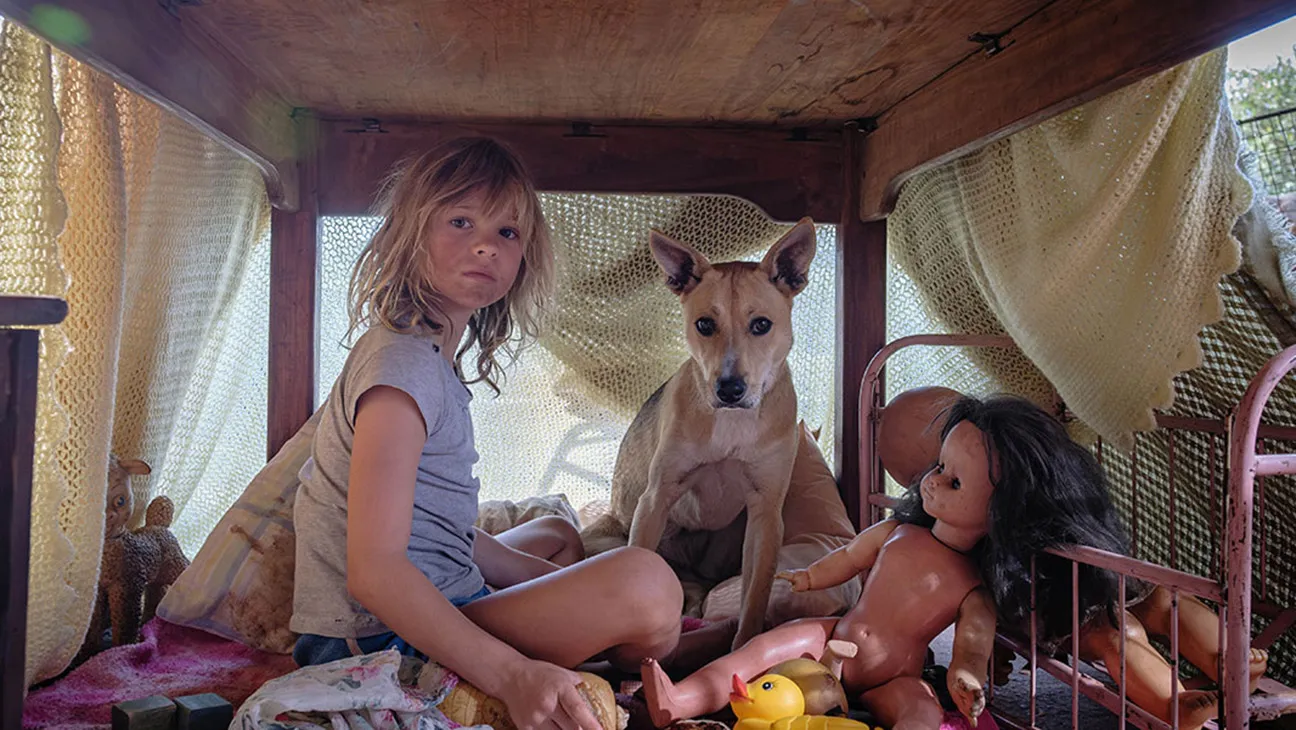

Making her feature film directorial debut, actor Embeth Davidtz (Old, The Morning Show) delves into her roots in Africa (her parents are South African, though she was born in the U.S.) for Don't Let's Go to the Dogs Tonight. The film is an adaptation of the memoir by Alexandra Fuller (Davidtz also wrote the script), who moved to Rhodesia in 1972 with her parents; the film recounts this tumultuous time in the country's history from the perspective of young Alexandra (known as Bobo).
Don't Let's Go to the Dogs Tonight doesn't require a history lesson in order to fully enjoy this story of a family and a country at a crossroads, but it wouldn't hurt. In the 1970s, Rhodesia (now Zimbabwe) was a British colony in the midst of a civil war, known as the Bush Wars, and a push for independence. The film puts this conflict at the center of Bobo's experience, albeit from an eight-year-old's point of view. At one point in the film she innocently asks her mother, Nicola (Davidtz), and grandmother if the family is racist. Both recoil in horror, insisting that's absolutely not the case—despite what we the viewers are keenly aware of.
The family, like every other white British person in the country, are colonizers, and as Bobo struggles to understand who she is and how she fits into the chasm between whites and Blacks, Nicola and the adults are navigating larger questions like how the war will play out and who will come out on top in an upcoming election. Lines are clearly drawn, and it's evident throughout the film that Nicola and Bobo's father Tim (Rob van Vuuren) are acutely aware of what's at stake. In these final days of colonialism, the country's citizens are asked to decide who will lead them into a new era of self-governing, and who they choose will have an undeniable impact on the Fuller family.
Young actor Lexi Venter is Bobo, a girl who spends her days zipping around on a child-size motorbike and being tended to by the family's Black housekeeper. She's perpetually covered in dirt, hair mussed and unkempt, spending much of her time outside on the family farm and in the wilderness. Every filmmaker works differently with actors, but it's clear based on young Venter's performance that Davidtz, both behind the camera and in front, created a safe and supportive set; it's a natural and unfiltered performance, a rarity for child actors. Davidtz herself digs deep for the role of Nicola, a proud woman who's grasping at straws to hold on to a life that she believes in and wants to maintain, despite the tides of history working against her.
As a filmmaker, Davidtz creates a compelling sense of space, one awash in warm tones (with the support of cinematographer Willie Nel) and the wilderness surrounding the Fuller family. One can practically feel the dirt of the dry lands that must've stuck to every possible surface; even their formal dining room feels dingy and dust-covered, despite the Fullers' best effort to transform the space into something that resembles their British backgrounds.
There are likely many other stories that can and should be told about this period in Zimbabwe's history, but in adapting Fuller's personal story, Davidtz manages to offer a deeply personal take on these historical events without marginalizing or sidelining those who were driving the country's future forward.
Don't Let's Go to the Dogs Tonight is now in theaters, including the Gene Siskel Film Center.
If you enjoyed this post, please consider supporting Third Coast Review’s arts and culture coverage by making a donation. Choose the amount that works best for you, and know it goes directly to support our writers and contributors.
