
A glowing blue invertebrate washes ashore somewhere along the coast of Florida. A set of six-pack beer rings dangles from its head. Nearby, a group of teens does what it does best: piss the day away. After briefly acknowledging the roughly house-pet-sized creature, Billy (voiced by Jack Corbett) steps aboard his Swagway, a two-wheeled hoverboard with a lawnmower soundtrack, to do what adults do best: make money. An employee of Grubster, a GrubHub-style “flexible delivery partnership,” he hopes to amass $5,000.
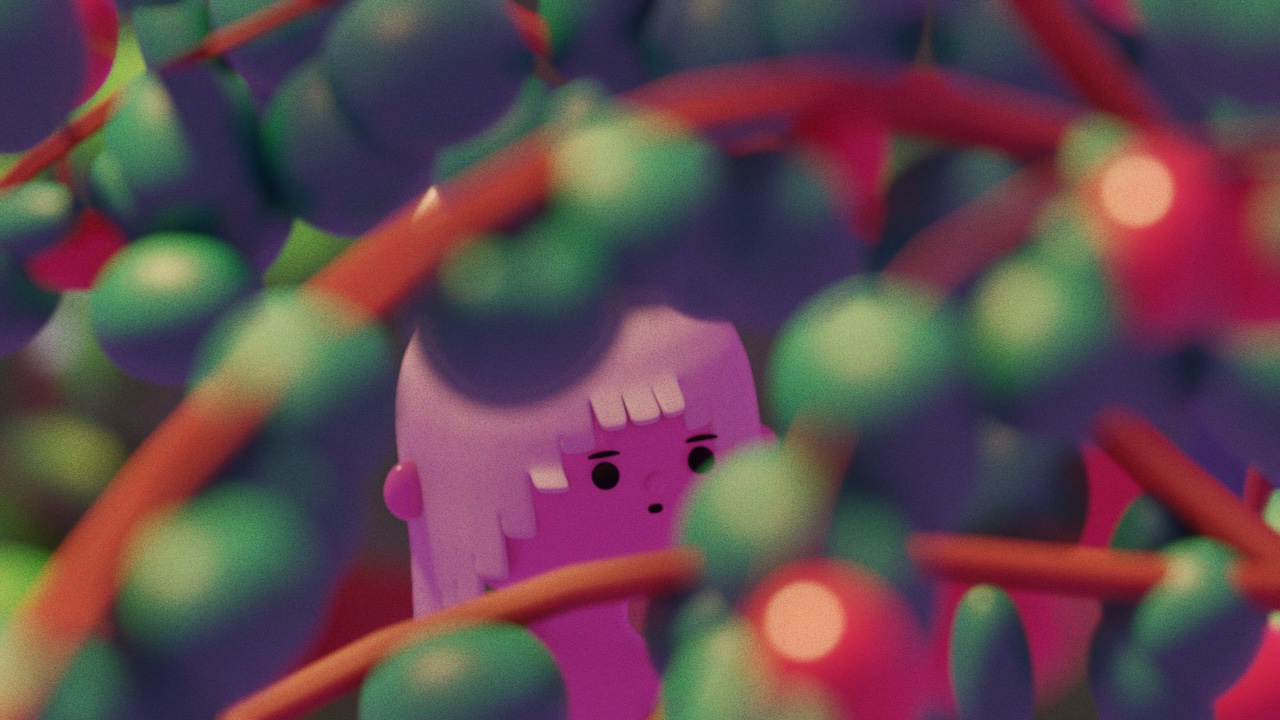
Boys Go to Jupiter looks like a modern-day mobile game marinated in an '80s glaze. Think Animal Crossing-meets-Smooth Talk (1985), dressed in a synth-pop score. This film’s shallow visual design even resembles video game levels; it seems like the characters and settings could drop off the earth at the blowing of a hearty wind. It's cozy and desolate in equal parts. Written, directed, produced, and animated by Julian Glander, Boys Go to Jupiter teeters on a balance beam of optimism and doubt over humanity’s current state.
The dichotomy stretches from end to end like the absurd wingspan of Billy's mulleted friend Freckles (Grace Kuhlenschmidt). Like Kiyoshi Kurosawa’s recently released Cloud, this film skewers our youth’s grind culture with an absurdist streak. But where Cloud did not capture the hypnotic mania of this phenomenon, Boys Go to Jupiter has it emanating from every pore. Our early introduction to influencer Mr. Moolah (“Moolah! Moolah! Moolah!”) says it all and more. Soon after, Billy mutters the thesis on Gen Z's mind: “Sleep is for rich people.”
Everything here embodies the tension of the modern age, that of nature perverted—and in some ways bested—by technology. In Glander’s universe, Florida’s chief export, oranges, have been engineered within a millimeter of their lives by the nefarious Dr. Dolphin (Janeane Garofalo). Hardly a stretch, but hopefully the Doctor’s next logical step, cube-shaped tangerines for ease of transport, never comes to pass on our Earth. Dolphin’s daughter, Rozebud (Miya Folick), spouts ideas of rejecting corporations—notions lifted from books she’s hardly read. As with several characters in the film, nearly every positive notion of Rozebud’s blankets a profound ignorance. That’s “Rozebud” with a “z,” mind you.
Elsewhere, farms get filled with multi-colored balls from the errant strokes at a mini-golf course down the road. Even the very look of the movie bumps the natural world against manmade unreality. These characters might well have stepped off a vintage Fisher-Price set, and yet, they move with human fluidity. I’ve never seen an animated figure dribble a basketball or descend a slide as gracefully as Freckles and Peanut do, respectively.
The scene of the film concerns, what else, a hot dog stand. If the sign is to be believed, the statue on the roof is in fact the “World’s Largest Hot Dog.” The guy running the stand appreciates the business the monument brings, but he wishes people appreciated the quality of his franks. He puts a lot of work into them. Alas, his customers are “blinded by the spectacle.” Many people care only to read the package, not dissect the contents. The patter of modern life has robbed our critical thinking and appreciation for artful, honest expression. Granted, a hot dog is no paragon of naturalness or sophistication, but the sentiment behind it is as pure as the creator cares to make it.
I should also mention Boys Go to Jupiter is a musical. We get ditties about the beauty—and profitability—of citrus as well as our insatiable compulsion to produce garbage. And that’s before God and inter-dimensional transmission come into play. Yes, this is one weird movie, but a hilarious and spiritual one.
If you enjoyed this post, please consider supporting Third Coast Review’s arts and culture coverage by making a donation. Choose the amount that works best for you, and know it goes directly to support our writers and contributors.
