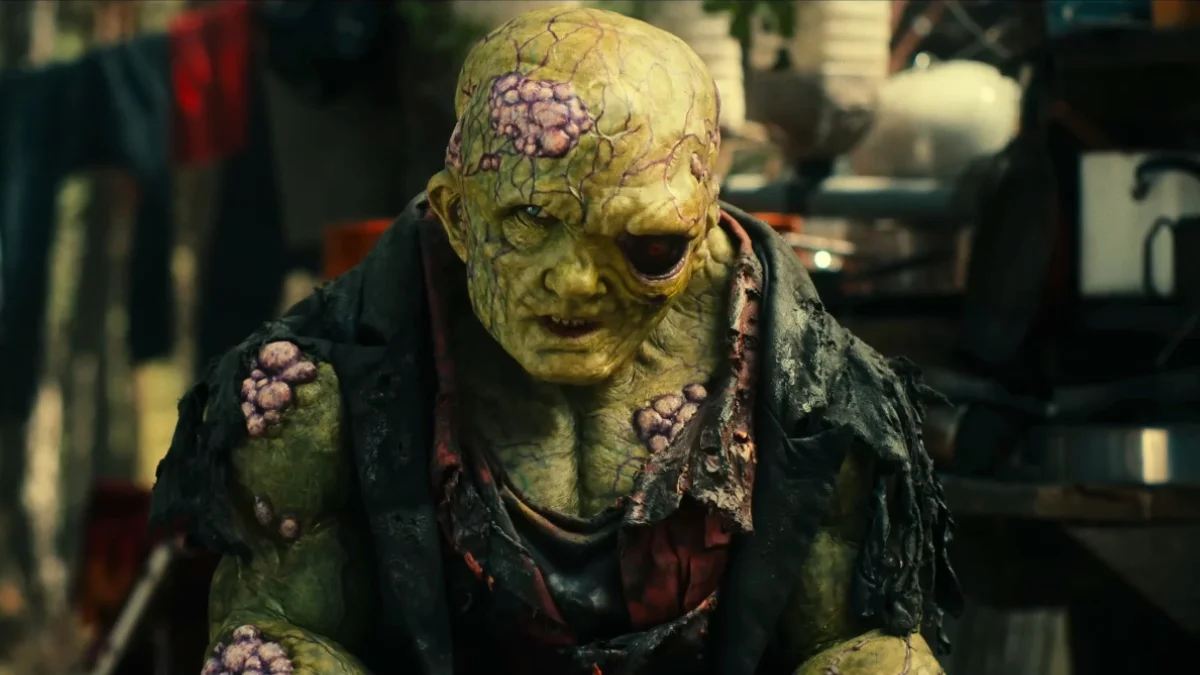
It’s been nearly two years to the day when I first saw the extremely fun and excessively gory remake of arguably the most famous of all of Troma Entertainment’s cinematic offerings, 1984’s The Toxic Avenger. This time around, the production actually had a bit of a budget (it was financed by Legendary Pictures) and an artistically inclined writer/director in Macon Blair (no shade thrown at original director and Troma founder Lloyd Kaufman), the actor-turned-director whose previous film, 2017’s I Don't Feel at Home in This World Anymore, is a magnificent work.
As an actor, Blair had starred in such tough-edged thrillers as Blue Ruin and Green Room, and he also had a strong supporting role in Oppenheimer. He’s also established himself as a solid screenwriter, having penned works like Small Crimes, Hold the Dark, and last year’s Brothers. But his take on The Toxic Avenger (released unrated this past weekend) is not only a passion project for Blair; it’s got more heart, thanks to an adjusted storyline that moves from a younger guy trying to find a girlfriend in the original movie to an older guy (Peter Dinklage) trying to bond with his teen stepson (Jacob Tremblay). The film also stars Kevin Bacon and an almost unrecognizable Elijah Wood as evil brothers running a chemical company whose toxic waste factors into the origin story of our hero—as does a super-powered, green-glowing mop.
Blair has also added a storyline involving a disgruntled employee of the chemical company (Taylour Paige) who is definitely all about a little corporate sabotage and ends up teaming up with Toxie to take down this polluted empire. As broad as Blair allows things to get at times, he keeps his film grounded through believable relationships and a worthy hero at its center. For those of you with so-called superhero fatigue, consider yourself alerted to the alternative.
I sat down with Blair after the world premiere of The Toxic Avenger at Fantastic Fest 2023. Since the SAG actor’s strike was happening at the time, we couldn’t dive into any of his acting work, but there was plenty to discuss about his gooey remake. Please enjoy our conversation…
I think it’s fair to say I never saw a superhero movie in the cards for you as a director, but you kind of found a way around that by making this film. Was that the buy-in for you, that as long as it was this story, you’d be into telling it?
Totally. That being said, I’m interested in the other ones as a viewer. I’m not interested in them or that I could add anything to them that not already there in that space. So yes, although it works on some level as a superhero movie, for me, it was always a comedy that has the trappings of a monster movie or superhero movie. But straight up and down, even before you would get into stuff that seems obvious—like Robocop and Frankenstein—I was talking about Police Squad! and Airplane!. That was the tone but with blood and guts.
I think one thread through many superhero movies is motivation. What is pushing this person to decide to help other people? And that’s here in your screenplay. It starts out being about saving his stepson, but it turns into him being a altruistic hero by the end. Tell me about mapping that growth.
Yeah, it was because the bad guy is in this familiar situation where you have this evil corporation overlord and there’s a secret serum and there’s an outsider; you’ve seen this deck of cards before. But because the villain is characterized as this remorseless wealth generator, and the hero—yes he has muscles and some sort of healing ability—but it’s really about mutual aide. The powerful people are not going to take care of you. He’s got this landlord lady who lives below him, and there’s this group of people who don’t have a lot of resources on their own, but they are taking care of each other. It’s obviously the father and son, but it’s also the community that he lives in, and they have to take care of each other. And I saw that as a way into this because I didn’t think it could just be a superhero battling villains; it needed to have that heart and warmth to it.
Did Peter Dinklage take convincing to do this? He’s done a lot of crazy shit over the years, but nothing quite to this degree.
I would say more like clarifying. If you look at the script, you could easily interpret it as “Do you know that this is dumb?” I had to be like “No, that’s definitely deliberate, but you’re going to play it very straight. The circumstances are going to be very dumb.” Whatever you want to say: cartoonish, over the top, silly, but he was going to play it straight, and ultimately, it will be a comedic performance but he wasn’t going to be playing it super-funny. So once I could contextualize it for him, then he was really into it. It helped that he and I had met at a film festival; we weren’t best friends but we did stay in touch and trade scripts to find something to do together. There was a bit of an opening because of that. So at some point I said “Would you like to do this?” And he says it was a little out there, and I walked him through how it was out there but purposefully so and showed him the other areas where it would be more grounded.
When you were initially tackling your screenplay, what was it about the original screenplay did you want to maintain and what elements did you want to play with and change?
There is a fine line of wanting to honor the original, so you’re coming at it appreciating the original and follow in those footsteps. But you don’t want to do the Psycho remake, where it’s literally the exact same thing. So you really want to milk every moment for a gag as much as possible, and if this joke doesn’t work, fuck it, let’s move on to the next one as quick as possible. Where we veered off was, the first one has more of an adolescent viewpoint with a high school nerd trying to get date, and he’s being bullied by the cool kids. I felt like we could have the goofy monster stuff and the mop, all of which felt like essential ingredients, but I didn’t want to repeat the story of a guy who wants to get laid. Also, that didn’t feel personal to me. I’ve got kids, and like everyone with kids, you’re struggling to do the best you can with them, and you’re not always at your best. So where we veered off was having the central emotional core of the story being about a dad/stepdad who’s trying to do the best he can. He’s not great at it, but he’s trying.
When you’re designing this new Toxie, it looks like part mutation, part melted body parts. Working with your makeup team, what were some of things that you were going for in his look?
Originally, I went more in a horror direction. He looked more like a zombie, with more rotting flesh, and it didn’t work and we couldn’t articulate why. It turned out that it looked to painful, like he was inaccessible because it was too monstrous, so we walked it back a little bit. We didn’t mean to take so much inspiration from the cartoon version of Toxie—we were more leaning into Part 2, as far as the facial design—but we found that we wanted to more more toward a design where you could see more of Peter’s facial features, even though his skin is green and he has boils and big eyes. You still feel like there’s a human in there that you’re connected to.
The world building here is fantastic, even though I had a tough time—I’m guessing by design—figuring out when and where this takes place.
Deliberately so.
Sure, some of it feel retro steampunk, and other parts feel very futuristic. Have you ever had the chance to build a world from the ground up before?
No, and I was joking with someone earlier that this is either the least-expensive Legendary film or the most expensive movie I’ve ever been a part of.
The most expensive Troma for sure.
Absolutely. It’s a little bit of all of that. But having it be this little, self-contained universe was something that was set from very early on. We needed to take in on faith that if you fall into toxic waste, you will get muscles. You don’t have to talk about why because it’s just a couple of degrees of reality removed from the real world. There are cell phones, but there are also boxy tube TVs. The cars are also older. We didn’t want it to feel like a period piece, like say this was specifically taking place in the 1980s, but we tried to tweak all of the design choices, like clothes, hair styles, architecture, so that it has and outside-of-time quality, which sounds more highfalutin than it is, and make it feel like it exists on its own terms, so that anything we wanted to do in it was acceptable, but could still have a bit of fantasy to it as well. Technically, if you look at some of the cars, they have Jersey plates and there’s a Jersey skyline in the background, but it’s all filtered through this unreal version of itself.
You mentioned something earlier about the personal aspects of this story, when you saw this film when you were young, what were the elements that you remember connecting to?
There’s the surface level stuff, like the sense of humor and the irreverent, dirty jokes that we would steal from as we were trying to make our own movies. But much more than that and the thing that goes beyond The Toxic Avenger or any other Troma film is the independent movie mindset, which we didn’t understand. We just knew that movies were supposed to be like Indiana Jones and Close Encounters, with these big fantastical things that you have no idea how to make. Now all of the sudden, we saw this at a very formative time when we had just gotten our hands on a VHS camera around 1986-87, and by all appearances, they had made this movie in their own neighborhood, with their friends as actors. And we were like “Oh shit, that’s obtainable.” We couldn’t do spaceships and that stuff, but we can put our friends in as actors and go into our neighborhood and make a movie. That was enough and was much more than a sense of humor or gag—and we did steal those, for sure—but it was more that self-starting mentality that was the most valuable take away.
You jokingly tease a sequel. How far do you want to take that?
If they were to suggest it, I’d be all in. But we did put that on…we were not planning to play that last night; they just let it roll by accident. But in retrospect, I’m glad it did play. It starts off with the lady villain surviving the explosion and a version of the Carrie ending with her going “I’m going to get you!” That’s the traditional post-credits scene, but then it goes into Toxie’s cooking lesson. The idea was that I didn’t want any walkouts during the movie, but I wanted to people to go “Damn, this thing is eight minutes long, and he’s still talking about bread.” I thought that would be funny.
Macon, good to see you again. Best of luck with this.
Yeah, nice to reconnect.
If you enjoyed this post, please consider supporting Third Coast Review’s arts and culture coverage by making a donation. Choose the amount that works best for you, and know it goes directly to support our writers and contributors.
