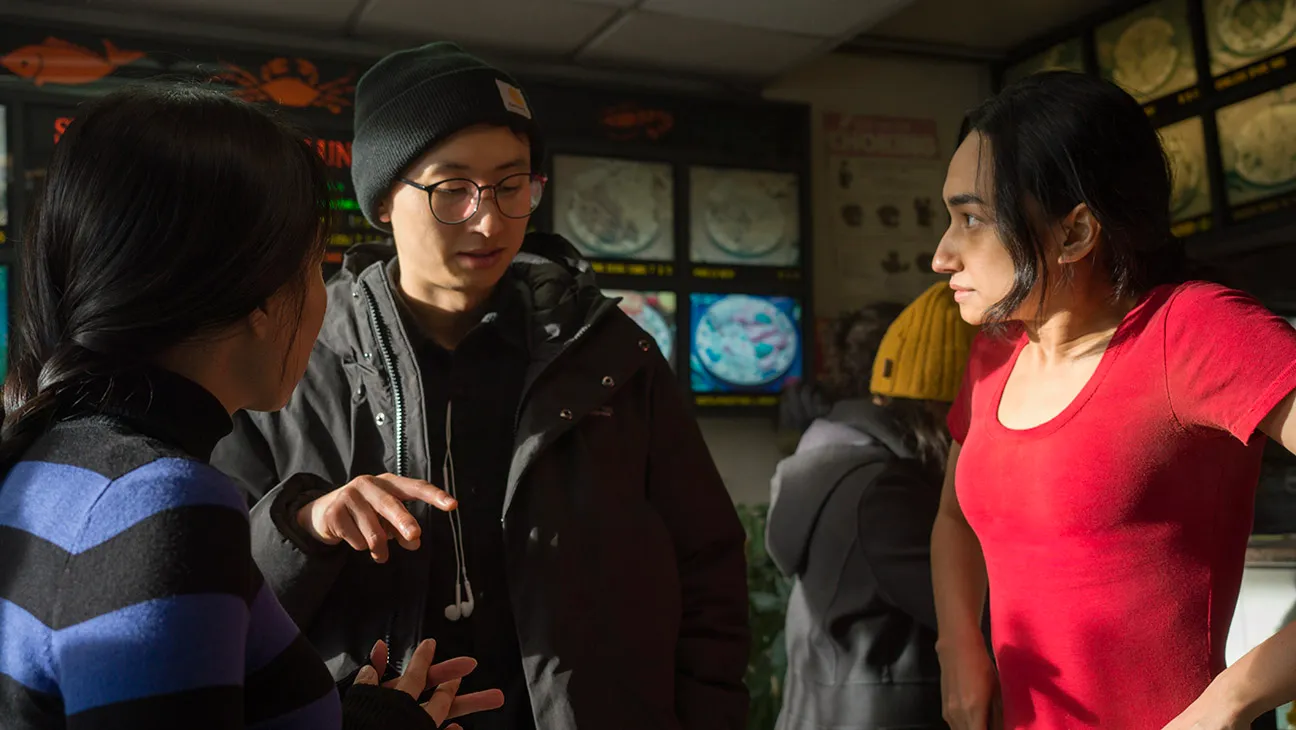
Academy Award-nominated documentary filmmaker Bing Liu’s (Minding the Gap) latest film, Preparation for the Next Life, is about Uyghur migrant Aishe (newcomer Sebiye Behtiyar) living in New York City and barely getting by working in Chinatown’s underground kitchens. But her future suddenly becomes hopeful when she falls in love with American soldier Skinner (Fred Hechinger), almost against her better judgment. Not only is she on constant lookout for immigration officials looking to scoop her off the streets, but Skinner, with three tours of duty to his name, is showing signs of PTSD, making him dangerous to himself and possibly her.
Liu’s specialty is telling stories about people who live on the outskirts of society, and the performances by his lead actors certainly sell the authenticity of the relationship and the characters’ individual struggles. And while Aishe sees the advantages of having someone who understands her struggles to a certain degree, she’s worried that Skinner’s drinking and mental state might become problematic as time goes on.
The film has some heavy-hitter producers on board, including Brad Pitt’s Plan B company and filmmaker Barry Jenkins, who played a huge role in Liu taking on this project and transitioning from documentaries to his first fiction feature. We sat down recently to discuss the genesis of the project, the parallels between his family’s lives and Aishe’s world, and his first exposure to the Atticus Lish book upon which the film is based. The film is now playing in Chicago at the Alamo Drafthouse in Wrigleyville. Enjoy our conversation…
What was the biggest transition or adjustment from documentaries to something like this?
The loneliness . I worked on crew for Chicago productions, and it feels like a traveling circus show, and you have your people. , there would be times I’d be on set for preparation, reading sides in a room and thinking about the next shot, and I’d hear the crew laughing a room over, and I’d walk into the room, and the crew stops laughing. And everybody who talks to you, it’s always about logistics, and there’s a structural power dynamic that is strange. The real emotional work was with the actors, my two leads. That was the only time I felt like I got to be human. The rest of the time it felt like an unwanted dictatorship.
I’ve talked to other documentary filmmakers who have made this transition, but for some reason I really started thinking about how different an experience it must have been for you. Was it weird to cast a role? Because in a doc, you get who you get; you can’t change it out. How did you like the casting process?
I didn’t find it too dissimilar from how I make documentaries. I worked with Kartemquin Films for many years, and while I was making Minding the Gap, Steve James hired me for America To Me. I saw the way they cast that project because I was involved. They literally had open auditions for family and kids, and they’d interview them for an hour in these casting sessions. They’d tape those interviews to us, the series directors, and we all weighed in and talked about who we thought was important, meaningful, or engaging. In some ways, my process felt similar to that.
Let’s go back a little. How did this come to you initially? Did you read the book first, or did this come to you as a finished screenplay?
I was touring with Minding the Gap in 2018. In May, I went to Telluride for the Mountain Film Documentary Festival, and Barry Jenkins was a jury member, and he saw my film, gave it an award, and came up and said, “I think you should do fiction.” A little after that, he sent me the book.
Did you arrange to have it turned into a screenplay, or was that already happening at that point?
No, Barry had written a 60-page, TV pilot for preparation, but I read the book and was like “I think I see it more as a feature?” And they were like, “Alright, do you want to write it?” and at the time, I was writing two other screenplays and developing other stuff, so I didn’t think I could take this on. So, they sent me Martyna Majok’s plays, and I was like “Yeah, she gets it. She’s an immigrant, she’s from working-class New Jersey, she’s lived similar life experiences.” So we hired her, and we started collaborating over the course of many years to get the script written.
When you read the book, what was it about the story that hooked and made you think you could do something with this?
It’s about two outsiders on the fringes of society. I’ve known a lot of those people; I am one of those people for much of my life. And it’s a Uyghur character. There were production companies like Plan B who want to back a story of a Uyghur protagonist, and it aligned eerily with the story of my mom and I. We moved to America when I was five. She was a single mom, working in Chinese restaurants. This guy followed her home and asked her out on a date, a customer, and she said yes. She had to make a choice: that man wanted to get married, which would have given us citizenship, so she said yes. But this person in the book said no. What if my mom saw this film at the time? Would she have gotten the courage or a roadmap to say no as well. There’s a cost to saying no, but it’s a choice some people make.
Sebiye is remarkable, new to film; there’s nothing actorly about her performance at all. How did you find her and know that she was the one to embody this character?
Our casting director had a tough job. You had a role that required fluency in English, Uyghur, and Mandarin, and she delivered. The first self-tape that we got was Sebiye.
Were there others?
There were a few others, maybe a half-dozen others.
I love the way that the character equates physical strength with mental and emotional fortitude. Part of that is her late father’s military training being passed down to her, but even when she goes to the detention center, we know she’s going to be okay because she’s able to exercise. Talk about that element of her character.
The way that I see it, it’s like skateboarding. I wouldn’t have been able to survive without skateboarding. It’s a kind of exercise, but it’s also a kind of exorcism, in a way. For her, it’s a somatic thing, which is also very human; it’s true to all of our human experiences. If you can work out your body…there are five times as many neurons in your gut as there are in your brain, so if you work out that part of your body, it really does help you process. On the flip side, Skinner, he’s so medicated and stuck in a way, that he doesn’t do that, even though he could. And when he does, you can see there’s a little bit of hope for him when he does workout and move his body. But sometimes when you don’t have anything to lean on, moving your body around is not a small thing.
I don’t think it’s accidental that the scene of them at the gym together is one of their happiest moments.
Not at all.
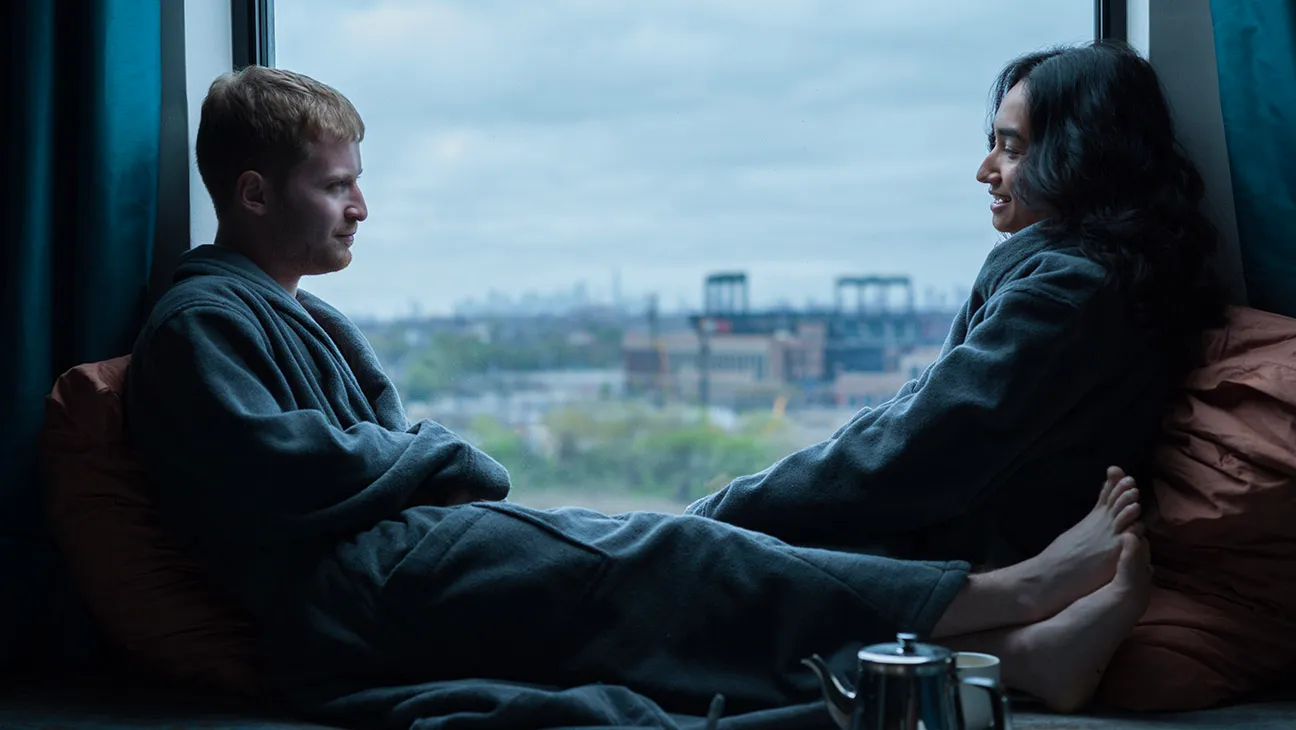
Can you explain the importance and significance of Aishe’s ethnicity. I know it’s a minority ethnicity in China, so even the Chinese people in New York are looking at them like they aren’t part of what they are.
What the film is saying is that there are no monolithic cultures. There are minorities within every single country all around the world, there are outsiders. A lot of that has to do with the way history has created borders and nation states, which shift all the time. This woman is Uyghur, and the Uyghur people have thousands of years of history; they are more closely related to the Turkish people than anything. That’s why there’s a large diaspora of Uyghur in Turkey because the languages are so similar.
And that’s why so many of them are Muslim as well?
Yeah, Uyghur people are usually culturally Muslim. But even that is not a monolith. Their Islamic faith looks very specific to the Uyghur people. They live in what is now modern-day Xinjiang, which is a gigantic province in the northwest of China. Even within that province, there are a lot of different cultural hubs—there are two big cities that have very different cultures from each other. None of this is in the film in an explicit way, but for me, it was really important to show that minorities are not monoliths, and there are people who feel like outsiders in an insider group.
I was going to call Fred Hechinger a rising star, but based on the films he’s been in, he might already be there. How did you get him in this movie? He has to be sympathetic to a certain degree, but Skinner is also dangerous, mostly to himself.
He met on the project because Plan B has worked with him on Nickel Boys, and Barry had worked with him on Underground Railroad. We met at a restaurant, and he really loved Minding the Gap and knew that I was going to want to bring a humanist, fully rounded, deeply emotional perspective to the character he’d be playing, so that’s what we did. At the beginning of the rehearsal process, I said, “We can either do the short-cut version of this where we just get scenes up on their feet, or we can do this as a play.” I’d taken many years of acting classes and knew how valuable it is to explore off the page and do it wrong and make insane choices that absolutely would not work just to figure out how to portray truth in a way that is surprising, original, and works for the script.
I was going to ask you how open you were to improvising to get to that emotional truth. Did that help you make things feel more natural and less scripted?
One-hundred percent. The way that I’m going to describe our process is an improvisation, in the sense that we didn’t just trying something random. We dealt with it like a play, we talked about in terms of intentions and choices and tried to get at what works. But as a documentarian, I saw something in Fred and Sebiye and who they are as people that I wanted to bring to this role. And part of our long, drawn-out rehearsal exploration process was getting them comfortable and trusting that they already had it, that they were already in those characters, they didn’t have to try.
There’s a fair amount of having your actors just out on the streets of New York. Did you just throw them out there and shoot it? Or was there more structure to it than that? It looks like they’re just wandering free.
Totally. Again, working for years in the camera department, you’re the one at the marking rehearsals, putting down marks for the actors. I was trained to think in traditional blocking, and all of those scenes were blocked and choreographed with the camera.
The immigration story is obviously as timely as it ever could have been, maybe even more so than when you shot this. Did you see something drastic on the horizon, or is what’s going on today shocking even you?
I absolutely didn’t see what was coming when I took this project on in 2018. But I am a student of history, so I understand the history of this country, the ebbs and flows of the way the U.S. immigration policy swings—to the right and to the left. We happen to be in a time when there’s a lot of fear that’s motivating immigration policy, but this isn’t the first time the U.S. has taken a strong stance on the issue of who gets to have a shot in this country, who gets a chance to have a life here. So unfortunately, we’re in a time where the answer is “Not as many people as there have been in times when people have been able to come to this country and make a life here.” It’s tough, but what drew me to the project and draws me to every project are evergreen questions about…even if you get the chance to make a life here, what is the cost? What is the spiritual and emotional cost of having made it?
Do you think you will continue down this fiction film road, or will you got back to docs, or will you be one of that small group of directors what toggles back and forth?
That’s kind of where I’m at now. I have several fiction projects and several docs in development. Being a filmmaker feels less like a road and more like a series of winding paths. I don’t know which one is going to lead to where, but I know that I trust the next step in front of me, as long as I keep being passionate about the next step.
What do you hope people think and talk about and consider as they leave the theater?
If we’re lucky, we have seven, eight, nine decades on this earth. It’s a short time; what do you want to do with that time? A lot of people don’t have to think about that question. If you’re lucky, you do have to think about it and live more intentionally and make a decision about “Why am I here? What am I going to do with my life?”
Best of luck with this, Bing. Good to see you again.
Thank you, Steve. Good seeing you too. Take care.
If you enjoyed this post, please consider supporting Third Coast Review’s arts and culture coverage by making a donation. Choose the amount that works best for you, and know it goes directly to support our writers and contributors.
