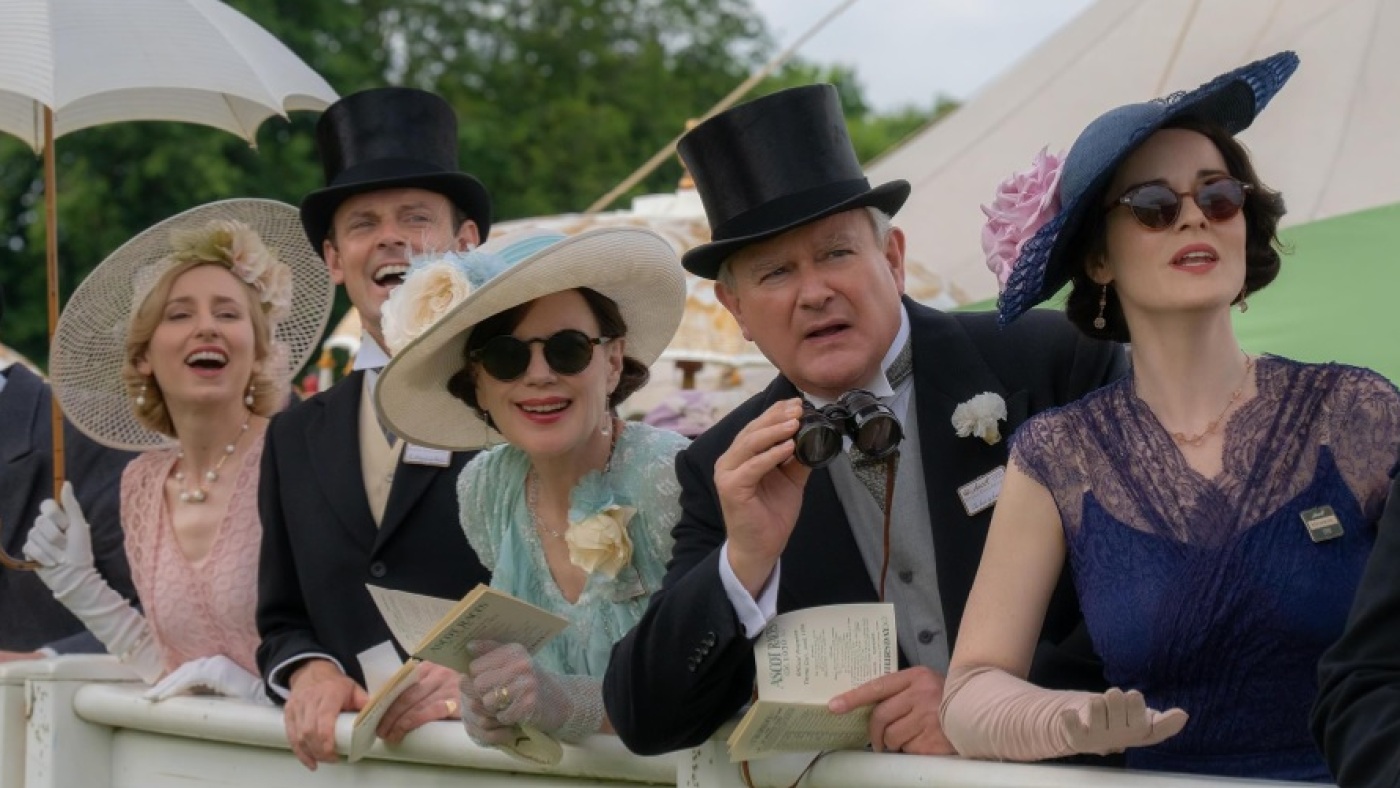

When it premiered on PBS in early 2011, Downton Abbey took a certain subset of American audiences—ones who enjoy period pieces, glossy soap operas and all things British—by storm. Set on the titular estate outside London, the show (created by Julian Fellowes) follows the upstairs/downstairs dynamics of a well-to-do family in the British aristocracy and the men and women who earn their living managing the house and grounds. The show ran for five seasons, though the show progresses over more than a decade of early 20th century history (the pilot episode begins following the sinking of the Titanic in 1912), a tumultuous time of changing social moors and evolving industry and technology. Much of the show is about a resistance to progress, an insistence on things staying as they've always been only to learn that the real triumph is in adapting to the times.
Whether in service to the fans or their pocketbooks, Fellowes and crew expanded the world of the Crawleys in 2019 with a feature film progressing the characters' stories; then again in 2022 with A New Era. Both films saw familiar characters confront the kinds of conflict and tension that Downtown Abbey does best, all relatively low-stakes and yet somehow endlessly watchable. Coupled with gorgeous period costuming in a lush, pastoral setting, watching this ensemble grow and change with the times has kept those of us living vicariously through them coming back again and again.
And now, we go back to Downton once more for Downton Abbey: The Grand Finale, the film its creators swear is the last in the franchise (and based on the film's sense of finality and closure, one can take them at their word). Written by Fellowes and directed by Simon Curtis, The Grand Finale brings us to 1930 and opens with a splashy view of the West End, all lit up in bright marquees and ads. It's modern London and we'll spend the rest of the film learning just what that means for Robert Crawley, Lord Grantham (Hugh Bonneville), Cora Crawley, Lady Grantham (Elizabeth McGovern), their family, staff, estate and legacy.
Given that the film is set eighteen years after we first met the Crawleys, much has changed in their world; recounting it all would be far too much for one film review. Feel free to revisit our reviews of the 2019 film and the 2022 follow-up for a refresher. Suffice it to say that as nearly a generation has passed, many of the show's key relationships have changed, characters have come and gone, and through it all, those of us watching all along (I admit I even visited the estate that stands in as Downtown when I was in England in 2015) have come to be quite invested in their lives and fates. When we join them at the theater in London, Lord and Lady Grantham are joined by their middle daughter, Edith (Laura Carmichael), now Lady Hexham, and her husband, Bertie Pelham, Lord Hexham (Harry Hadden-Paton); after the production, they head backstage to meet star Guy Dexter (Dominic West) and his dresser, Downton's former butler Tom Barrow (Robert James Collier).
In the process they meet the show's creator, Noel Coward (Arty Froushan), a breath of fresh, forward-thinking air in the Downton crew's often stuffy ranks. Though he doesn't appear again for a bit, Coward will soon play a key role in the lives of all the Crawleys (and even some of the servants). In the meantime, the film's real scandals (we use the term lightly) begin to unfold. First, we learn that Lady Mary's (Michelle Dockery) marriage, which was already on the rocks in A New Era, is now ended in divorce, a status that makes her all but untouchable in polite society (in fact, she's asked to leave a party royals are expected to attend rather than besmirch their reputations in turn).
Next, Cora's American brother, Harold Levinson (Paul Giamatti), arrives in England with companion Gus Sambrook (Alessandro Nivola); the former had been back in the US settling their now deceased mother's estate (the fortune to which Downton owes its sustainability) and while Sambrook helped Harold hold onto his cash during the market crash of 1929, he subsequently lost it all just after. Mary, who's long been known to be Robert's successor to overseeing Downton, had grand plans for that money, some of which she's already spent on renovating Downton and its surrounding buildings. With the estate's future uncertain, Robert is more hesitant than ever to hand the reins over to his eldest daughter.
Elsewhere in the Downton universe, Lady Merton (Penelope Wilton) is named the county fair patron, succeeding matriarch Violet Crawley (the late Maggie Smith); soon, she's coming to odds with its Chairperson, Sir Moreland (Simon Russell Beale), especially when she names Downton's cook Daisy Parker (Sophie McShera) and butler Carson (Jim Carter) to the board in order to bring new perspective. There's even more change downstairs at the estate as longtime head cook Mrs. Patmore (Lesley Nicol) prepares to retire to live on a nearby farm with her now husband, Mr. Mason (Paul Copley). One thing Fellowes and his team have always been able to do well is weave several different narrative threads together in a way that works rather than overcomplicates; while there's nothing particularly innovative about the plot here, it does help to have some working knowledge of the franchise in order to keep track of what everyone is up to and, more importantly, why.
To this end, where the film only slightly slips up in this last installment is in how it handles the next generation of Crawleys and their extended family. Nearly fifteen years since the show premiered and I had a hard time remembering whose kids were whose, especially since very few of them are named at all. But otherwise, Fellowes, who has reteamed with A New Era director Simon Curtis, knows what fans of the show (and films) are looking for and he delivers. Relationships are tested (but not too hard), quips are made (in very British ways), and through it all, we're rooting for both the wealthy family and the working class to prosper.
Perhaps no one gets their due in this final installment as much as the long-suffering Lady Edith, always the overlooked middle daughter and always at odds with her sister, Mary. As Sambrook is about to swindle even more of the British upperclass, none other than late-bloomer Edith, now a social player in her own right with a strong marriage and small fortune to rely on, calls him to the carpet and sets him straight. It's a sight to behold, and perhaps the scene worth going to see the film for if not for the warm and nostalgic way it all winds down. In a movie where everyone is playing characters they have inhabited for over a decade, the performances feel lived-in in a comfortable, familiar way. Edith's moment, then, feels all the more remarkable as its so out of character for the trod-upon young woman; it's a nice touch for the character and the film overall.
Not many franchises can manage to keep their storylines moving for the span of time Fellowes has kept Downton Abbey moving, both in real time and across the era covered in the show and films. And certainly, not many can boast a successful television run and not one, not two but three good feature film spin-offs. Did we need one more Downton Abbey film? No, probably not. But this Grand Finale offers die-hards a heartfelt way to say goodbye to the Crowleys, their staff and an a place we've all come to know like home.
Downton Abbey: The Grand Finale is now playing in theaters.
If you enjoyed this post, please consider supporting Third Coast Review’s arts and culture coverage by making a donation. Choose the amount that works best for you, and know it goes directly to support our writers and contributors.
