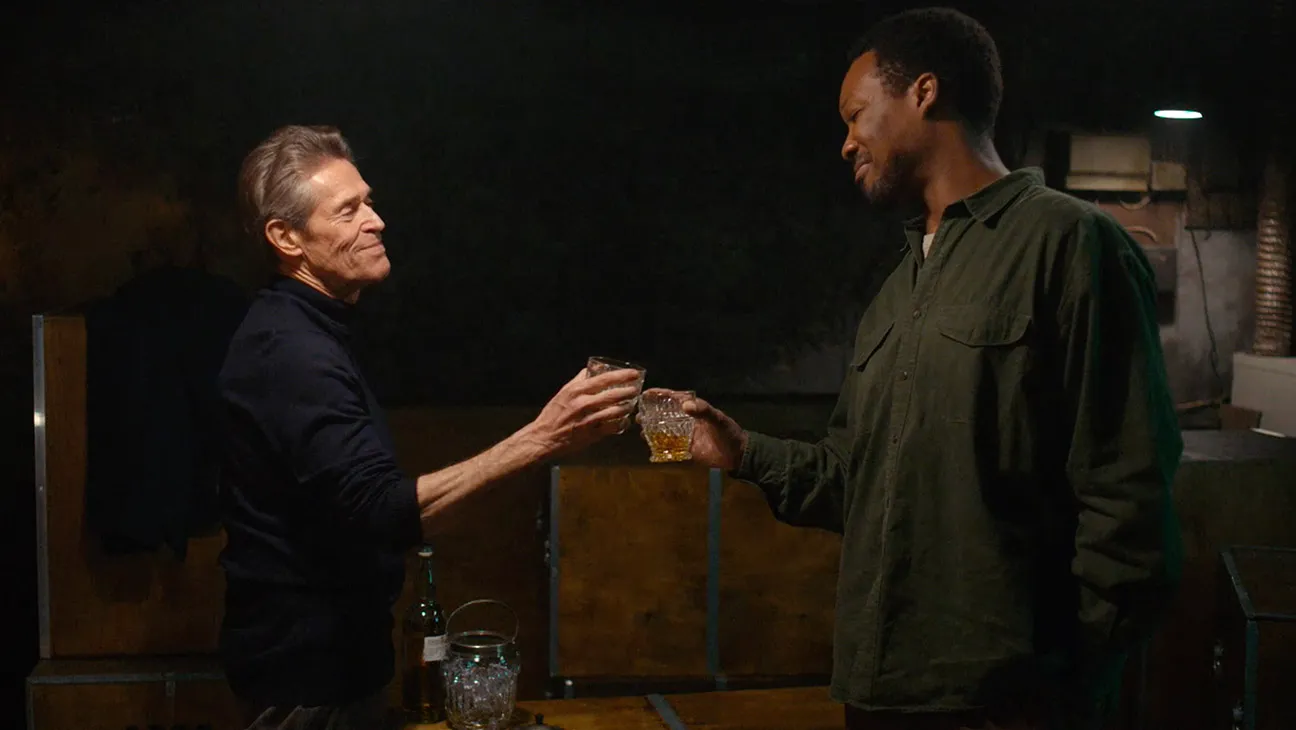

Sometimes the metaphor screams louder than the story itself and the subtext is written bigger and bolder than the text. Such is the case with director Nadia Latif’s second film (after White Girl), The Man in the My Basement, set in the primarily African-American neighborhood of Sag Harbor, New York. With the home that has been in his family for generations about to be taken by the bank, Charles Blakey (Corey Hawkins) is feeling about as low as he possibly can. He’s unemployed and seemingly on the worst losing streak of his life, with no one in his life willing to help him save the house.
At that exact moment, the mysterious Anniston Bennet (Willem Dafoe) shows up on his doorstep with a proposal that feels too good to be true (or wise): he wants to rent Blakey’s basement for two months at $1000 per day, a lucrative offer that would solve a lot of problems for Charles. The kicker is, Bennet wants to live in a cage in the dingy basement, having Charles bring him meals and books when necessary. His motivation for living like this is unclear. Is he hiding? Is his mentally unstable? Is he attempting a sociological experiment involving sensory deprivation? Whatever it is, the agreement binds these two men in a contract that seems to unlock their individual family ghosts and life-changing traumas.
It’s clear that Bennet is a rich man, and he even ups the dollar amount in order to get Blakey to agree to the arrangement. And suddenly having access to money gives Blakey the resources to dig into his family’s history, beginning with a handful of tribal masks that may be worth a great deal of money if they’re authentic. But with Bennet caged like a prisoner rather than a guest, the power dynamic begins to shift. With all his money, he is now dependent on Bennet to hold up his end of their bargain. Suddenly, the racial power dynamic between the two shifts, with Blakey able to subjugate the one with all the money but none of the power currently. The two performers do their best with this inversion of the more typical American incarceration scenario, but I’m not sure the screenplay (by Latif and producer Walter Mosley, based on his 2004 novel) quite gets to the potentially powerful heart of this dynamic, even when the local antiques dealer Narciss (played by the great Anna Diop) is introduced to challenge Blakey’s morals about his heritage and the specific history of his family.
The filmmaker’s use of imagery and lighting is frequently effective and impactful, but it’s the actors who make the film spark and give what we’re watching any kind of smoke. And even after especially heated exchanges, especially between Hawkins and Dafoe, we frequently wait for a followthrough to nail down whatever the point is that simply never arrives. The use of the tribal masks almost leads us to believe the The Man in My Basement will turns into something like a horror film, but that never manifests either. Great potential can be seen all over this movie, but most of it ends up lost by the time any given scene ends.
The film is now playing near Chicago at the AMC Loews Streets Of Woodfield and will be available to stream on Hulu and Disney+ later in the fall.
If you enjoyed this post, please consider supporting Third Coast Review’s arts and culture coverage by making a donation. Choose the amount that works best for you, and know it goes directly to support our writers and contributors.
