
Hanging on the wall by my front door is a print called "The Big Leap" by an artist from Missouri, Carrie Shryock. I wish I could say I found it at an art fair or local shop, but no; I discovered it at Anthropologie, and I immediately fell in love with it. The print depicts a robin's egg blue sky with just one simple subject: a woman, mid-air. She's dressed in black bottoms and a white top that, like her hair, is rushing upward in the wind as she flies downward through the air after taking some jump off of some...thing. What she's jumping off of, or why, isn't the point. The point is that she is leaping. She is going from solid ground to the unknown, and (at least in my reading of it), she's doing it joyfully...and maybe a little scared. But she's doing it.
The print, positioned as it is so I see it every time I leave the house, is a daily reminder that the good stuff, at least in my experience, is always on the other side of that leap, the other side of the unknown. It's a big risk and it always takes some convincing (of oneself or of others), but every leap in life is how we grow, how we get closer to building the life, the relationships, the world we want.
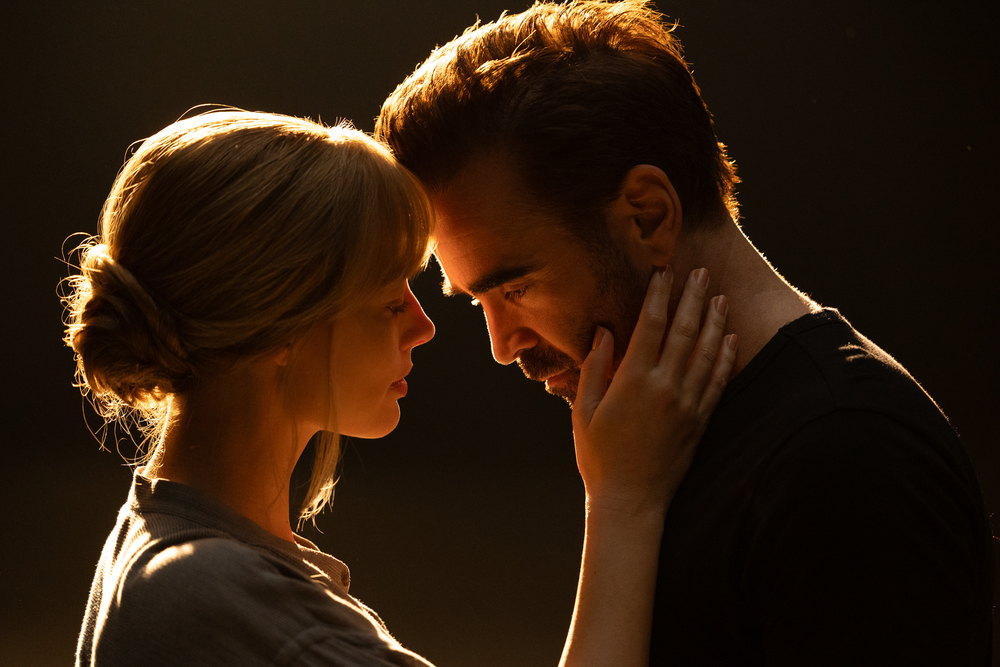
In Kogonada's beautifully rendered, charmingly refreshing A Big Bold Beautiful Journey, written with originality and wit by Seth Reiss (who over-performs, considering he also wrote the misfire The Menu a few years back), Sarah (Margot Robbie) and David (Colin Farrell) are about to take the biggest leap of their lives: falling in love. Getting there, or even thinking about getting there, is what the journey, literally and figuratively, is all about, and it is, in fact, big and bold. It's also endearing and heartfelt, authentic and nuanced, whimsical and wildly imaginative. What's more, it's played with care and chemistry by two actors who could both very easily be doing much bigger, but likely far less meaningful, projects than this.
David, living on the north side of an unnamed city, is on his way to a wedding at the film's outset; when he discovers that his car's been ticketed and booted, he takes a chance on a nearby ad for The Rental Car Agency. It's about here, roughly ten minutes into the film, that we know this journey isn't going to be set entirely in reality, and I promise you the choice to let go of expectations and follow where David (and eventually Sarah) lead us is one of the best movie-going decisions you'll make all year. In a nondescript warehouse, David meets the rental company agents (cameos from Kevin Kline and Phoebe Waller-Bridge) who offer him a 1994 Saturn, encouraging him to get their GPS (a car from 1994 doesn't have an option to plug in an USB and use one's phone; and besides, phones have a way of crapping out at the worst possible times, after all).
The wedding he's headed to is nearly 300 miles away, but once there, the happy couple introduce him to Sarah, beautiful and charming and instantly dancing between flirting David's pants off and keeping him at arm's length. The connection is undeniable, but neither seem capable of making something happen between them. On David's drive home, his GPS asks the question that will change everything: would you like to go on a big, bold, beautiful journey? It takes only a bit of convincing for David to say yes and soon, he's pulled off the highway to get a fast food burger at the same spot where, imagine that, Sarah is grabbing her roadside lunch, too. When Sarah's car, also a rental with similar GPS, won't start, the two share a shrug aimed at the universe and embark together on whatever it is the car computer has in store for them.
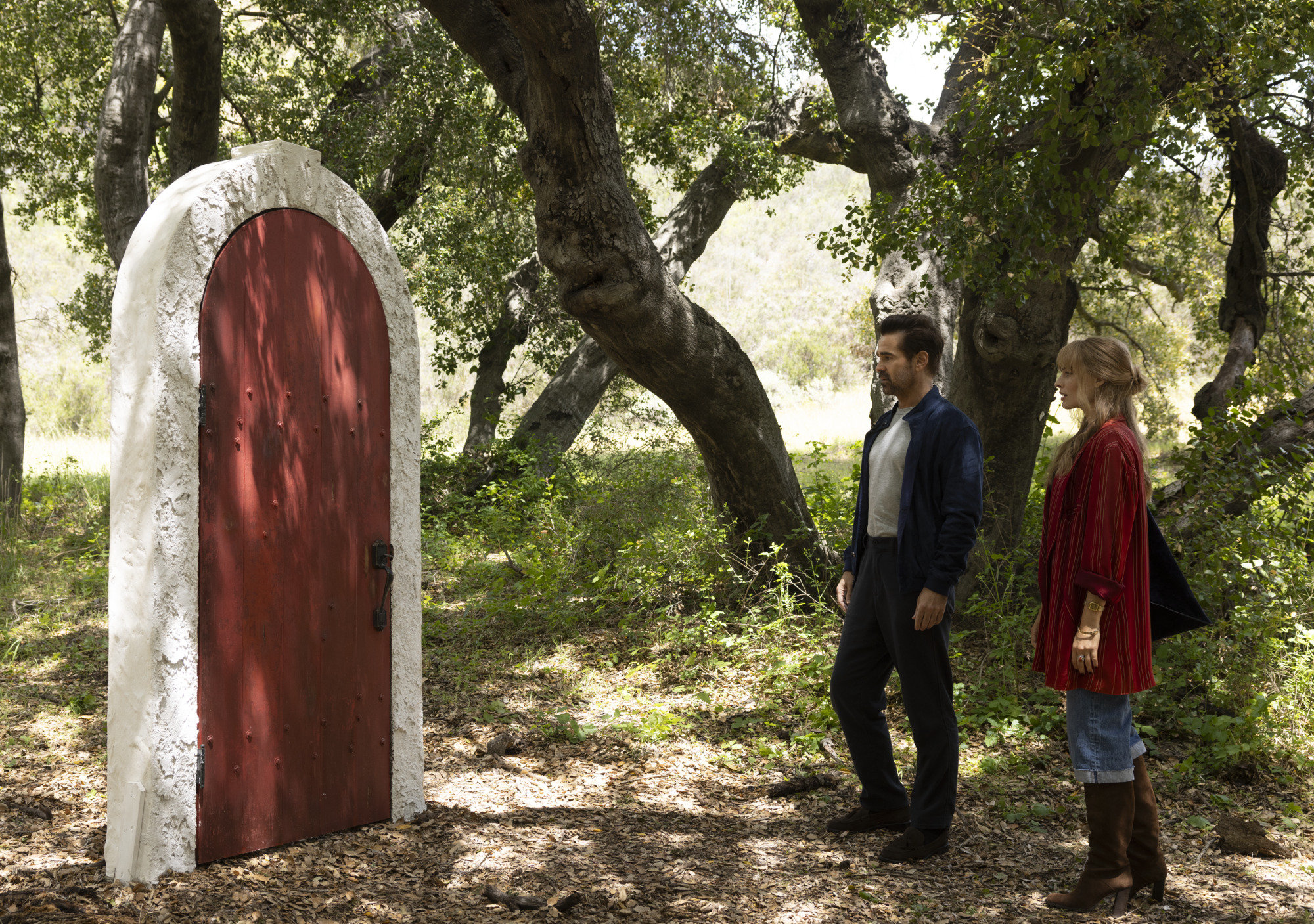
It's hard to describe what follows, but I have a theory: Reiss and Kogonada (who, according to the film's press notes, is responsible for the film's key narrative device) create a wholly original visual language to describe the experience of dating, particularly the experience of those first few dates with the person you're relatively certain is going to be your person. In the film, this shared experience is depicted through a series of strange doors the couple are sent to find, each a portal to a past experience, a moment in one of their lives that is formative, for better or worse. There's the lighthouse David visited on his frequent solo travels but didn't really appreciate in the moment; there's Sarah's favorite art museum, visited clandestinely thanks to an in with the security guard. There are personal moments, many of which involve their parents, and there's even a big, bold musical number. Individually, they're all charming vignettes that help us learn more about each of these characters.
But it's what they're learning about each other that's important here. As David and Sarah revisit these moments that create their stories, the other is bearing witness, listening and learning about the person across from them and navigating their own responses as a fuller picture of the other comes into focus. If that's not dating—recounting one's life experiences and hoping the person on the other side embraces them (and you)—I don't know what is. In the process, and in a way so quiet it's nearly imperceptible at first, it's not just the other person who's affected by the stories; both Sarah and David have chances to rethink critical moments in their lives and, with the benefit of their adult experiences and emotional maturity, respond to them in ways that heal wounds, repair relationships, offer new insights and change the narrative they've been telling themselves their whole lives.
Filmmaker Kogonada, who was raised in the Chicago area and lived in and around the city into young adulthood, burst onto the scene with Columbus, a deeply humane story of grief and connection told with remarkable aesthetic and a gentle touch, brings his signature sense of subtle style to A Big Bold Beautiful Journey, too. With production designer Katie Byron, he creates a visually captivating world where everything from the color-block costumes (by Arjun Bhasin) to the choice of umbrellas (it rains a lot for Sarah and David, and I have theories about that, too) to the design of the GPS is a statement. (But not, like, a Wes Anderson, hit-you-over-the-head-with-it statement, thank goodness.) The film relies on practical elements to create its fantastical elements, a combination that makes the proceedings, unrealistic as they may be, feel grounded and tangible.
Though every film, to varying degrees, attempts to capture the human experience, no one is quite as capable of that in contemporary cinema as Kogonada and his team of collaborators (Farrell also starred in 2021's After Yang). A Big Bold Beautiful Journey is the kind of film that keeps me going back to the movies, hundreds of times per year; it's a film that lays bare any pretensions or assumptions and instead holds a mirror to this odd, unpredictable thing called life and all its vulnerabilities, uncertainties, opportunities and more. In a way no film in recent memory has been able to do, A Big Bold Beautiful Journey captures the head-spinning, heart-wrenching experience of falling in love, of choosing to hand one's heart to someone else (for a time, or for forever), of having no idea what's about to happen but, goddammit, taking the leap anyway. It's good stuff.
A Big Bold Beautiful Journey opens in theaters Friday, September 19, with advanced screenings on Thursday, September 18.
If you enjoyed this post, please consider supporting Third Coast Review’s arts and culture coverage by making a donation. Choose the amount that works best for you, and know it goes directly to support our writers and contributors.
