Considering how many communities (and countries) have a bullseye on their backs thanks to the policies of the current administration, film festivals are more than ever a welcoming safe space where many of these communities can share their stories. (Not that festivals themselves don’t have a bullseye on their backs. They do. Arts, culture and anything that represents knowledge are also under attack.)
For 43 years, Reeling: The Chicago LGBTQ+ International Film Festival has offered that safe space, not only to the LGBTQ+ community but to anyone who is willing to cast their prejudices aside and listen. Running September 19-26 at Chicago’s Landmark Century Centre Cinemas (2828 N. Clark St.) and Chicago Filmmakers Firehouse Cinema (326 W. Hollywood Ave), this year’s festival will present 38 feature films and 59 short films, organized into 10 shorts programs. That programming includes one of the most robust selections I have seen at Reeling of films from Latin America, Spain and Portugal in years: eight features (the five I review below plus Perro Perro from Argentina, This Is Ballroom from Brazil and the Argentina/U.S. co-production Drunken Noodles) and 13 shorts from Spain, Puerto Rico, Brazil, Cuba, Colombia and Portugal with Spain and Brazil leading the pack.
The Festival opens on the 19th at 7pm with Emma Hough Hobbs and Leela Varghese’s sapphic animated cosmic quest Lesbian Space Princess. Reeling will also feature two centerpiece films: the documentary It’s Dorothy!, Jeffrey McHale’s exploration of Oz through the women who have portrayed its iconic heroine (Sunday, Sept. 21, 4:15 pm) and She’s The He, a trans coming-of-age story from director Siobhan McCarthy (Thursday, Sept. 25, 8:15 pm).
Keep in mind that all of these films will be screened once, so this could very well be the one and only chance you get to see them on the big screen:

NEWBORN/UN MUNDO PARA MÍ

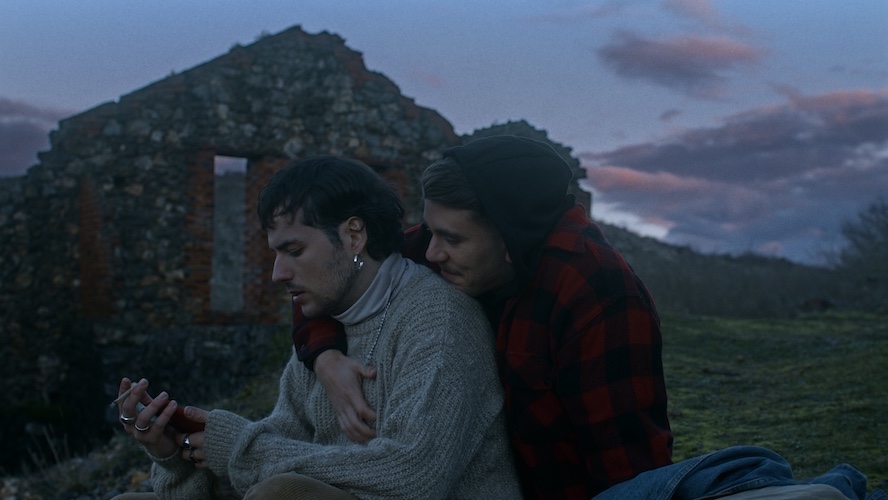
Billed as Reeling’s first intersex film, Alejandro Zuno’s feature debut is as much about parenthood and parental responsibility as it is about identity and who gets to have a say in a person’s choice…especially when that person is a newborn child. Mexico City pastry chef Nico (Andrés Delgado) and theatrical light and set designer María (Mayra Hermosillo) are about to be first-time parents of what they’ve been told over and over will be a girl. The birth, however, has to be induced. That is not all: the doctors can’t determine the child’s sex and want to place the child under observation. Medical terms like “disorder of sex development,” “genital ambiguity,” and “gender normalizing procedure” are thrown at them. Bottom line, Nico and María have one year to decide if they want to go ahead with a sex assignment operation.
María is not yet willing to sign on the dotted line and begins to research her child’s condition on her own. María and a reluctant Nico seek the advice of Alex (trans actress Nova Coronel), an intersex person whose gender was changed from male to female through a similar medical procedure as a child. Nico still believes medical protocol is the way to go, no matter how much evidence to the contrary María manages to find. The decision weighs heavily on them, but Zuno makes sure that the audience never, ever forgets what’s at stake as he places the baby center stage, scene after scene, throughout most of the film.
Zuno avoids the histrionics characteristic of the Latin American family drama and telenovelas to deliver a measured, emotionally honest and compassionate narrative. The filmmaker looks at the issue from all angles, at the pressures it exerts on both parents, at their support system. He also has an eye and ear for those little emotional nuances that say more than words, and the way voices can be silenced by others. The performances are strong across the board, especially Delgado and Hermosillo who, with just one tiny gesture, manage to express so much, even when their characters are close to exploding. Newborn is brave and honest, a must-see at Reeling. (Saturday, Sept. 20, noon, Landmark Century Center)
RAINS OVER BABEL/LLUEVE SOBRE BABEL
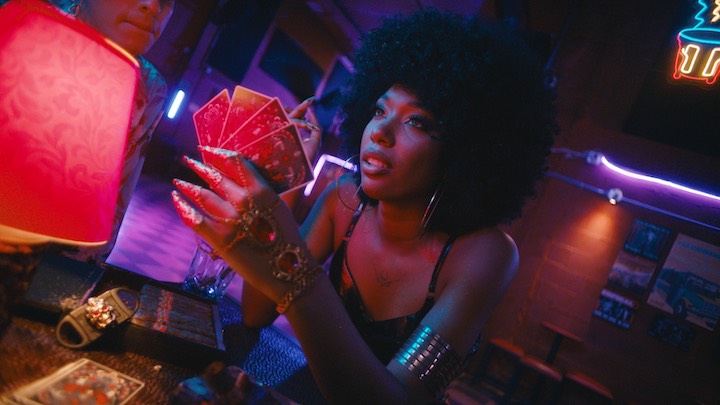
I love, love, loooove Gala del Sol’s wild, extravagant, über-campy, imaginative, risk-taking, exhilarating, adrenaline-shot of a feature film debut. Seriously, folks, it’s that good. Frankly, I never even thought this was a retelling of Dante’s Inferno until I did some research. And you don’t need to make that connection to enjoy Rains Over Babel; even though it explains why one of its characters is named after Dante Alighieri. Other characters' names include El Boticario (The Apothecary), the main bartender at a Cali, Colombia, bar called Babel (where most of the action takes place), El Callegüeso, a popular salsa star, and Darla Experiment (a drag queen). Others derive their names from Greek mythology.
I don’t have the word count to even give you a hint of the multiple story strands Gala del Sol weaves into this colorful quilt. Suffice it to say they all center, in one way or another, around La Flaca, the living incarnation of Death (who gives the current TV incarnation of The Sandman’s Death a run for her money), and the mysterious disappearance of El Callegüeso, who is scheduled to perform that evening at Babel. There is also the son of a local pastor who is eager to unleash his inner drag queen at a do-or-die drag competition as part of Darla’s team that evening at Babel. Oh, did I mention a kung fu fight in a BDSM joint with men wearing leather animal masks? And the music? Sensational. I want the soundtrack.
I could go on, but why spoil the fun? Except to say: do stay for the end credits. (Saturday, Sept. 20, 9 pm, Landmark Century Center)
THE SILENCE OF MY HANDS/EL SILENCIO DE MIS MANOS

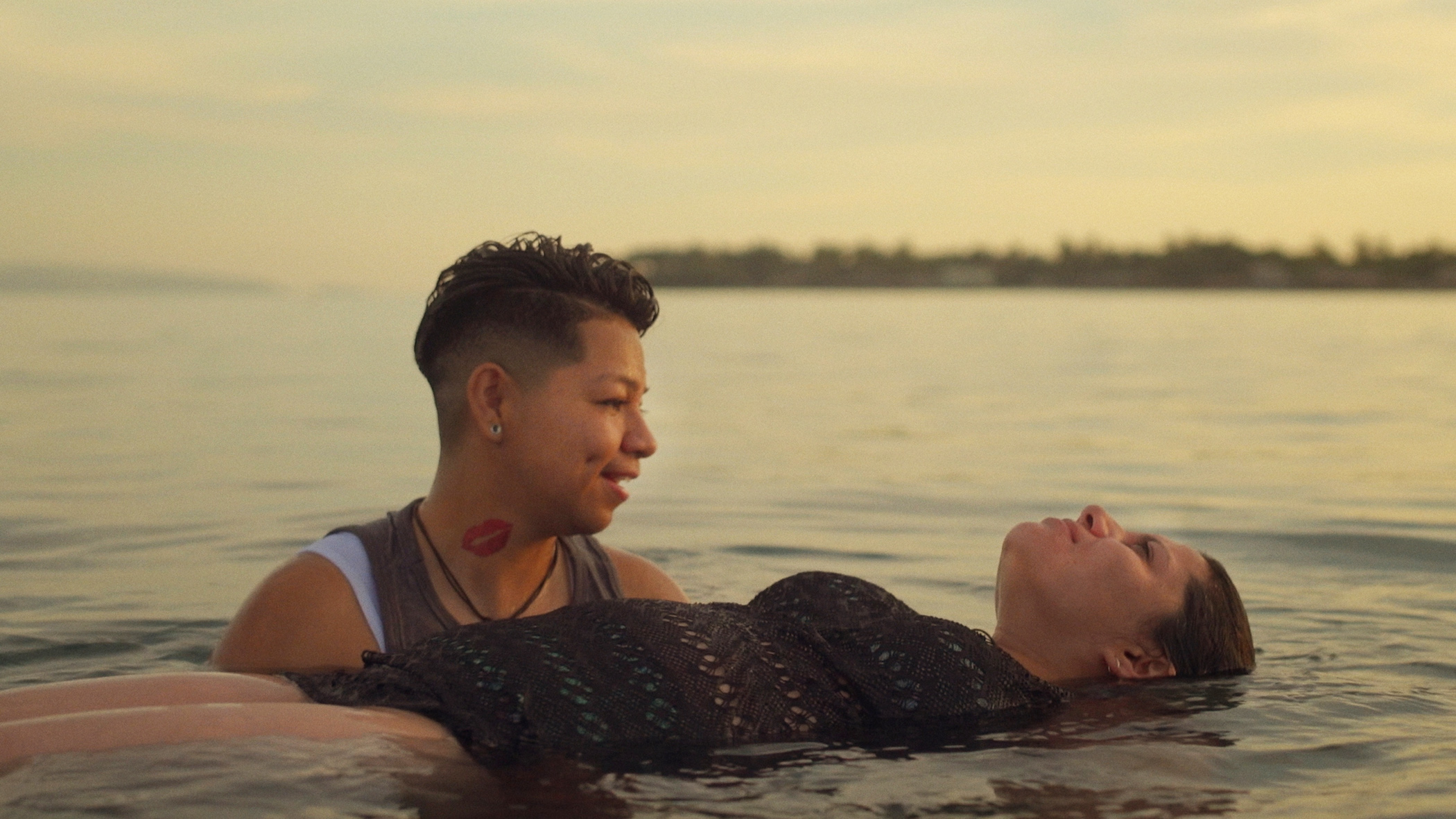
Who said that love stories belong exclusively in the realm of fiction? Filmed over a period of seven years, Manuel Acuña’s intimate, immersive and poignant documentary tells the story of LGBTQ+ couple Rosa and Sai, who are deaf. They live, love and struggle with whatever life happens to throw at them, including a long-distance relationship. Rosa, a law student at the University of Guadalajara, wants to become Jalisco’s first deaf lawyer. Sai is in the process of transitioning from female to male; their entire family lives and works in California and they begin to feel that oh-so-familiar pull of going back home.
The first half of Acuña’s documentary is truly sensorial; we inhabit Rosa’s and Sai’s headspaces, we perceive the world as they perceive it, together and individually. There is something truly sensual and delicate in the way Sai and Rosa caress the glass barriers at their local aquarium. Sounds are at times muffled; when embracing at the beach, their respective hearing aids emit a high-pitched sound due to their close proximity. Some of their off-screen sign language is delivered in italics, the equivalent to a voice-over.
Acuña uses the sharp, ultra-pristine digital images shot by Sai in their video messages to Rosa to underline the distance, physical and emotional, between the couple once Sai leaves for California to begin their transitioning process. Rosa fills the void left by Sai by throwing herself into her studies and serving as a liaison between the deaf community and the able-bodied one. And yet, that distance doesn't deter Sai. They are so in love with Rosa, their videos so filled with optimism, joy and longing that you truly wish their relationship will survive the distance. You will never forget Sai’s smile; it will break your heart. (Saturday, Sept. 20, 4:15 pm)

A FEW FEET AWAY/A METROS DE DISTANCIA

Twenty-year-old Santiago spends most of the day scouring dating and hookup apps on his phone. The tipping/tapping of his fingers on screen, expanding the images of potential candidates for a one-night stand and the pings from text messages are constant leitmotifs in Tadeo Pestaña Caro’s feature debut making its U.S. premiere at Reeling. As the film opens, Santiago (Max Suen) is meeting a real estate agent in an empty flat during his lunch break. The meet-up doesn’t go as planned. Santi is invited by his best friend Rita (Jazmin Carballo) to go out for a night on the town with her friends and a potential hook-up of her own. He reluctantly joins her. Santi is pretty passive; he is also a pretty good liar. Santi lies to that real estate agent and he lies to a potential hook-up hanging out with him and Rita about what happened earlier in the evening at another bar with another potential one-night stand that went nowhere. The night ends for him back at an underground gay club he had been kicked out of early that evening where he now finds more than he bargained for.
Both a portrait of Buenos Aires’ vibrant night life and of dating in the age of Grindr and other apps, A Few Feet Away is a weirdly static, aimless film. It does reach a hectic, frantic climax of sorts (no pun intended) once Santi gains access to the forbidden levels of that underground club. Even though its story is rather slim and seems to go nowhere, A Few Feet Away is still compelling in its portrait of loneliness and desire in the digital age. (Wednesday, Sept. 24, 8:45 pm, Landmark Century Center)
CENSURADA

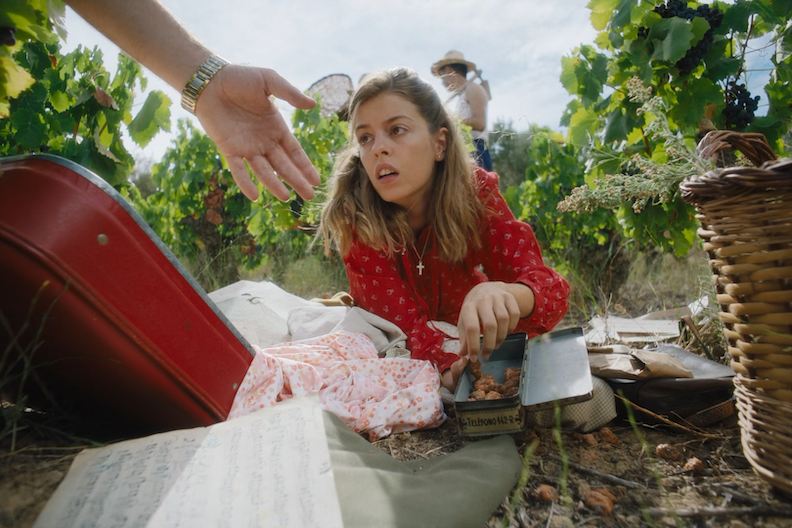
Receiving its world premiere at Reeling, Mexican director Mario Garza’s sapphic coming-of-age feature debut has its heart in the right place. It’s just too bad that the film comes across as a cliché-ridden after-school special. Set in Obanos in the northern autonomous community of Navarre, Spain, in 1969, at the tail end of Franco’s regime, Censurada tells the story of Salomé (Nerea Rodríguez), the shy dyslexic daughter of a widowed farmer, who dreams of being a professional pianist. Her father puts a stop to those dreams when, to settle a debt with his brother, the local priest, he sends both Salomé and her brother Kiko to live with him. Impressed by her talent on the keyboard, her uncle makes her the church’s organist.
Kiko’s sudden accidental death leaves her adrift. Enter Miranda (Sena Ortiz de Zárate), who also moved in recently to Obanos with her overtly religious, conservative mother after her father’s death. She sticks out like a sore thumb in this small town. She reads books! She is open-minded! She dreams of living in Paris! And, of course, Miranda ends up befriending Salomé, the town’s new oddball. They start spending more time together, and Miranda, acknowledging the talent that remains dormant in Salomé, encourages her to participate in a local song contest. But the forces of evil, in the form of two mean girls, Miranda’s mother and José Miguel, the man she wants to marry Miranda with, will stop at nothing to keep these two girls apart.
Ridden with stock characters, images and situations that are borderline laughable (the local bully ripping a big piece of chorizo with his teeth is a stand-out), dialogue that tends to frequently state the obvious (“A star doesn’t need permission to shine”), and the obligatory montage sequence as Salomé writes and even rehearses her song, Garza and co-scriptwriter Sarah Gamazo are not afraid to use every trick in the book. There is even a nightmare sequence involving Salomé and the townspeople that is so groan-worthy given when in the film it takes place that you begin to wonder how they will top this off. You can tell that Garza loves these characters and what they represent to him. But the melodramatic and cliché overload prove fatal to his good intentions. (Sunday, Sept. 21, 6:45 pm)
Tickets to all films and events are available online at reelingfilmfest.org or at the theater’s box office on the day of the screening. Tickets are $15 ($12 for members) for regular screenings at Landmark’s Century Centre Cinema and Chicago Filmmakers’ Firehouse Cinema, with the opening night film $18 for the film only ($15 for members) or $55 for the film and after party ($50 for members). Passes are also available for purchase, and members receive discounts on tickets and passes.
