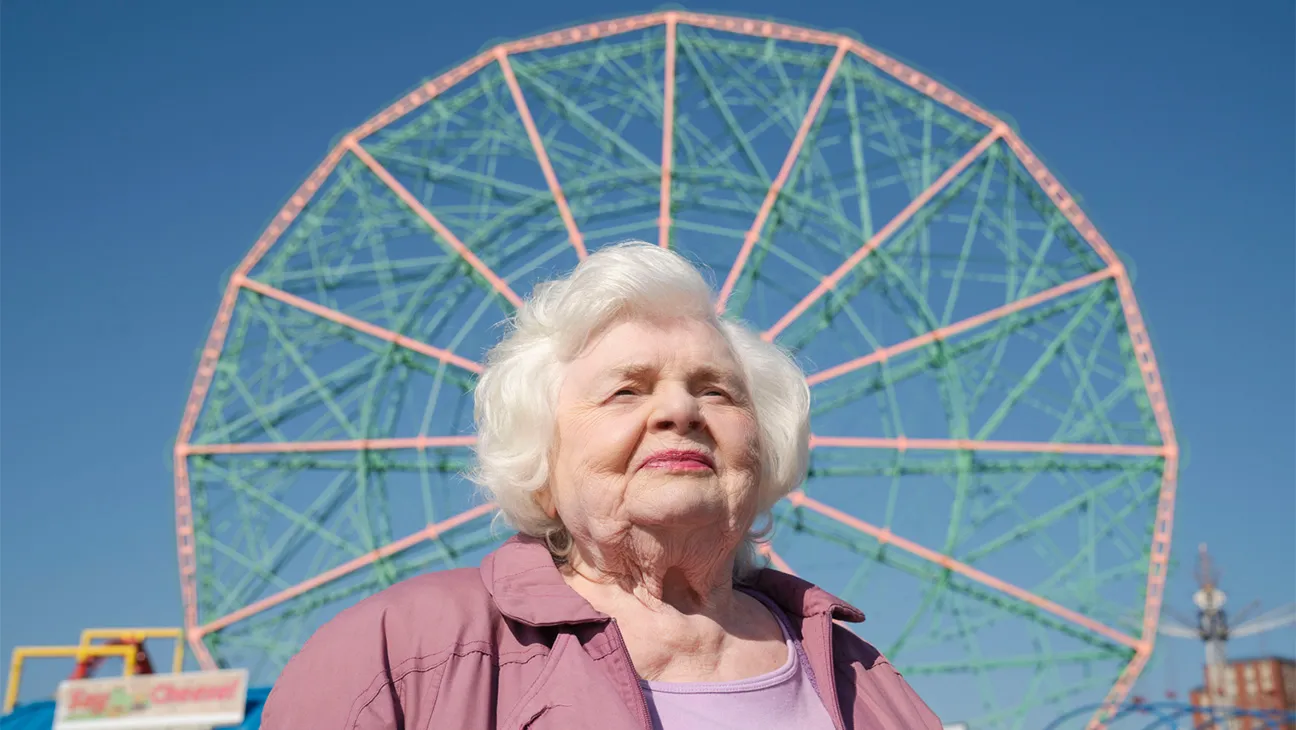

June Squibb is having a moment. At 95 years old and with an acting resume that dates back to the mid-1980s, the longtime character actor is finally becoming a leading lady. Following last year's Thelma where she starred as a grandmother who gets conned and goes on a lofi, Mission Impossible-style adventure to get her money back, she's now at the center of Scarlett Johansson's directorial debut, Eleanor the Great. The film, a first feature script by Tory Kamen, sees Squibb become the titular Eleanor, a widow who, after the death of her longtime friend and roommate, Bessie (Rita Zohar), returns home to New York to live with her grown daughter, Lisa (Jessica Hecht), and teenage grandson, Max (Will Price).
There is a lot going on in Kamen's script, which is the root of most of the film's problems. Eleanor is a doting but judgmental (aka clichéd) Jewish grandmother who harps on her daughter at every turn. In an effort to build a new social life in New York, Lisa signs her up for activities at the local JCC, but Eleanor stumbles into a Holocaust survivors group where she starts telling a harrowing story of her tragic history. The problem is, it's not her history to tell, even if no one else knows that just yet.
A young student journalist happens to be in the meeting looking for a story; when Nina (Erin Kellyman) asks Eleanor to be featured in her article, the older woman realizes she may have painted herself into a corner she can't get herself out of. Elsewhere, Nina's struggling to connect to her TV news anchor dad, Roger (Chiwetel Ejiofor), who we learn in a blink-and-you'll-miss it moment Eleanor and Bessie admire. His wife / her mother recently died, and they're both wrestling with profound grief and nowhere to put it.
What unfolds is a convoluted and underwhelming story about Eleanor's well-meaning deception (albeit a deception nonetheless), Nina's difficult lessons learned in her journey to grow up, and by the end, the kind of paint-by-numbers resolution that ultimately lands hollow as we've spent the bulk of the film confused and unmoved by the players. Johansson does well enough at the helm, weaving together these many storylines in a tonally consistent if unremarkable way. Squibb is many things—charming, endearing, warm and engaging among them—but she struggles mightily to be sharp and snarky as the character calls for. Every time she tries to take a jab at Lisa, it's like watching a kitten trying to roar.
The film's biggest flaw is the massive suspension of disbelief we're asked to make as Eleanor and Nina become more and more enmeshed in the film's central lie, and that falls squarely at screenwriter Kamen's feet. Eleanor the Great gets so caught up in wanting us to buy into the budding intergenerational friendship between them that it expects us to forget not only what a massive, hurtful deception the older woman is engaged in, but to believe that no one in a reputable school of journalism would ever ask Nina to fact-check the story she's working on. Get your tuition money back, girl.
By the film's third act, when everything has to come to light before the credits can roll, Johansson is at least able to up the film's serious notes in moments that matter; Eleanor facing the other, actual Holocaust survivors with the truth is possibly the film's most moving scene, treated with the gravitas such a moment would need to be. But that's the exception in a film that otherwise wants to be a glossy feel-good family drama but only succeeds in giving us surface-level emotions. With a promising director and top-notch cast, it's an unfortunate outcome for a film that just doesn't add up to the sum of its parts.
Eleanor the Great is now in theaters.
If you enjoyed this post, please consider supporting Third Coast Review’s arts and culture coverage by making a donation. Choose the amount that works best for you, and know it goes directly to support our writers and contributors.
