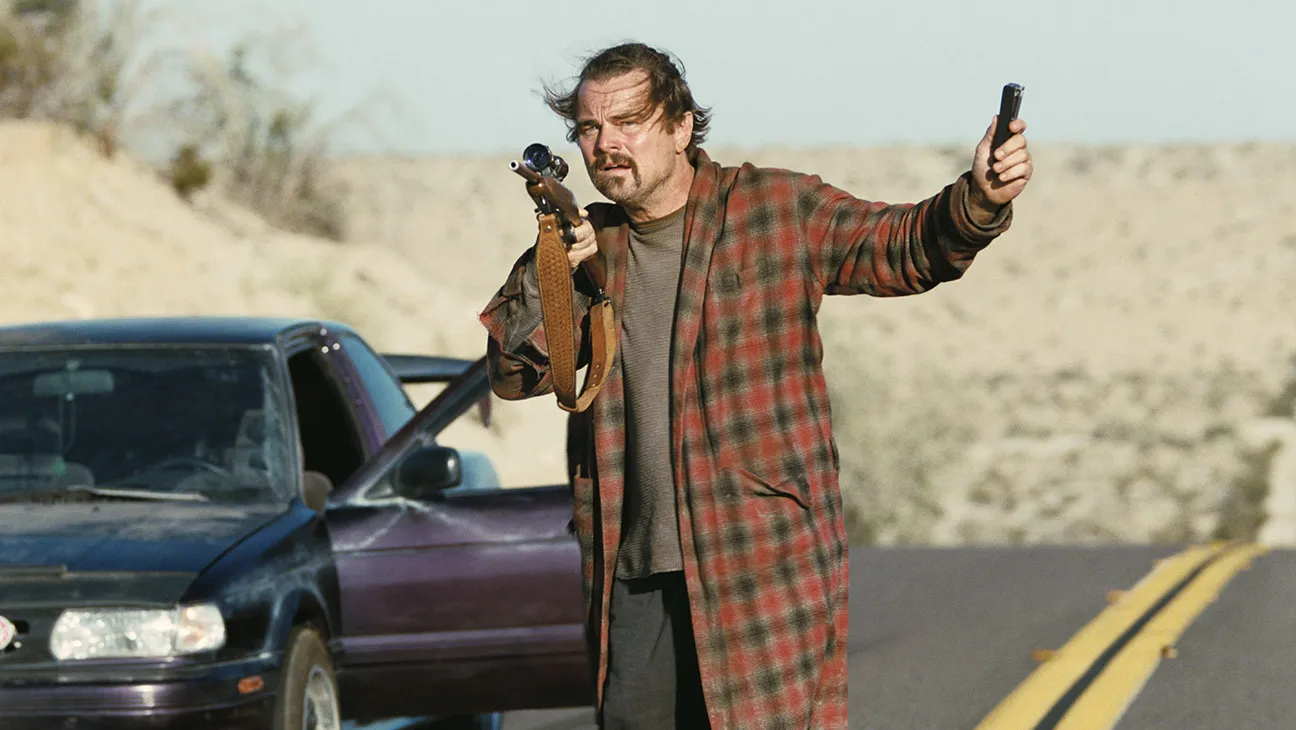

In any other action movie, the emphasis on a revolutionary would be on his/her glory days of radical acts, like blowing up buildings, freeing political prisoners, etc. But in writer/director Paul Thomas Anderson’s One Battle After Another (inspired by the Thomas Pynchon novel Vineland), he spotlights said revolutionary 16 years after he’s effectively hung it up. Now a stoned, paranoid sap named Bob (Leonardo DiCaprio), he's trying to raise teen daughter Willa (Chase Infiniti) off the grid. In the process, he’s ended up raising a tough, self-reliant rebel who finds herself a target by simply being his daughter.
The film opens 16 years earlier when Bob and his partner (both in revolution and in love) Perfidia (Teyana Taylor) are at their peak, along with a handful of other rebels, including those played by Regina Hall, Alana Haim, and Wood Harris. They’re so successful in their missions that they’re been given a full-time adversary in Col. Stephen J. Lockjaw (an absolutely inspired, hard-bark performance by Sean Penn), who not only manages to capture Perfidia, but also falls for her after she seduces him into letting her go. Eventually the team (known as the French 75) disband, Perfidia lands in jail, has a child, and eventually disappears, having made a run for Mexico. Her disappearance leaves Bob crushed and all of the rebels forever targets of Lockjaw.
So when Willa goes missing, Bob emerges from his shell and activates all of the French 75 agents who are still reachable, as well as their affiliates and other networks, to help locate (and rescue if necessary) his daughter. Chief among these associates is Sensei Sergio St. Carlos (Benicio Del Toro), who runs migrants into the United States through a complex network of contacts and tunnels, all of which he uses to help Bob evade Lockjaw in an extended and beautifully edited action sequence that defies logic and description. The thing you’ll notice almost immediately about One Battle After Another is that, in many ways, it is unlike any other Anderson film because of its emphasis on action—there’s a ton of it, and it’s all staged masterfully (in the end credits, there are two full pages of stunt performers listed) and edited expertly by Andy Jurgensen. Explosions, car chases, shootouts—you name it, this film probably contains it, and it all feels believably messy.
When Lockjaw isn’t chasing down revolutionaries, he’s being recruited by an elite white-supremacy group (I won’t ruin the ridiculous name of the organization), represented by Tony Goldwyn, James Downey, and Kevin Tighe, who end up hiring a “fixer” to take care of a few loose ends regarding Lockjaw and his connection to French 75. This all may sound convoluted and possibly even confusing, but the truth is, One Battle After Another is one of Anderson’s most clearly scripted and accessible films to date (especially when you compare it to his last excursion into Pynchon, Inherent Vice). There are certainly classic Anderson touches, including a more action-appropriate score by Jonny Greenwood, costumes by the great Colleen Atwood, and stellar cinematography by Michael Bauman (which is believed by some to be an alias for Anderson).
Near the end of the film, there’s a car chase sequence involving three vehicles going up and down a long series of hills, and they can only catch sight of each other when some combination of the three are at the top of these hills. It’s an exquisite progression of moments, with tension building a little more each time the cars reach the peaks of the hills. You might find yourself exhaling each time it happens, and it’s one of so many moments in which Anderson reminds us he’s one of the greatest working filmmakers today. But One Battle After Another isn’t just a technical exercise; it’s a film that feels relevant and of-the-moment (even giving the recent Eddington a run for its money in terms of timeliness) that you have to imagine that the filmmaker is somehow prescient.
It’s also a story about dealing with the consequences of the past, whether it’s your past or the history you were born into because your parents wanted to change the world. There are absolutely people in this world who are going to see the revolutionaries and migrants as the bad guys in this scenario, while viewing Lockjaw as the savior (if you do feel that way coming out of this, stay far away from me). Whatever baggage you bring into this movie, there’s no way you come out of One Battle After Another feeling nothing, because this is one of the finest movies of 2025.
The film is now playing in theaters, including a 70mm presentation at the Music Box Theatre.
If you enjoyed this post, please consider supporting Third Coast Review’s arts and culture coverage by making a donation. Choose the amount that works best for you, and know it goes directly to support our writers and contributors.
