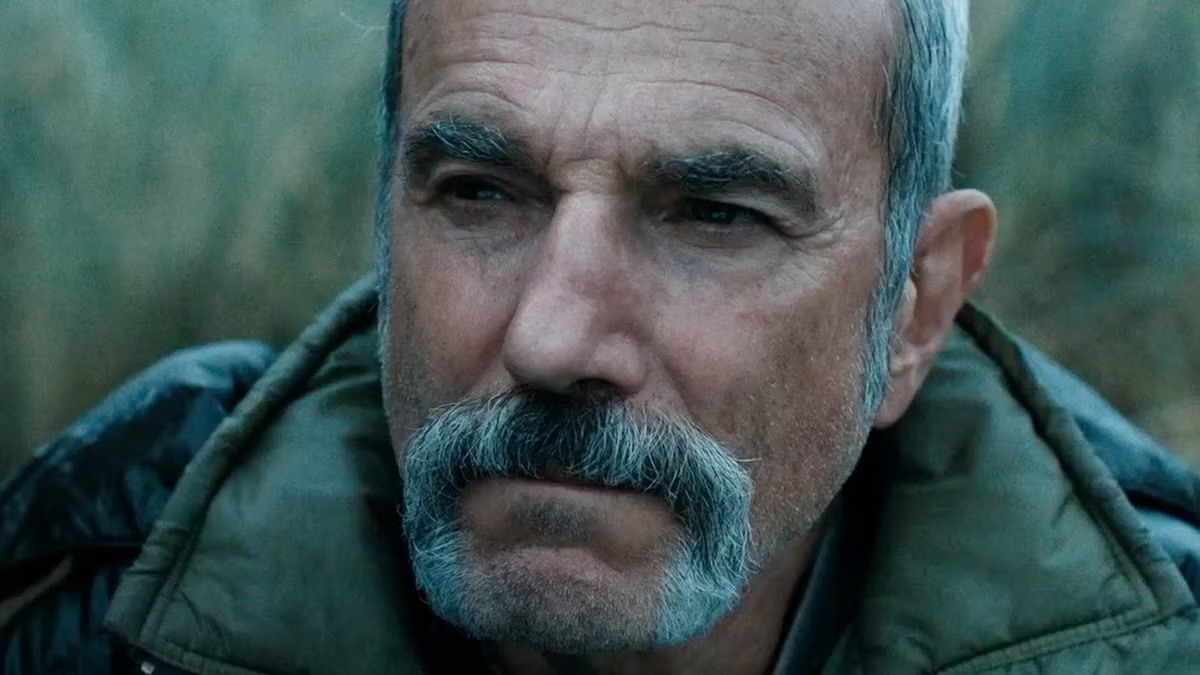

There's an interview clip floating around this week where Oscar-winner (and one of our best living actors) Daniel Day-Lewis takes umbrage with having the term "retirement" attached to his recent hiatus from acting. Instead, the actor, who hasn't been seen on screen since 2017's Phantom Thread, gently insists that he just sometimes would like to pursue other interests for a time. It's our great luck that his interests have circled back to acting and, in the case of Anemone, co-writing the original script with his son, Ronan Day-Lewis (who also makes his feature filmmaking debut). A dark, quiet film (there's hardly any dialogue in the first half hour) about a family torn apart by history and the choices made during the most difficult of circumstances, its two hours is essential viewing if only to watch the elder Day-Lewis provide a masterclass in screen performance. That the filmmaking is at best choppy and at worst heavy-handed is an unfortunate distraction, but overall the story the father/son duo has crafted remains a powerful rumination on generational trauma and grief.
Day-Lewis is Ray Stoker, a former soldier in the Queen's army who fought during the Irish Troubles and saw combat horrors of which only he knows the extent. In a relationship at the time with Nessa (Samantha Morton), his return to civilian life is rocky at best and not long after he's back home, he leaves again, choosing to exile himself to the remote woods and leaving Nessa and their unborn child behind. Twenty years later, their son, Brian (Samuel Bottomley) is grown and struggling with his own demons, several of which are the result of knowing his father abandoned him in shame. He's been raised by Nessa and her new partner, Jem (Sean Bean), who happens to be Ray's brother. This tangled web of relationships comes to a head when Jem sets out to find Ray and make him aware of just how badly the son he's never met is doing.
Zooming out, filmmaker Day-Lewis takes a big swing in an effort to infuse the film with importance; there are a lot of dramatic establishing shots, from the forest treetops writhing in strong winds to a symbolic dead fish floating by Ray as he stands by a stream contemplating life. There are odd cues in the score that sometimes don't fit the action on screen; at least once, I wondered why two tracks in particular weren't swapped. Further, he's inclined to linger...and linger...on a moment, as if to say "are you watching this? do you understand the importance here?" and after a while, it all gets a bit tiresome. But only a bit, because in between, he and his father have crafted a multi-layered, multi-generational story of trauma and guilt that asks real questions about war, masculinity, fatherhood and what we're willing to give up for the sake of others.
Once Jem has found Ray and the small cabin he keeps deep in the woods, the film alternates between their interactions reconnecting and reminiscing and Nessa navigating Brian's descent into depression following an incident at his own base where he's enlisted as a soldier himself. Both sets of interpersonal interactions are compelling, and though the film does a lot of telling in recounting what they've each gone through, it's forgiven when it's Day-Lewis and Morton doing the telling. They are endlessly watchable and evoke such emotion, it practically radiates off the screen.
Though it may be because he co-wrote the script, there's nevertheless a sense that Daniel Day-Lewis is the only person who could have played this role, he makes it feel so lived in and authentic. The younger Day-Lewis is wise to give most of his monologues the close-up treatment, as it gives us a sense we're sitting right across from this master at work, and it's riveting. It's the way the lives of these two men who've never met—one looking back on actions he can't undo and another frightened of what his future might hold—intertwine and ripple out to those around them that makes Anemone a soulful first outing for a filmmaker still honing his skills.
Anemone is now in theaters.
If you enjoyed this post, please consider supporting Third Coast Review’s arts and culture coverage by making a donation. Choose the amount that works best for you, and know it goes directly to support our writers and contributors.
