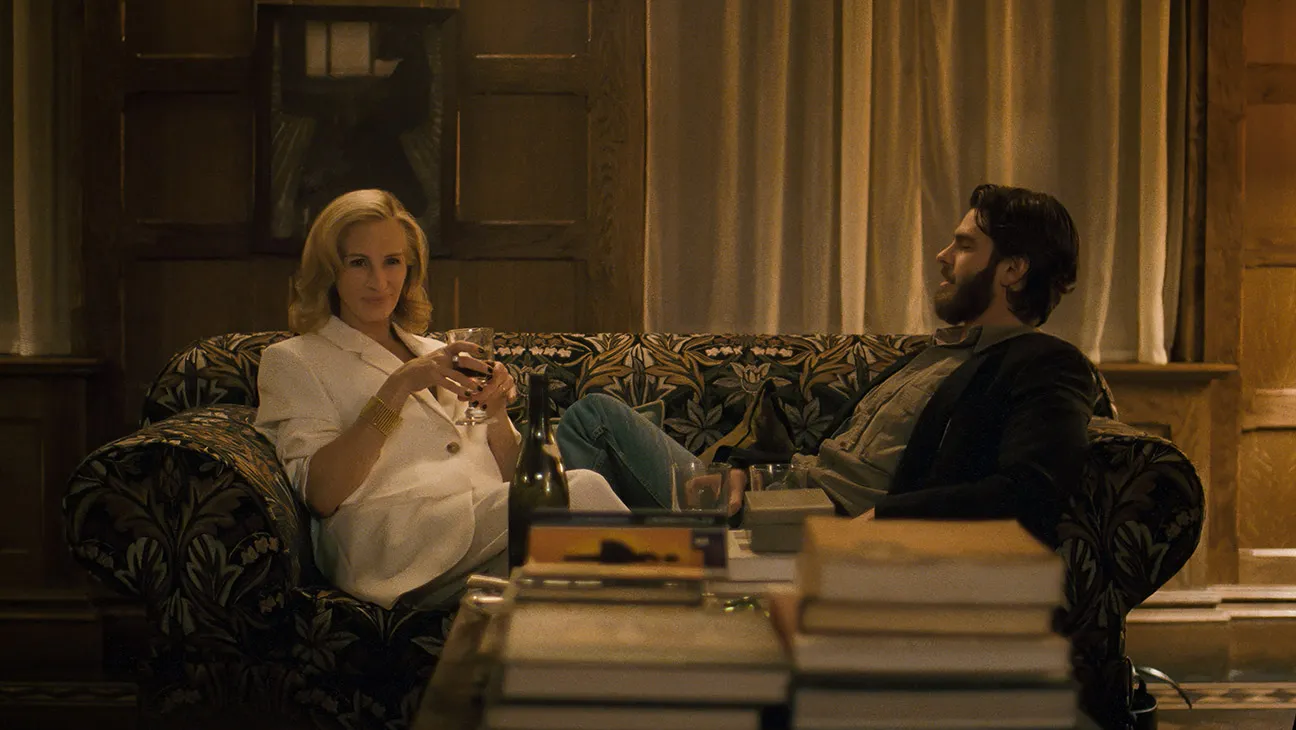

It would appear one of the hottest tickets for an actor these days is a Luca Guadagnino gig: Daniel Craig recently starred in Queer; Challengers featured Zendaya and Josh O'Connor; he re-teamed with Timothée Chalamet for Bones and All; and most recently, the one and only Julia Roberts shows up in After the Hunt, a timely and sharp take on #MeToo, "woke" culture and the intergenerational clash happening on college campuses across the country. Written by first-time screenwriter Nora Garrett, Roberts stars alongside Ayo Edebiri (The Bear) and Andrew Garfield (We Live in Time, the Spider-Man films) in a drama set in the philosophy department of Yale University where students and faculty mingle socially as much as they lecture and learn together.
As professor Alma Imhoff, Roberts is a woman who knows herself and her environs; she's well-established at the university but not yet tenured. In fact, she and colleague Hank Gibson (Garfield) are waiting to hear which of them will be selected for the position this year. Nevertheless, Alma is the doyenne of the department, swanning between the vintage apartment she shares with her husband, Frederick (Guadagnino regular Michael Stuhlbarg) and her campus office and lecture rooms in tailored blazers and custom jewelry. She and Frederick host department social gatherings where the martinis and conversation flow and, this being the philosophy department, the conversations are usually quite heady between Alma, Hank, their colleagues and the select students lucky enough to join them. Among the star pupils is Maggie (Edebiri), a young woman Alma has forged a connection with that goes beyond the classroom; at the cocktail party that opens the film, we learn they're genuinely friends as well.
Well, as friendly as two people at opposite ends of a power dynamic can be. And that's the central theme of After the Hunt, the clash of power dynamics and whose narrative gets to be the truth. When Maggie accuses Hank of inappropriate behavior, their tight-knit, small academic world is sent careening into a complicated web of egos and he said/she said, with each of them confronted by ugly realities they've become experts at otherwise ignoring or, perhaps more accurately, pretending like they are actually more enlightened than they really are. If Alma and Maggie are friendly, Alma and Hank are brushing right up against the line of inappropriate; a generous reading would be what some call "work spouse," but there's clearly a strong current of sexual tension between them. Is that because there's a history there, or because Hank's language for moving through a world of intelligent, attractive women is flirting and flattery?
Though some may disagree, I find the controversies and questions at the heart of After the Hunt to be quite intriguing; in a post-#MeToo world, in an era of "if you don't include me, you exclude me" thinking, the film uses generational, gender and racial differences to call out the stark contrasts in worldviews that are being asked to co-exist in today's ultra-connected world. The players here, enmeshed as they are in a world where they do little else but...think, are better positioned than most to grapple with the nuances of modern relationships, politics and the ripple effects of a single act, perhaps to their detriment; there are certainly moments where the proceedings descend into navel gazing, but for the most part, each of these characters—Alma, the righteous Gen X stalwart; Hank, the elder Millennial charming his way through the world; and Maggie, the Gen Z-er quite comfortable on her high horse—stays solidly in their lane and it's fascinating to watch them collide in messy, unexpected ways.
This lead trio—Roberts, Garfield and Edebiri—are an odd casting choice at best, yet somehow it works. Roberts does her best work since Erin Brockovich as a woman pushed to her limits and forced to confront both the lies she's been telling herself for years and the frustrations that come with molding young minds of a different generation. At first glance, Garfield seems a bit miscast in a role that is part lothario, part victim, but per usual he rises to the occasion and the age discrepancies between him and the two women is ultimately a key factor of the film's skeevy-ness (yes, it's a word). And I'd be the first to admit that I'm still on the fence about Edebiri, an actor who for the most part is always the same no matter what her role; here, however, she seems to be gleaning a bit of wisdom from her more seasoned co-stars and a singular directorial talent and she actually manages to be something a bit different than we've seen before.
There's no easy way to tackle the big, messy questions After the Hunt tries to investigate, and there are certainly moments when its narrative falls into cliché, minimizing important broader conversations and opting for melodrama over authenticity. And yet, Guadagnino does strong work in realizing Garrett's timely and fraught script into something engrossing in its ugliness (while at the same time being quite beautiful to look at, an odd but not unwelcome juxtaposition). The reality is that we live in a world of shifting shared priorities and evolving language around complicated issues, and what After the Hunt gets right is that there is never one singular version of an experience, never one absolute truth in these matters. It may have its shortcomings, but in the end, After the Hunt is one of the better interpersonal thrillers seeking to hold a mirror to these complex issues and its strong cast only helps its case.
After the Hunt is now in theaters.
If you enjoyed this post, please consider supporting Third Coast Review’s arts and culture coverage by making a donation. Choose the amount that works best for you, and know it goes directly to support our writers and contributors.
