
Richard Linklater’s been busy. The Austin-based filmmaker has a number of films both in the works and coming soon; his two latest are both centered on artists, albeit at very different moments in their respective careers. Nouvelle Vague, the story of French New Wave pioneer Jean-Luc Godard’s feature filmmaking debut, Breathless, will released via Netflix yet this year. Starring frequent collaborator Ethan Hawke, Sony Classics will first open Blue Moon, a Broadway-based chamber piece that takes place on the night of March 31, 1943, the opening night of the soon-to-be Rodgers & Hammerstein hit Oklahoma!
Taking its title from one of the best known songs created by the songwriting duo Richard Rodgers and Lorenz Hart, Blue Moon is told from the perspective of the latter as he faces one of the most difficult nights in his career: his longtime writing partner has moved on and is about to catapult to levels of fame Larry could only imagine. Since Hart stood just five feet tall, Hawke is not a likely choice for the role, but Linklater and his team use some creative tricks of the camera (and CGI) to create the illusion that the five-foot-ten-inches-tall Hawke is Hart-sized. He’s also balding with a combover and wearing an ill-fitting suit; all this plus Hawke’s endless watchability as an actor make the film a compelling viewing for Broadway babes like me, even if the proceedings do get a bit stale after a while.
Hart, who collaborated with Rodgers (played here with biting resentment by the great Andrew Scott) on shows including Babes in Arms, The Boys From Syracuse, Pal Joey, and On Your Toes, was known for being a talker, a drinker and a partier, a creative whose work ethic often took a back seat to his social calendar. Though he never came out publicly (this was the ‘30s and '40s, after all), the film plainly mentions the curiosity of his sexuality, one his peers and the press often made assumptions about. Following a brief prologue, we meet Hart while he’s in the audience at Oklahoma! and he just can’t take it any more; he kisses his mother on the cheek and excuses himself to the downstairs bar at Sardi’s, the legendary Broadway watering hole down the street from the St. James Theatre, the bar with caricatures of every notable star on the Great White Way adorning its walls.
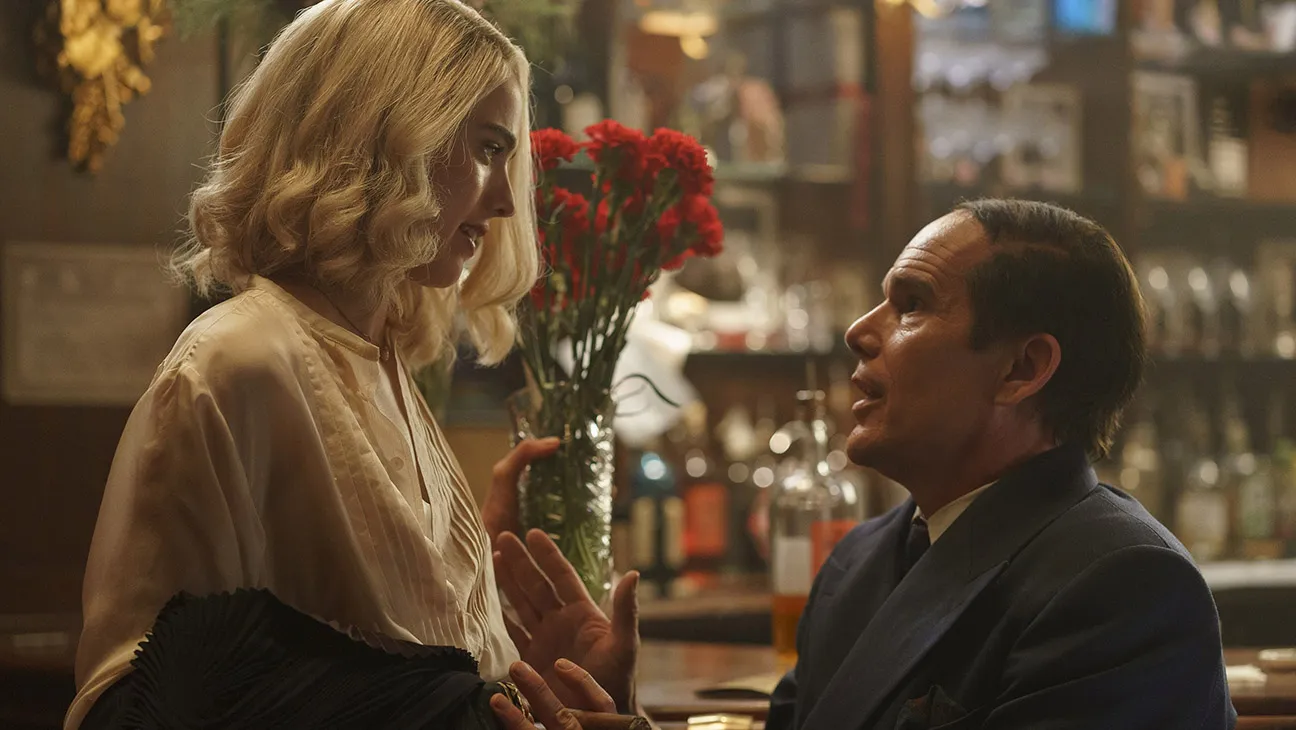
There, he’s greeted by benevolent bartender Eddie (Bobby Cannavale), who knows him so well he knows Hart is trying to stay on the wagon; when Hart asks for a shot of whiskey, Eddie only gives it to him when he swears he just wants to smell it. The first 15 minutes of Blue Moon are Hawke as Hart simply holding court in the nearly empty bar as the show finishes nearby. There’s Eddie behind the bar; an unnamed Cigarette Girl (Caitríona Ennis) preparing for the post-show crowd to arrive; Troy (Giles Surridge), a soldier home on leave playing the bar’s piano (which provides the film’s ambient score); and E.B. White (Patrick Kennedy), the writer Hart tries to convince of Oklahoma!’s shortcomings. Before long, Hart is regaling Eddie and crew with tales of Elizabeth (Margaret Qualley), a 20-year-old co-ed he’s infatuated with even though she’s keeping him at arm’s length.
The greater challenge with a chamber piece like Blue Moon is keeping the visuals interesting and engaging for the duration of the film; from what I know of my many meals and cocktails at Sardi’s, Linklater and his production designer Susie Cullen take some liberties with the floor plan, expanding the downstairs bar quite a bit. It makes sense, and yet the location still becomes frustratingly claustrophobic; we never see much of the restaurant's large downstairs dining room and when Rodgers, Hammerstein (played by Simon Delaney, whose tall, broad stature is a stark contrast to puny Hart) and their party do show up post-curtain call to celebrate the opening and await the first reviews, they head to the upstairs bar and dining room and we are left behind.
But in the end, that’s because this is Hart’s story, and as his ego takes more and more hits (as Oklahoma! receives ever-more-glowing reviews), it’s all he can do to stay upright let alone join the party. Hawke is on screen if not the entire film, close to it, and though he plays the role fiercely and with a great vulnerability, Hart’s own victimhood and inability to get out of his own way becomes tiring. Much of the movie is Hart talking at people, regaling them with stories and anecdotes they didn’t ask about. Hawke manages to create a character of an era, to be sure, one that many of his costars (I’m looking at you, Qualley) can’t similarly evoke. The film’s most delicious moments are when Hart does finally connect with Rodgers, who is clearly at his wit’s end with his longtime partner (and we are beginning to learn why). Scott is one of our best living actors, and his ability to channel emotion in a word, a look, a moment is unmatched here yet again.
Ultimately, Hart’s is a sad story, as his own demons would catch up with him not long after this fateful night. As a chronicle of a very specific (and significant) moment in the history of American Musical Theater, Blue Moon is a treasure of a film for Broadway nerds like me. There are Broadway Easter eggs throughout (a certain young neighbor of Hammerstein’s shows up, which made me hoot!), and Linklater clearly appreciates this era of American creativity and creation. By focusing on Lorenz Hart, he allows us a way into this world through someone who is flawed but earnest, grasping for something, anything to help him find his way back to the spotlight the only way he knows how. How successful he is, ultimately, is only up to him and his ability to tame his inner demons—and ego.
Blue Moon is playing in theaters.
If you enjoyed this post, please consider supporting Third Coast Review’s arts and culture coverage by making a donation. Choose the amount that works best for you, and know it goes directly to support our writers and contributors.
