
Writer/director Guillermo del Toro has had a vision for his telling of author Mary Shelley’s Frankenstein for a couple of decades—not just the makeup and production design but also what themes to be emphasized. He's said that he's always seen the story (originally told in the book Frankenstein; or, The Modern Prometheus) as one about what it means to be human, and how, if you can’t die, that takes away your humanity: what makes life so significant is that it will eventually end, and we all have a limited time to do what we were put on this earth to do. But the Creature in Frankenstein (as portrayed beautifully in Del Toro's version by Jacob Elordi) can’t die, and thus, can’t be fully human. And when it realizes this, its heart breaks and it becomes full of rage, as one might.
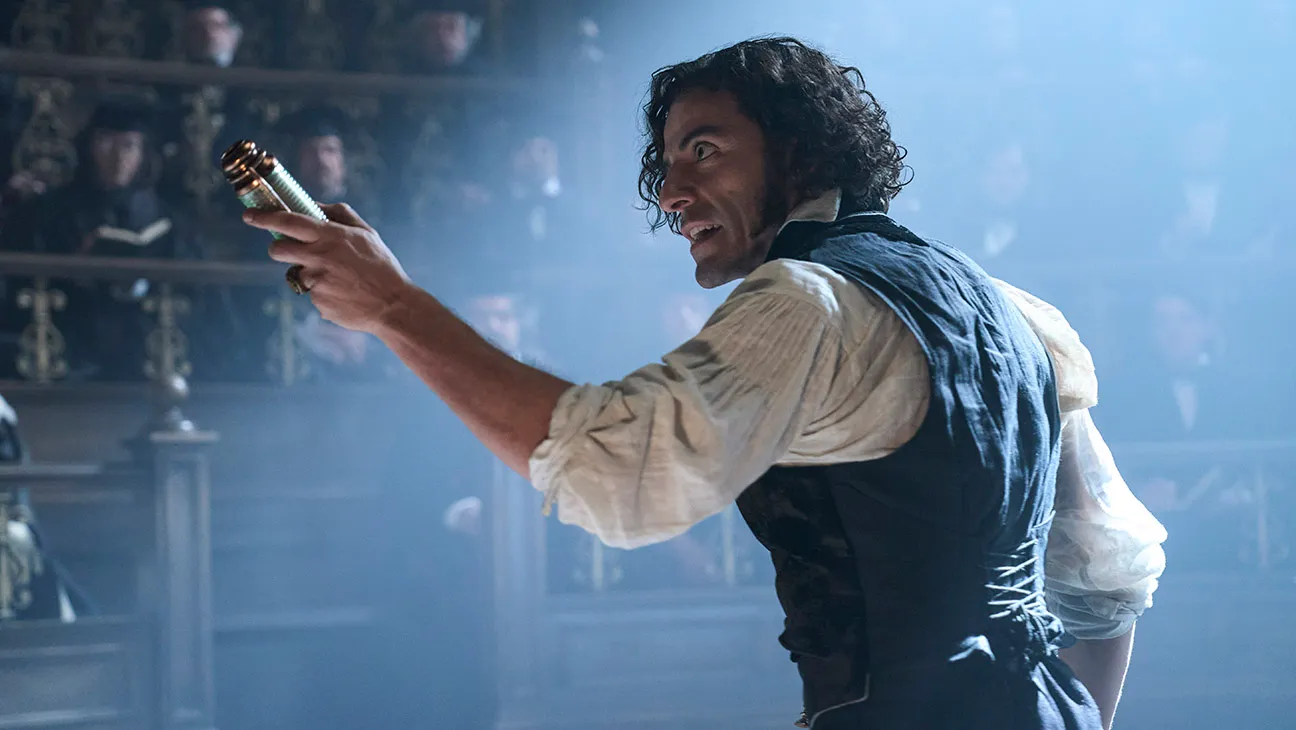
As the framework for his telling, Del Toro uses a ship stuck in the Arctic ice, which is attempting to dislodge itself, as the place where a story will unfold—two stories, actually. When an explosion occurs in the distance and a search party investigates, they find a man unresponsive: Victor Frankenstein (Oscar Isaac), who begins spinning the long story of how he got there to the ship’s captain (Lars Mikkelsen). As many stories do, he begins at the beginning, and we meet young Victor (Christian Convery), his adoring mother (Mia Goth), his younger brother William, and strict doctor father (Charles Dance), who pushes Victor into the medical field. But when his mother dies while he’s still a boy, Victor becomes obsessed with how to bring dead tissue back to life, and he begins experimenting in medical school. One of the best early scenes involves Victor giving a presentation on his work and graphically bringing back to life half of a corpse.
Someone curious about his work is a man named Harlander (Christoph Waltz), who becomes Victor’s benefactor after the school kicks him out. Eventually, we find out why Harlander is so interested in Frankenstein’s work, but by then, Victor already has his first successful attempt at regenerating stitched portions of other bodies. With his Creature chained up in the lower levels of Harlander’s castle, brother now-grown William (Felix Kammerer) and his bride to be Elizabeth (also played by Goth) arrive for a long-overdue visit, and when Elizabeth discovers the Creature, she immediately feels empathy for this scared, confused experiment.
The film is split in half, with the first part being told from Victor’s point of view, and the second being conveyed by the Creature about his journey to the Arctic to track down Victor. Elordi brings true humanity to his Creature portrayal, which incorporates pathos with violence, super-human strength, and a healing ability that makes it impossible to be killed by conventional means. After setting fire to the castle and running away to stay with his brother in the time leading up to his wedding, Victor thinks the Creature is dead when in fact, it has retreated to a nearby farm where it meets an old blind man (David Bradley), who teaches it to speak and behave more gently, especially around others. But he also instills in the Creature a sense of what life is, and it’s this knowledge that might be its downfall, making it clear that Victor is the story’s true villain and not the monster.
Throughout Frankenstein, the production design, practical special effects, and costumes are a wonder to behold. Goth’s Bride of Frankenstein-inspired wedding dress alone should get costume designer Kate Hawley an Oscar nomination. My only major issue with the film might be Isaac’s exaggerated, melodramatic performance, which would seem appropriate for the material, except no one else in the cast is acting at the same temperature as he is, which is all the way up. It’s not a terrible performance, but if frequently comes across as wildly out of place in the context of this specific telling. Still, with Elordi’s career-best performance dominating so much of the film’s second half, it’s hard to complain. Del Toro doesn’t go wildly astray from the Shelley text; if anything, his is a fairly faithful adaptation. But hearing the Creature talk so eloquently and spout philosophy and considered opinions might be jarring to some. This is not your grandparents’ Frankenstein, and that’s high praise.
The film is now streaming on Netflix and is still playing in select theaters.
If you enjoyed this post, please consider supporting Third Coast Review’s arts and culture coverage by making a donation. Choose the amount that works best for you, and know it goes directly to support our writers and contributors.
