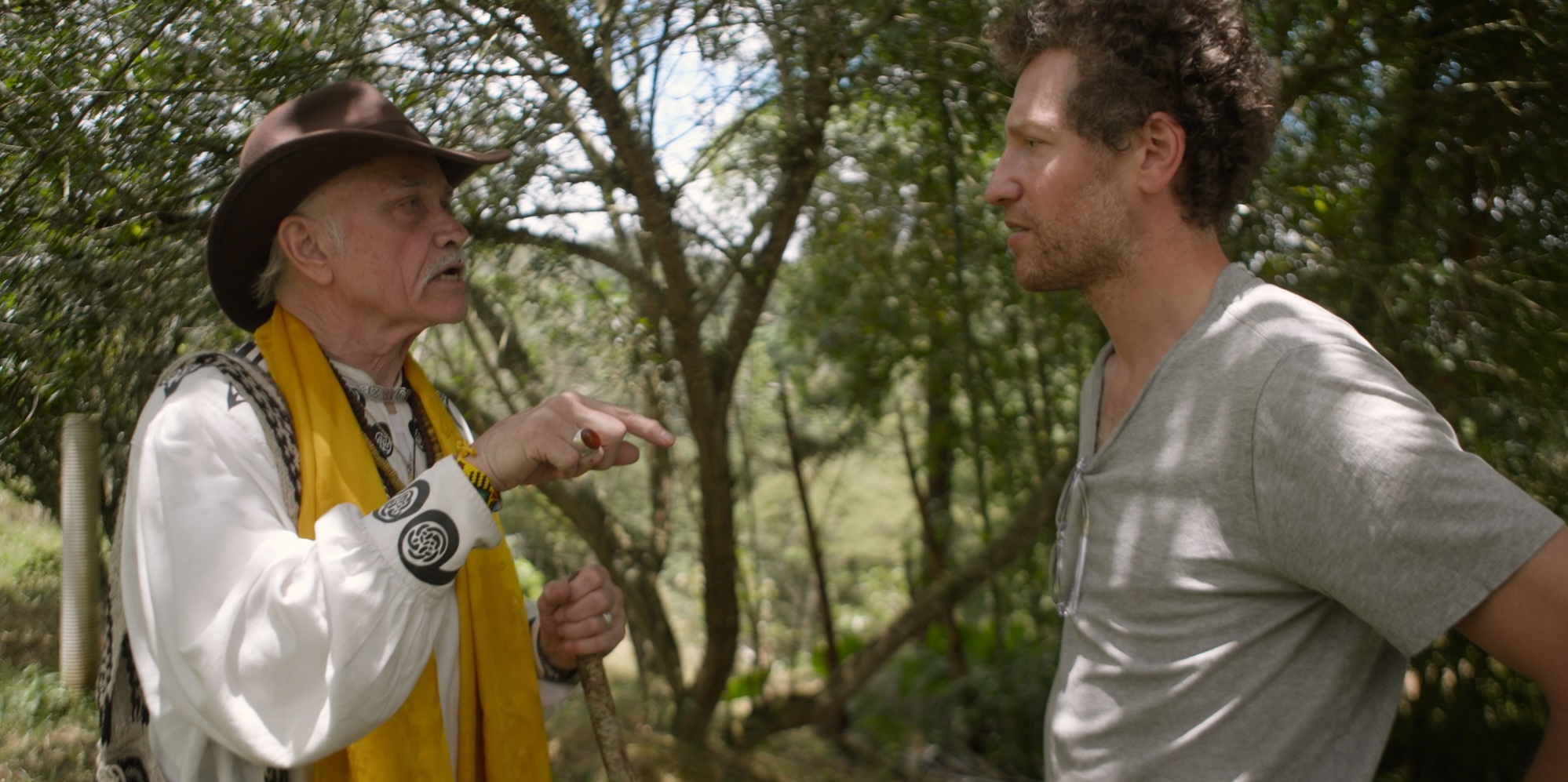
“Patrick is probably the most extraordinary person I've met.” — Jane Goodall
The above quote was made about Patrick McCollum, whose list of jobs, experiences, and titles is not only lengthy, but also improbable. But most importantly to the following interview, he’s the subject of a fascinating new documentary from writer/director Gabe Polsky (Red Army, In Search of Greatness, Butcher’s Crossing), who has deep roots in the Chicago area.
The Man Who Saves the World? (the question mark is intentional) is a film that tracks the most recent chapter in McCollum’s life, in which the Indigenous Elder of the Amazon, including the Kogi tribe in Colombia, believe he fulfills an ancient prophecy: to unite the tribes of the Amazon in a fight to save the rainforest. Much like some of his other roles in life—carnival worker, jewelry designer, kung fu master, reverend, pagan ritual leader—McCollum takes this one seriously, and has actually made great strides in uniting the tribes for the first time. And for some reason, he’s letting the initially skeptical filmmaker Polsky (who narrates and is frequently seen on camera) follow along.
Produced by the likes of Peter Farrelly, Danny McBride, David Gordon Green, and Jody Hill, the documentary follows Polsky into the Amazon, a journey that raises as many questions as it answers. The film is funny at times, shockingly revealing, and in the end, we discover that many of McCollum’s claims about his life experiences are true, though that never quite erases our ability to ask if all of what we’re seeing and hearing is equally true.
Or is the problem that we, the audience, are too cynical and too far removed to see what's right in front of us?
The film is set to open in Chicago at the AMC River East this Friday, Nov. 14, with Polsky and McCollum on hand for a post-screening Q&A on opening night. The film will also play at the Wayfarer Theaters in Highland Park, beginning Nov. 15, with another Q&A on that day.
I had a chance to talk with Polsky (as I have several times in the past) about his film, his ever-evolving relationship with McCollum, and his ability to make the profound blend with the seemingly absurd. Please enjoy our conversation…
The thing I love most about interviewing you about your documentaries is that even after you’ve finished the film and we’re here talking about it, I get a sense that you’re still working out some of the themes in your head. You’re still in it and making it. Maybe no more so than with this film. Does that feel accurate?
Yeah, it does. I’m still unpacking it.
The first question I want to ask you is about a question. You have a question mark at the end of this title. Why is that? Are you still not convinced? What is the reason behind that?
There are two reasons. I do have a little bit of doubt, but that doesn’t mean I don’t believe it. But also, if you have a title like that and you don’t have a question mark, it’s a little dangerous. I want to let the audience decide and I don’t want to be the guy that just declares that he saves the world. That’s not the movie. And he hasn’t saved it yet, which is why it’s “Saves.” It’s a little humorous in way, which is an important part of the film too.
Was the question mark always there when you were coming up with a title, or did you add it later?
I remember it always being there.
Let’s go back a bit. How did Patrick McCollum’s story first cross your path? And what about him made you think he’d be an interesting subject for a doc?
Yeah, I’d never heard of him before, and I wasn’t looking to make a film like this necessarily. In hindsight, it does capture my voice maybe more than any of the films I’d done before—the humor, the bizarre nature. It came out of the blue; it was a call from a producer colleague who was an executive producer on Jimmy Kimmel, and he said “There’s this really weird story; I don’t even know how to pitch it to you, but would you be open to getting on a call with me and these guys?” And one of them was Patrick McCollum, and they started telling me this story. They weren’t telling me in the context of Patrick being this special guy; it was more about this prophecy about uniting the tribes. Initially, I thought they were crazy, I’d never heard of it, and I’m not one to believe prophecies, but I was curious to continue hearing them out, meeting them. What I realized was that Patrick is a fascinating guy, and just being with him made me learn a lot because he’s a wealth of knowledge and he’s done everything. So that kept me engaged.
So I started checking out some of this stories, which were so weird, and I started connecting with some Indigenous folks, verifying information. And I went more and more into the rabbit hole until they invited me to Columbia with them to start unfolding the prophecy. There was no point where I felt comfortable telling this story; I was more wondering what I was doing and was I wasting my time.
That’s what I’m curious about. You could still be shooting today because his work isn’t done. How did you know when it was time to step away from shooting and start constructing this film?
Well, I was constructing it while I was going. I probably shot about half of it or more, and I don’t want to sit on a film for years and not finish it. But you start asking “Where is this going? What’s the ending?” The ending started becoming clearer, and that confrontation helped in the last part of it where he does what he said he was going to do, and this big thing actually happened. It’s for the audience to decides what it is, but it did look like a good way to end it. And toward the end, I was getting frustrated, like “What’s going on here?” So it was a good time to step away and see what I had.
That did seem like a natural place to end this story because even if it’s only the first step in saving the Amazon, it’s a huge step. And good things will probably come of that outside of this big-picture goal. But the Amazon is still in danger, so you could follow up on this if you wanted.
Yeah, I’m also seeing Patrick quite a bit, now that we’re out supporting the film. So I’m getting updates all the time. He’s an incredibly optimistic guy, so while this is happening, he still talking to various elders and continuing to do this and making big waves.
You said this felt like your most personal film, and it is if only because you’re a part of it and you narrate it. This is very much a journey the two of you take together. And you’re a stand-in for the audience by bringing a skepticism to his stories about his life. Going into this, how skeptical were about the things he was claiming, and was there something that shifted you into a believer?
I was incredibly skeptical, but everything he says has truth in it. He’s not a crazy guy; he might embellish here and there, and I called all of these people to verify facts, and he did a lot of these things. So that was helpful. And having Jane Goodall…
Having Jane Goodall in your movie talking about him so glowingly certainly upped his credibility in my eyes. I’m sure it did the same for you.
Yes, and there are a lot of people like that, but she was a great figurehead and great for the film in that moment, because it was getting insane at that point. The things he says like “I’m a king in Africa,” it sounds big and crazy, but it tells you a lot about the nature of this film. When you think of a king, you think it’s something huge, but some kings in Africa have a tiny village and sit around. It’s not always what we think. So yes, he is technically a king. And what does saving the Amazon mean? It doesn’t have to look like this grand thing that we envision; it’s just people uniting. How do big deals get done anywhere, Silicon Valley? It’s probably two guys getting together on a golf course. It’s the magical and the mundane.
Anytime you throw the word “prophecy” into the conversation, I’m sure 50 percent of the people watching this movie will think it’s nuts. How do you prevent that loss of believability when that word gets thrown into the conversation?
A lot of people are curious about prophecies; that’s the sexy part of it that gets people in. Honestly, I think more people than you believe are open to that idea. It's just being able to see into the future through oracles or prophets. Do you believe that it’s possible to see the future, or that some people can do this?
Honestly, not as a rule. But when I watched this film, I felt like I was watching Patrick—in small but real ways—rewire your brain a bit and maybe make you open to these things. And maybe you came out of this experience looking at the world differently. And I feel like if I spent time with somebody like that, I might also feel that way. Is that essentially what you went through?
Yeah, I think so. I think I’m more open to things that might have magical qualities. By that I mean things that are unseen and we might think are coincidental. There’s a lot happening that we can’t perceive, and science event admits that. We just don’t know what’s going on. So I guess my appreciation for that and that magic and ability to access it, being among Indigenous people who have a much deeper connection to the earth and animals. It’s a deeper perception, and that’s opened me up a little more. But like you and everybody else, I’m not going to believe everything. I’ve gone deeper into the unseen and unknown.
While I was watching this film, I couldn’t help but think about your other film, In Search of Greatness, which is also about that unknown and unnamed quality in great athletes that makes them the best in their field. This sort of search is not new for you.
That’s super interesting that you bring that up, because all of these guys in In Search of Greatness, they aren’t what we expect out of the great athletes. We expect these superhuman people who are the fastest, the strongest, but these people were just different and saw the world differently. You can’t be the greatest by copying what everybody else is doing, and here in this story, Patrick is this outlier. You wouldn’t expect a guy like that to be doing what he’s doing, but he’s just doing it in his own way. There are definitely aspect that what you’re saying.
Do you think that Patrick has that quality, that Greatness quality you were searching for and trying to identify?
I think he’s got an element of that, for sure. Like anything in life, it’s hard to know if somebody is going to be the greatest of all time until they get the right opportunity. In hindsight, we always say “Of course.” Patrick has unbelievable skill and knowledge; he’s capable. But you need other elements to come into play as well. But he’s on his way .
It seems like all of the work he’d done up until you were introduced into his life was done quietly, off the radar, not looking for publicity. How has he been with this level of exposure, especially now that the two of you are on the road with these screenings? Is he okay with that?
We’ve been slowly releasing the film through events in L.A. and New York, different places on the West Coast, but he’s excited that the word is going to spread wide, and he’s doing what it takes to get the message out about Indigenous people. He’s happy about it. He worked in the carnival when he was a kid, maybe 13-14, so he knows what it’s like to put on a show and get people interested. So he’s bringing some of that back.
He has a showman and a shaman quality to him.
Exactly!
I have to ask about the scene where you basically blow drugs into your own nose. Now that you are hopefully clear-headed from that, what happened to you in that moment?
I was obviously really afraid because I’d never done that before. It was a really strong Indigenous tobacco, 10 times more powerful than a cigarette, which is nothing. But I think it’s semi-psychedelic, but not like mushrooms or acid, but you are in something like an altered state. Since then, I’ve experimented a little deeper with other medicines. There was one time when Patrick and I were together in Columbia, and one of these Indigenous elders had a pipe that was like two feet long, with similar tobacco, and he blew it into our noses, and it felt like it went straight into our brains. For literally 24 hours, we were both puking our brains out. They do this, but it’s offensive if you say no. For all I know, he poisoned us, but I think we just weren’t used to it.
As serious as the work is that Patrick is doing, the movie also has a lot of very funny moments in it, I think by design.
That was definitely part of because it was funny and bizarre and absurd. One thing Patrick was surprised about initially was how much people were laughing in these screenings. Now he says that he laughs.
In the end, as I was contemplating how I felt about the film, I thought “Nothing else is working to save the Amazon; why not give this guy a shot?” That was a good feeling.
Absolutely. He’s inspiring what’s he’s trying do through resilience, and it’s selflessness. We can think about him what he want, but in the end, what the guy is doing is spending his life and money trying to do something. My favorite thing is when I get on the phone with someone like you, and I see what your first reaction was to this, because I know this is weird.
You might be the master of capturing the weird, both in your feature films and your documentaries. You produced a Bat Lieutenant movie that Werner Herzog directed; that’s pretty weird.
That’s true. I actually did show this to Herzog; I try to show him all of my films before they’re done. And this one, he looked like he was in pain watching it , and I’m like “What’s going on?” And he said, “I don’t think this one’s for me, Gabe.” And he said the reason was that Patrick reminded him of his dad too much, and his dad got back from World War II and was basically a storyteller, but everything he said was bullshit. He would make up these stories, and the kids would say “Dad, what are you talking about?” And his dad would look at them with blank eyes. I found that so interesting because some people have described this film like something Herzog might have done, so it’s a little ironic.
It was great seeing you again; best of luck with this.
You too, Steve. Thank you again.
If you enjoyed this post, please consider supporting Third Coast Review’s arts and culture coverage by making a donation. Choose the amount that works best for you, and know it goes directly to support our writers and contributors.
