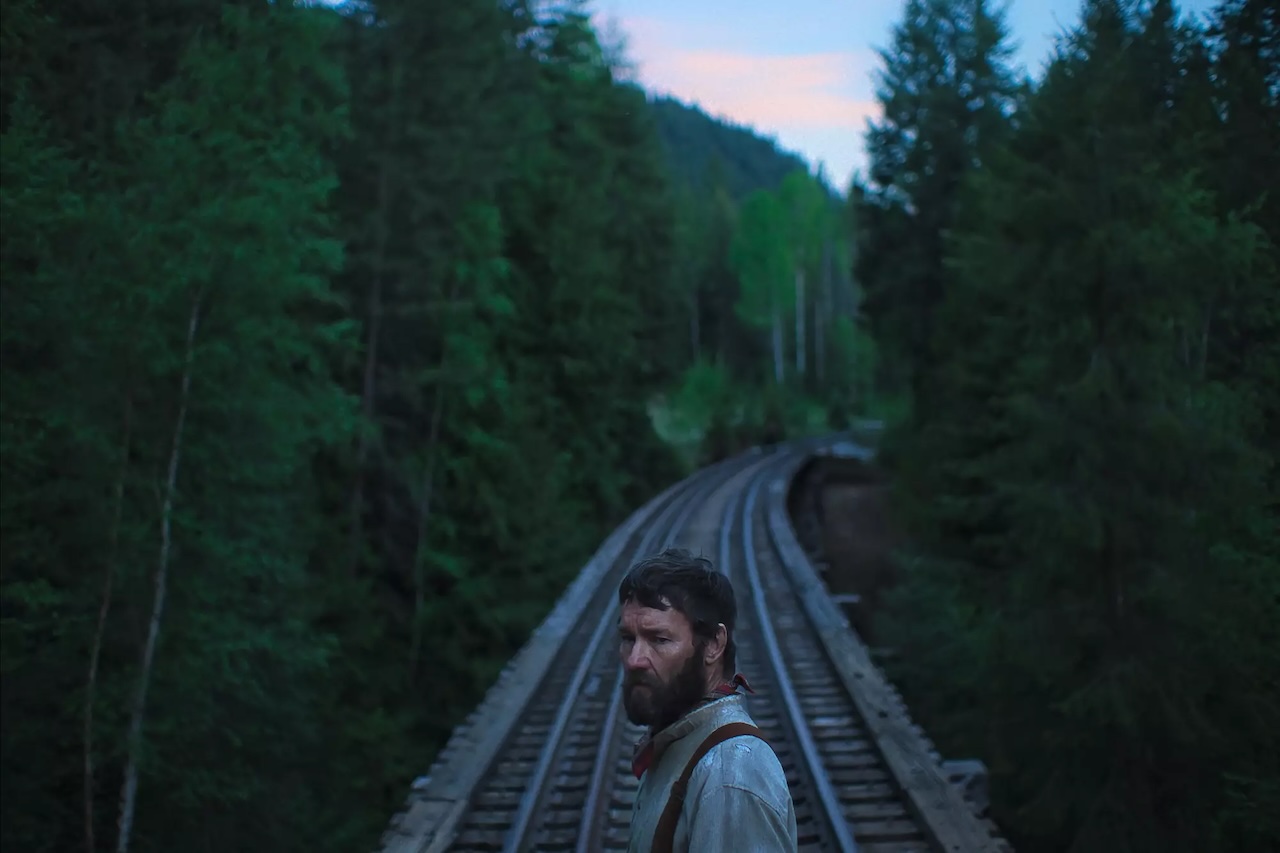

I sometimes think about the shrinking of our world. Each leap in transportation—trains, cars, planes—has made trips shorter and less significant, sapping our sense of wonder. Werner Herzog once said, "The world reveals itself to those who travel on foot.” Train Dreams, directed and adapted by Clint Bentley, is about a man who walks.
Based on the 2011 Denis Johnson novella of the same name, the film follows Joel Edgerton’s Robert Granier. The opening montage and voiceover present the basics on this man: he never knew his parents, he doesn’t know his age, and he has no great aspirations. That is, until he meets Gladys, played by Felicity Jones. Their touching “engagement” under a golden-hour sky lays down the emotional anchor of the film. They resolve to build a life free of confusion or pretense.
In Train Dreams, everything true stems from the natural world. Not always good, not necessarily bad, but true. Granier works as a logger, felling trees to satisfy the industrial restlessness of early-20th-century America. He tries his hand at railroading but finds the metal laces constrict his soul. He turns away from the so-called “progress” mankind touted at the time. The voiceover drives the spike home: That railroad will become outmoded by a concrete highway just years later. It’s this cycle of disposability that stifles the voice of the planet.
Terrence Malick’s work with cinematographer Emmanuel Lubezki appears to be a touchpoint for Bentley and his DP Adolpho Veloso. Wheat sways, leaves rustle, skies shimmer, and people stare. The aesthetic serves this sparse story well, but it sometimes outweighs the thematic content of the film; we spend quite a while watching Granier study his natural surroundings, without much new conveyed narratively. Not every filmmaker can imbue moments of rumination with as much meaning as Malick does. If something like To the Wonder is a breeze, then Train Dreams is a vapor. We get a whiff of the complexity in the protagonist’s head, but not much more.
Edgerton is a sturdy actor, always a welcome presence. An Australian, he affects an American accent here that sounds just like Steven Wright’s radio host of K-Billy’s Super Sounds of the '70s in Reservoir Dogs. It turns out this dry timbre is just as good at describing crushing grief as it is at providing ambivalent commentary on torture. Edgerton’s prodigious beard, gathering grays throughout the runtime, also proves a commodity for this insular man enduring the march of time.
William H. Macy provides a welcome flicker as TNT specialist-cum-philosopher Arn Peeples (now there’s a character name). Peeples acts as a pivot for the film’s philosophy, waxing poetic on the earth and trees while earning his keep by blowing them to kingdom come. As the movie reveals, nature has much the same capacity for serenity and destruction. Few are better than Macy at tossing off wisdom with such wit and casualness. I cherish him as a performer.
Sometimes, the film’s indie trappings let it down, as in the visual effects during a natural disaster sequence feeling too sterile to land the wallop they need to. The modest budget may be to blame there. The score also tends to lean a bit too cutesy for my taste. (I admit the “N” before the opening credits may be swaying my judgment. We know what that stands for, Netflix.)
Train Dreams is a lovely poem. It’s a sketch of a life and, as co-writer Greg Kwedar put it before the 35mm Music Box screening on Saturday, “an epic in miniature.” Before we even get an image, we hear nature’s own logger, the woodpecker, at work. The universe ebbs, flows, creates, and destroys, often without meaning. But there’s some kind of order and comfort in the mystery.
Tickets to 35mm screenings of Train Dreams are available through the Music Box Theatre. The film will stream on Netflix starting November 21.
If you enjoyed this post, please consider supporting Third Coast Review’s arts and culture coverage by making a donation. Choose the amount that works best for you, and know it goes directly to support our writers and contributors.
