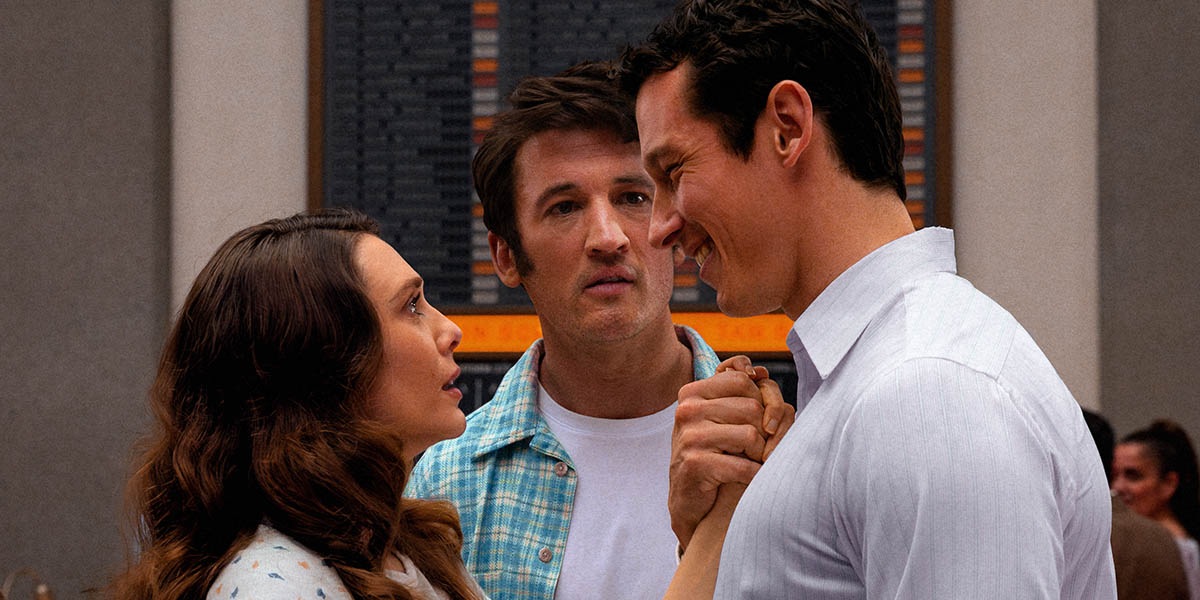
Now in theaters, Eternity tells the story of an afterlife where souls have one week to decide where to spend eternity—and the options are infinite and sometimes hilarious. When the elderly Larry (Miles Teller, because you can also choose at what age you’d like to spend your eternity) dies, he lands in something of a way station for souls where they have a guide (Larry’s is played by the great Da’Vine Joy Randolph) to help them make their decision. But he decides to take a job in this place until he can be joined by his wife of many decades, Joan (Elizabeth Olsen), who does arrive in due time. The only issue is, Joan’s first husband Luke (Callum Turner), has been waiting for her as well, since he died in the Korean War decades earlier. So the film becomes about Joan’s decision—which, if any, husband will she choose to spend her eternity with? And where will they spend it together?
The film is part romantic-comedy, part existential crisis, and it’s the product of screenwriters Pat Cunnane (making his film debut, after being on the writing staff of Designated Survivor) and David Freyne (Dating Amber), who also directed. Producer Trevor White and his producing partner and brother Tim White have had a fairly successful run since forming Star Thrower Entertainment, which was responsible for such films as Ingrid Goes West, King Richard, The Post, Fair Play, Wind River, and No One Will Save You. And the Whites, Cunnane, and Teller already have their next project lined up: Winter Games, about an overlooked female skier and self-absorbed hockey player who find romance in the Winter Olympic Village and the complications that stem from that.
I had the chance recently to talk with Pat Cunnane and Trevor White about Eternity, and how they built the surprisingly elaborate dimension where souls go to decide their forever future, accepting that either decision Joan makes will likely piss off half the audience, Cunnane’s history as a White House staff writer, and collaborating with director Freyne on the film. Please enjoy our conversation…
So I read this story last night about how you all met, and I don’t believe a word of it. So walk me through the real story.
Pat Cunnane: It’s all true. I used to work in the Obama White House, from when I was 22 to 29. And with like a year left, my boss knew I wanted to get into entertainment, so he told me that Rob Reiner was going to scout a movie here and asked if I wanted to give him a tour, and thank god I did.
So tour guide wasn’t normally part of your job?
PC: No, no. I was a writer, and not even a speech writer. My title was “Senior Writer.” There was so “Junior Writer” or any other writer. I basically wrote the stuff the speech writers didn’t want to write, like the death statements when a celebrity died. I was that guy. But my boss asked me to give Rob a tour, and Tim and Trevor White happened to be on the tour as well.
Trevor White: We were producing the movie with Rob.
PC: The way I remember it was Tim came up to me, because he knew I was doing some writing for Obama, and was like “I always through political writers would make good screenwriters.” And of course, I had written a pilot, because I didn’t know what job I’d have after working at the White House. So I said, “I have this pilot if you want to read it.” Tim tells it differently, that I came up to them. But it is true; that’s how we met, and we’ve done a bunch of projects together.
Was that the pilot for Designated Survivor?
PC: No, it was completely different. It was a half-hour comedy about the First Man, back in the day when we thought Hillary Clinton was going to become president. Nothing ever happened with it, but it did connect me with Tim and Trevor, so it’s been a ton of fun ever since.
So is this the first screenplay you’ve written for them?
TW: Second screenplay, first to be produced.
Where did the idea for Eternity originate?
PC: I’ve actually had this idea for a long time, long before I got into this industry. I don’t know if it’s a fascination with death or growing up Irish-Catholic or what, but I think everybody thinks about the afterlife. If the afterlife exists, I think our human problems would follow us there and complicate it in a fun way for a movie, and it just popped into my head “What would you do?” This happens all the time: you lose your partner, you remarry. What happens in the afterlife? And it really started from there. After I’d written my first script for Tim and Trevor, we were trying to figure out what else to do, and I was on a call with both of them, and I said, “I have an idea. What if a woman was married twice in life, loves them both, and she gets to the afterlife and has to choose between her two husbands.” They were quiet for a minute, and I was sure I’d just pitched the worst idea ever, but thankfully they loved the idea.
TW: I was speechless. This was such a big idea; how has this not been done?
PC: I was afraid to Google it because it must have been done before.
When you pitched it, was it a comedy idea or a drama, or did you see the possibilities in both?
PC: We had just done a romantic-comedy together.
TW: It was definitely a romantic-comedy. We had been on the hunt for the 1990s rom-com that we felt didn’t exist any more, so I think we wanted to make like a Richard Curtis, Notting Hill, Nora Ephron, even Rob Reiner.
They do get made; they just don’t end up in movie theaters most of the time.
TW: That’s true, and that was the other piece. We wanted to take a swing at something that felt both really fun, funny, earnest, and had some emotional weight to it. But we always knew it had to be a comedy.
PC: I wouldn’t have been able to write it any other way.
TW: Exactly. Especially knowing Pat’s voice and how he writes dialogue—some of the best dialogue you’ll ever read is Pat’s.
As much as I enjoyed the primary decision at the center of this, I’ll admit I was really fascinated with this world that you created. I wanted to explore some of the eternity options. How deep into that did you actually get?
PC: We should mention at this point that our brilliant director David Freyne is co-writer. When he came aboard, he had this vision that we were both instantly taken with. When we were in early stages of this, there was always this debate: do they go to a beach eternity, a mountain eternity? And David came in and said, “There should be a lot of eternities, and they should be really interesting, and some of them should be weird.” He had hundreds of them.
TW: So in our production office, none of them were written into the script—maybe a couple, like the ones we actually see or are mentioned in dialogue—so when we showed up in the production office, there was a giant board that David had put up outside of his office, like cork board, and it was empty, and every day, new notecards would go up with different ideas on them, and before long, there were a hundred ideas. Any spare moment that David wasn’t in the throes of normal preproduction stress, his at-peace quiet time was coming up with eternities. It was an outlet for him; he had a blast. It was so fun for us, and everyone in that production office would come to our floor to look at our board.
PC: What’s so fun now about it is, having watched the movie a bunch of times, you spot new things. This is a movie you could watch two or three times and catch a new joke that is not in dialogue, but is in the background. “Did you see what that sign said?” When this is available on streaming, people will be able to pause and really sit there and say “That’s really clever.”
So how do you make a film about eternity and step as far away from religion as you possibly can? And is there a Christian eternity, or other religious eternities?
PC: That comes up real quick.
TW: When Da’Vine first gets Larry to the room, she puts out all the pamphlets that are for all of the spiritual ones.
PC: At one point, Larry says, “I want to talk to the big guy.”
I remember that, but the implication of her response is that that person doesn’t exist.
PC: I don’t want to say that we sidestepped it, but we wanted to have fun with the idea that, even there, you don’t really know what’s going on here. Da’Vine has a run where she talks about working for Tom, who works for Frank, who works for Kevin. It’s endless bureaucracy. You could try and tackle that in the movie; it’s just a very different movie, if you wanted to try and get the meaning of all this.
TW: At the core, we’re telling a love story. We’re focused on this person’s choice. This was a big thing for us early because we had so many rules and questions we were asking: “Do we need to answer this?” “Will people be upset if we don’t?” And in the end, we decided there was some stuff we had to hit on, but by and large, we don’t have the real estate to dive into all of that, so let’s just focus on what the needs of our characters are and what we need as an audience to enjoy this. No one wants a two-and-a-half-hour movie where 45 minutes is just exposition.
I would watch a longer version of this if we got to see more of those worlds. You could do a series exploring any number of them.
TW: That’s a sign. With Da’Vine and John Early?
Exactly. No matter what decision Joan makes here, you run the risk of losing half of your audience at a certain point. What was the key to cracking that dilemma? How do you make it clear that both of these guys have flaws and very different people?
PC: It’s hard to talk about without giving anything away, but that was very difficult. David was really instrumental, especially in that third act, in figuring out how do we tell a true love triangle where everyone, in some ways, makes sacrifices for each other.
TW: There were earlier drafts where the script was more pointed in telling the audience where to go by making one of the characters have bigger flaws. Honestly, David came in and said, “We need to strip that out, because it’s not the audience’s choice.” There still will be satisfaction on our journey with what we’re providing. The thing about a romance like this is that if people are trying to pull from what their lives are, we’re never going to please everyone. So this is specific to these three characters and trying to use this as a way to raise questions about love and different kinds of love and what love means. That was the far more interesting thing for us.
PC: As an aside, it’s really fun that some people will have different opinions on who she should choose. I’ve watched it with people who have come out of it having different opinions, bud thankfully they enjoyed the whole journey.
TW: That’s the thing: are they going to enjoy it if we don’t pick their person?
I noticed that in the films that you’ve produced so far, you don’t seem interested in franchises or existing IP. You’re going with mostly newer filmmakers, newer writers. How do you and your brother decide what you’re going to make?
TW: Well, I should put out there: I’m not opposed to doing those . Tim and I were very entrepreneurial out of the gate; we were young guys in our 20s trying to start this company. We really believed we could find writers at the same level that we were, and we would all develop and break together—that was the original philosophy of the company. We’ve evolved in the last few years. These movies take so much out of us, not just how much time they spend in development and putting them together, but also taking us away from our families, so if we’re going to do this, it becomes “How much do I love this movie? How much do I enjoy the people making this movie?” Those are the two big things I look at, because this is going to be a huge chunk of our lives.
You had another film at Toronto, in addition to Eternity…
TW: We did, called Carolina Caroline.
I think I read that you three and Miles have another film, Winter Games, which I’m hoping is a remake of The Cutting Edge.
PC: Cutting Edge is a good reference, actually. It’s Miles Teller again, set during the Winter Olympics in the Olympic Village. It’s a sports movie and a comedy, and hopefully will be coming together very soon.
TW: Hopefully, we’re going to start on that at the beginning of the year, but it’s a really big romance, with comedy, drama, sports. It’s a really ambitious movie.
Your company has done a fair number of biopics or films featuring real people, and I know you have this Anthony Bourdain film coming out next year. Biopics seem like the hardest ones to get right. What have you found is the key to getting those right?
TW: They are really hard. Tim and I love them. The good ones really sit with us. I’m someone that if I learn about someone, I’ll go in the deep, dark rabbit hole of reading everything and watching everything, and I’m easily inspired by people and what they do. Take King Richard—Tim grew up playing tennis. He remember being a Junior and hearing stories about the Williams sisters, who were the same age as him, and about their father, and he had this memory about that time. Early on in the company, he said “We need to do this story about Richard Williams and how he raised these girls in Compton.” If you look at our true stories, they all cover very specific windows; we don’t do cradle-to-grave stories, we don’t really know how to.
And again, it comes down to this question of real estate: how do you have time to understand a character and what their experience is if you’re just ripping through chapters 10 years at a time. For us, it’s like, how can we find one chapter of this person’s life that’s more reflective of the thing we know. With Tony, it’s one summer in the life of 20-year-old Anthony Bourdain, the first summer he comes out to Provincetown, Massachusetts. Dominic Sessa is playing him, the first time he works in a restaurant, Antonio Banderas is his mentor, and Leo Woodall plays the guy who shows him maybe some of the darker sides of the life. But at its core, it’s got a lot of heart, and I think we’re drawn to that.
With Eternity, it’s hard to watch it and not think a bit of Defending Your Life, and since it’s less a romantic comedy and more of an adult romance, you can’t help but think of the films of James L. Brooks. What were some of the films or filmmakers you were using as touchstones for this?
PC: Defending Your Life was the very first obvious one. I remembered it, but I didn’t watch it again because I didn’t want to take anything directly from it. I probably should watch it now. Early on, it was those romances—and we are telling a romance story with pops of humor—that feel real, and even though they’re in this insane situation, they need to feel like real people, and we can put ourselves in their shoes. That’s what some of those 1990s, even early 2000s, romantic comedies did well, and we wanted to harken back to that. David talks a lot about The Apartment.
TW: David and my favorite director is Billy Wilder, and in the first meeting with David, he referenced Wilder, and I was like “Yep.” I mean, yes, it’s Jim Brooks, Nora Ephron, Rob Reiner, and Richard Curtis—those were certainly the tonal templates we wanted, but Billy Wilder, when you think about him in this sandbox, like The Apartment, they are real people, the dialogue pops, there is broad humor, yet they have emotionally deep questions that they ask. That’s what we were after; we wanted it to be equal parts funny and emotionally resonant.
Best of luck with this, and have fun at the screening tonight.
TW: This was fun, thanks so much.
PC: Take care.
If you enjoyed this post, please consider supporting Third Coast Review’s arts and culture coverage by making a donation. Choose the amount that works best for you, and know it goes directly to support our writers and contributors.
