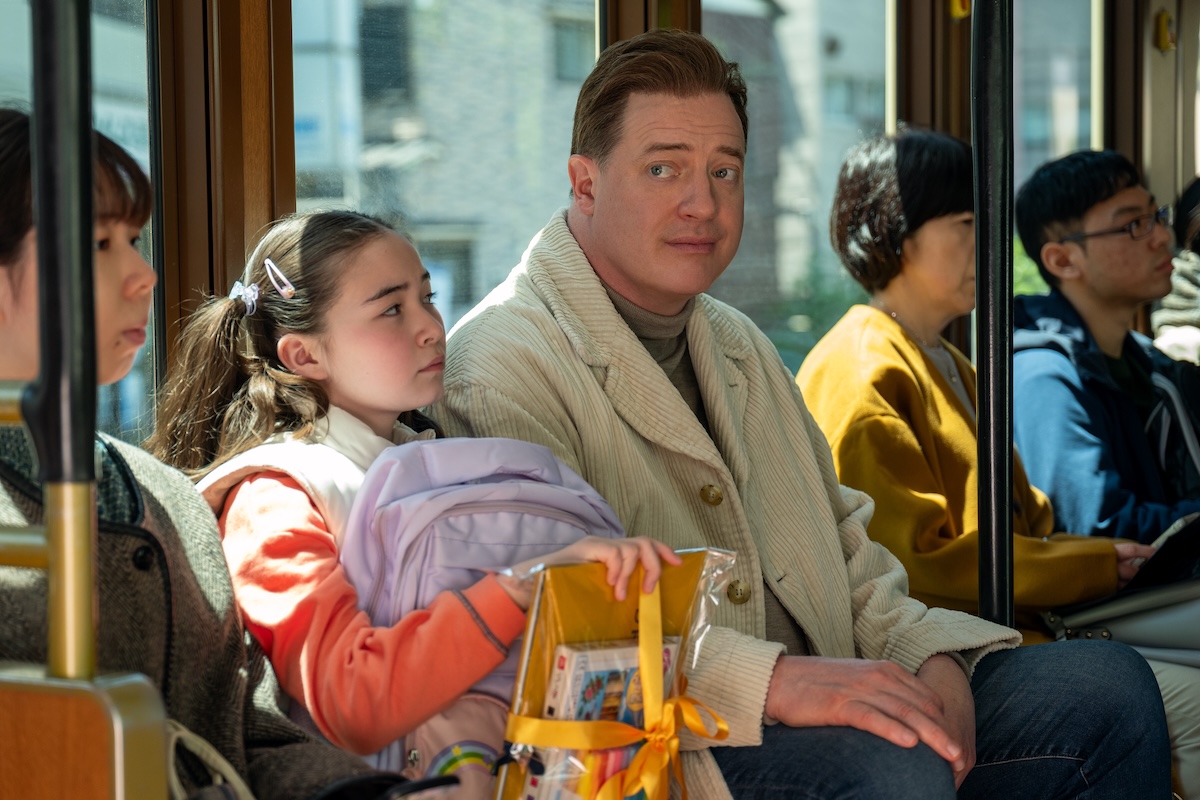
In her new film, Rental Family, the filmmaker known as Hikari traces the isolated life of American actor Phillip (Brendan Fraser, in his first lead role since his Best Leading Actor Oscar win for The Whale) who has lived in Japan for a number of years and specializes in playing the token white guy in TV shows and commercials. After being hired to play a fake mourner at a fake funeral, he is brought on by a company called Rental Family, which assigns actors to stand-in roles for strangers, ranging from a mother who hires him to pretend to be her young daughter’s (Shannon Mahina Gorman) absent American father to help get her into an exclusive school, to playing the part of a journalist interviewing a retired famous actor (the legendary Akira Emoto) to help make the actor feel remembered. Rental Family is sweet and good-hearted but with a faint undercurrent of melancholy as well, especially when it becomes clear that everyone involved on both sides of these transactions is missing some key emotional component in their lives.
Before taking on this film, Hikari wrote and directed the film 37 Seconds about a young Japanese woman with cerebral palsy who is torn between her obligations towards her family and her dream to become a manga artist. Hikari also directed several episodes of the award-winning Netflix series Beef as well as the HBOMax series Tokyo Vice. But it's her gentle, research-heavy work on Rental Family that was the prevalent topic of our interview last month during the Chicago International Film Festival. Please enjoy our conversation
I know that these types of businesses exist, and they have for decades, but do they actually provide the types of services we see in the film or is it a little different?
You can basically order whatever you want; there are no rules. For example, if you have a mother you haven’t spoken to and you don’t have a good connection with her. Maybe you left when you were young and she’s perhaps deceased, but now you’re at a certain age and ready to pass on to your next life, and you ask someone who looks like your mother to play exactly how you want your mother to be. You can order exactly how you want it done. Some people want her to walk in so they can apologize to her or they want to have a conversation and hug it out.
Or there’s a very popular guy named Mr. Do-Nothing who just sits across from you and says nothing. Just hangs. If you’re eating ramen and you want the salt, he’ll pass you the salt. It’s interesting, I’ve found out through doing interviews that in Italy, China, Korea, etc., they hire people to cry at funerals.
Okay, this I’ve heard about. Those are professional mourners, and I think that’s different than what you’re showing in your movie.
It is, but it’s still weird.
Oh, it’s definitely weird, but it’s not as elaborate as some of the scenarios that you show us. And a lot of people don’t know this service exists. Why is that?
People don’t talk about it in Japan. People use this service because they’re lonely and need a companion. And while we do have therapists in Japan, you have to go through so many hurdles to see one, and then you have to go see them, and by the time you get in front of one, people don’t want to express their problems because they don’t want to be judged. It’s easier for them to contact one of these companies and say, “I want to hire a friend.” And for two hours, you can talk or hear them talk, and it gives you a comfort zone and you don’t feel lonely. That’s how they cope. People who are in emotional distress, they don’t want to share that; they don’t want to admit that they’re depressed. They don’t talk about it. Some of the companies are female owned and only provide services to women, or to the LGBTQ community.
Is there something about the Japanese culture that makes it possible for these businesses to thrive the way they do?
In Japanese culture and other Asian cultures, there are bars that usually just men go to called a “hostess bar,” and those are the places where you just go to drink alcohol served by women. You pay a lot of money, but you also talk to them. Talk shit about your work, your boss, whatever you want to do. And now they have places like that in Japan for women, called “host clubs.” Sharing is easier with alcohol, so that’s how it started, but then these rental family services became popular. They also have a lap service, cuddling service, there’s nothing sexual about any of it. Those services exist because people are just looking for connection. It doesn’t have to be about expressing your issues or problems, and I’m guessing most people don’t. It’s a lot of people just looking for companions to spend that time with.
The places in Phillip’s life where there is some void, like growing up without a father or not having kids, these clients of his fill that void perfectly. He looks at the older actor as a father figure or that girl as his own daughter. It seems natural that he’s going to get way too close to them. Was that your intent in the writing, to have him find these missing pieces in his life?
You understand! Absolutely. We also had different scenes that we wrote that had nothing to do with his life. At one point, he wasn’t an actor; he was just a guy struggling to find a job in Japan. He was working at a cafe serving tea to Japanese women, but then these better-looking men come in and he loses his job because he’s getting older. His character is about what it’s like to get older and trying to connect with other people. He wants to know what it’s like to have a daughter or a father. But also, Phillip is us. I wanted audiences to see this through his eyes and perspective and see what it was like to be him. I wanted him to ask the questions about this service that the audience is asking, like at the funeral where he’s like “What the fuck?” That’s exactly how I would react if someone popped up out of their coffin. But I made this movie for everybody in the world, to show them what this looks like. If that person didn’t have a kid or father, he’s playing it for you. It’s okay to connect with people.
Well, the guy who runs Rental Family says don’t connect with clients. In your research, did you find that the people who did this job the best did connect with people?
Absolutely, people connect. As a company rule—because Japan is made out of rules—you are supposed to keep a distance, but some people feel connected. People who are actors do this because they get to perform, but a lot of people who work in this industry are not working actors, and they might be lonely themselves. So when they start working with a client who is coming in and paying for your time, and if that client says “I can’t pay you anymore,” if they feel connected, they might say, “It’s okay. Let’s have coffee once a week.” That’s okay too, as long as both sides are in agreement.
And there’s this great phenomenon happening, let’s say me and you are going to play brother and sister every time this client hires us. So we go in acting like brother and sister once a month, so I end up feeling like you’re my real brother because we’ve been talking a lot to each other about our lives, and we end up learning so much about each other. So outside of this client, we start to feel like a close family. And that’s something that’s started happening, where the actor start connecting with each other. It’s this community that building and it’s fascinating.
Did I read somewhere that the story of the little girl in the film, whose real father is not a part of her life, is based somewhat on your story? How true to life is that?
My parents got divorced when I was a baby, but I was told my father was dead until I was seven. It sounds dramatic, but it’s not. I just grew up not knowing what a father figure looked like. The only time I understood that I had a mom but not a father was in first grade, when we had the parent visitation days where it was just supposed to be the father, and everybody brought a father to school, and my mom was standing there by herself, and I’m wondering Who are these guys? And I grew up thinking he wasn’t there because he was dead. But then my neighbor told me that my dad left for another woman, and that my mom was lying to me and told me my dad was this handsome actor, and I believed her. But I found out he wasn’t, she told me that he wasn’t the nicest man, and she kept asking if I was happy and if she was giving me enough love, and of course the answer is yes, it’s perfect. And after that, I never asked about him again.
So in the film, people wonder why they are lying to get her into this school, but going to public school is a serious thing in Asia. If you don’t have a certain status, you’re a single parent, and you want your kids to have a really good future, people put them into these schools early on. Sometimes, some schools might not be as open to single parents because of the financial situation, which I don’t agree with. So I wanted to show that this mom is hiring this actor out love and wants her daughter to have a better future and doesn’t want her daughter lying to the teacher, so she has to believe this man is her real father.
Speaking of handsome actors, tell me about your initial conversations with Brendan about this role? Why was he the right person to play this part?
I knew when I saw The Whale, that vulnerability was unbelievable. And Phillip may not be as dramatic when he’s working for Rental Family, but the script at the time was more of a drama with occasional humor. But after seeing Brendan doing a Q&A, I knew we’d found him. So I sent him the script, and he loved it. After that, we met in a New York hotel for six hours; I thought we were just meeting for coffee for an hour, and it turned into six hours. I wasn’t sure at the end if he was interested in the role, and when I asked him, he just said, “Oh, I’m doing it.” I should have asked him much earlier. But he thought the story was unique, and he’d previous been to Japan to do press for The Whale, so he really loved the Japanese culture and felt what Phillips was going through, so it was easy for him. And he was very open to learning Japanese, so willing to try anything; I got really lucky.
How much fun was it to shoot the TV shows and commercials that we see him in, because some of those are full commercials?
I know, and we did them in Japanese, and I showed them to my Japanese crew and friends, and asked “Does this feel authentic?” and they all said yes. I used to make commercials in Japan to some extent, but nothing like those commercials. Mine were more dramatic, like car commercials—a bit different than what you see. But they were so much fun. I got to do the choreography and come up with the stories, design of the costumes. I got to do everything.
That toothpaste costume is too funny.
Oh, I know. I did that design and said “Go make it!”
I know before this film, you did a large number of shorts and worked on series like Beef. What did you learn doing those shorter-form projects that helped you transition into feature filmmaking?
I’m sure every director says this, but every project we do is a learning step. I was a little bit better on my second short than I was on my first, where I didn’t know what I was doing but I remember it was so much fun. And then first film did great on the festival circuit, so I did a second one. What I learned in doing television—Toyko Vice and Beef—was to quickly make decisions, and if you’re running out of time, this is how you cut to make your day. Rental Family was a great example: was originally thought we had 55 days, but then the weather changed, the cherry blossoms weren’t blooming, we had to push a couple weeks and therefore missed some of the days. We had to take a three-day hiatus, so we lost those days. Some of the locations said we could use a dolly, and I had this great idea for a sweeping shot in the final scene, and the location guy told me the neighbor said we can’t do it. So in that moment, I had to be able to say “Okay, we’re going to do this, this, and this.” You have to make quick decisions. You have to figure out how to tell your story under time constraints like that. I learned a lot of that from television work.
The older actor that Phillips befriends, did you base him on someone real?
Not really. The only thing I wanted to do…there are sometimes actors you’ve seen so much on television, and then you find out that they’ve been sick or have died or for some reason, they haven’t been in the public eye. I was wondering what happens in those moments to actors or actresses. And what if they were facing something like this character was, like starting to experience dementia. There was actually was a heartfelt monologue that he had that I took out where he talks about how he couldn’t remember his lines when he was on stage, and that was the last time he performed. And he shared that information with Phillip when he gets to his home. Even though we see these actors as celebrities, we all look at them in a spotlight, but in so many ways, they’re like us. Sure, they have been on the screen and we admire their work, but they are human. I wanted the audience to feel that, even though someone like him has stress living his life, and he has a family member that wants him to feel well. I felt a lot about that character, and he represents our lives and where he starts versus where he ends—it’s the circle of life.
What is the acting world of Japan like for a gaijin, an outsider like Phillip?
The word gaijin is used negatively in Rental Family because a character believes Phillip doesn’t respect what they’re trying to do and the meaning of the rental family. She instantly regrets saying it, but that’s why she felt like she needed to put him in his place. Again, because we have so many rules in our culture—don’t leave a mess, pick up your garbage when you leave—and some people don’t understand the rules. But even if you’ve been there a while, we all still know you aren’t Japanese; you’re a gaijin, which also means foreigners, but not meant negatively.
The two films you’ve made, you also co-wrote. Moving forward, would you be open to doing something that you didn’t start, like an adaptation or someone else’s script?
Sure. I’ve always open to finding a great story. My thing as a director is to find something where I can put a positive message in everything I do, and I have been doing that since my short film days. As long as I can see and end product where I can incorporate my messages into the movie, then by all means, yeah. I actually have a few things I’m looking at that I didn’t write. There are so many beautiful brains and creative people out there; I don’t think I’m the only one that has great ideas, and I think collaborating with other artists is as great as doing your own thing. I’m a selfless director .
Thank you so much. Best of luck with this.
Thank you so much, Steven.
If you enjoyed this post, please consider supporting Third Coast Review’s arts and culture coverage by making a donation. Choose the amount that works best for you, and know it goes directly to support our writers and contributors.
