
The cinema has been feeding us a steady diet of sad mothers in recent weeks. When I saw Rose Byrne tear up the screen in If I Had Legs I’d Kick You back in January during the Sundance Film Festival, I thought she was the performance of the year (and I still do to a large degree). And then a few weeks back, Jennifer Lawrence starred in Die My Love and delivered something that might have been her version of postpartum depression, though it goes far beyond that to a different level of disturbing behavior, like that of a trapped, lonely animal.
But of all of these recent performance, Jessie Buckley’s interpretation of Agnes Shakespeare, coping with the death of her 11-year-old son in Hamnet, is one of the purest expressions of traumatic loss that I’ve ever witnessed. In fact, she’s the only one of these three mother characters who loses a child, and you can almost see how the experience has hollowed out her heart and left her a broken shell of a person. But she doesn’t start out that way—quite the contrary.
Based on the celebrated 2020 novel by Maggie O’Farrell, who co-wrote the screenplay with director Chloe Zhao (Nomadland, The Rider), Hamnet begins as a passionate and exhilarating love story between a young, struggling William Shakespeare (Paul Mescal) and Agnes. He’s been hired by her family to teach Latin to her younger siblings. They run into each other in the woods near her affluent family’s home, and he has no idea that she’s part of the Hathaway brood, to whom his father owes a great deal of money (the tutoring is helping to pay down the debt). But he’s immediately taken with her, and the feeling is fairly mutual. Her older brother Bartholomew (Joe Alwyn) is the only one of her family members (which includes her aging father and nasty stepmother) who supports this coupling, for the simple reason that the two truly do love each other.
Agnes is a woman of nature; her late mother taught her about herbal medicines and other natural healing wonders that have made some believe she is a witch. In fact, she just feels things more deeply than most. I don’t think Shakespeare would have been any less interested in her if she were a witch, but before long she’s pregnant out of wedlock, and the two must get married before the rest of the world finds out. And just as the happy couple start their family, William decides he must move to London if he has any chance of becoming a successful playwright. That leaves her to raise their two daughters and son Hamnet (Jacobi Jupe) mostly alone, with William’s mother Mary (Emily Watson) checking in with a suspicious eye.
Will does become more successful, which keeps him away from home even more and makes Agnes’ affection turn sour. And when one of his daughters gets deathly ill, he takes his time coming home; soon, the illness transfers to Hamnet, and before long, the boy dies just before Shakespeare arrives. When he sees the shrouded body, he assumes it’s his daughter under the sheet and is all the more horrified to discover the truth, which Agnes makes him feel even more by making sure he knows how much the boy suffered and cried out for his father in his final moments. He leaves almost immediately to finish work on his latest play, and it’s clear that the marriage is in danger of exploding from Agnes’ resentment.
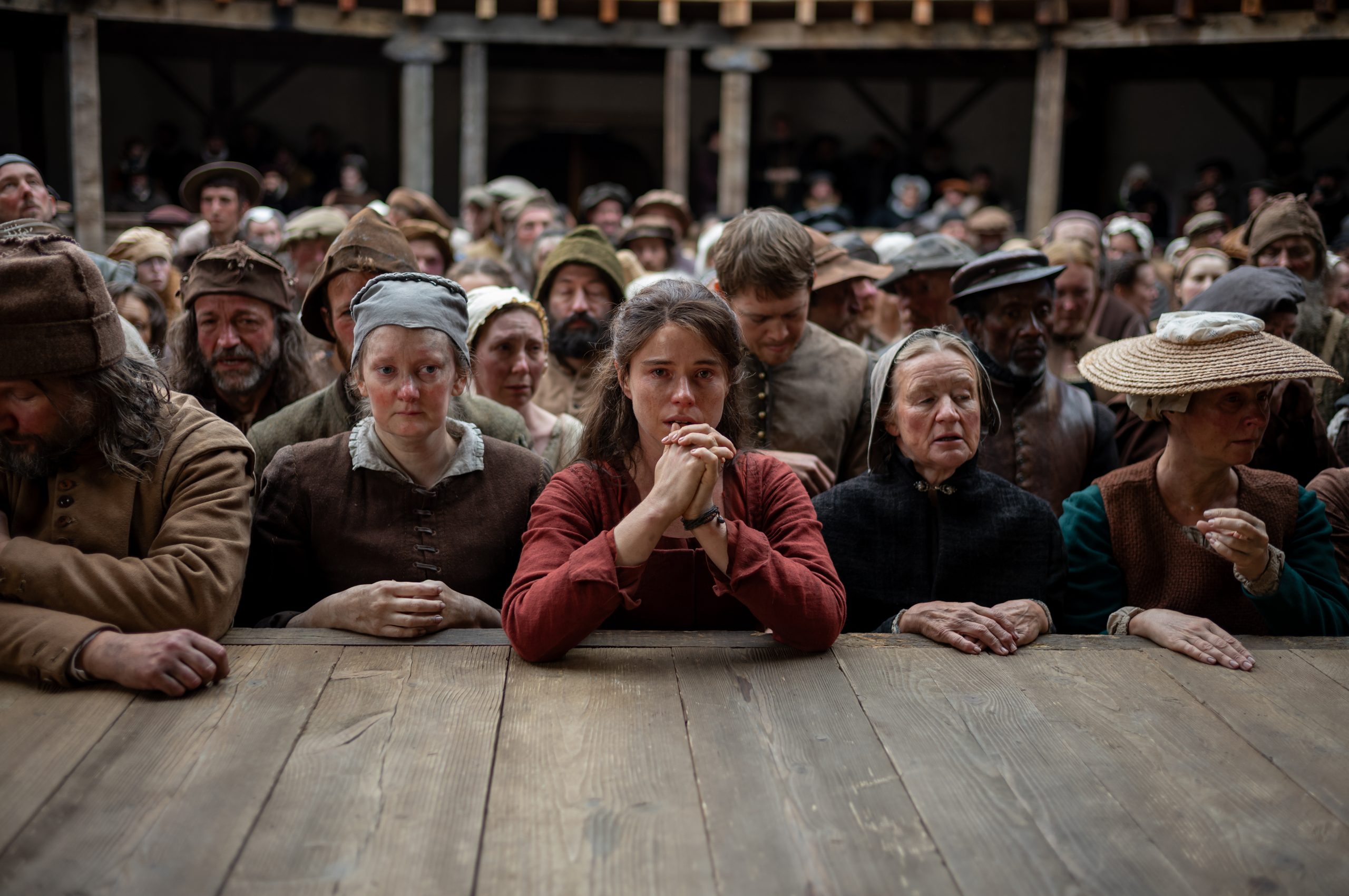
The film’s final third involves Anges finally going to London to see her husband’s latest production, titled Hamlet (which we’re told in an opening title is effectively the same name as Hamnet), and she doesn’t know whether to be crushed or moved at the fact that her husband has chosen to honor their son in such a way. But the play isn’t about a dead son at all, and she’s so confused by the plot of the production that she openly chastises the actors for not getting her reality correct. In a bold and eerie casting choice, director Zhao gets Jupe’s older brother Noah to play Hamlet in the play; the two look enough alike that it quiets Agnes and she begins to have a visceral reaction to the production, even going so far as to reach out to the actor playing Hamlet in his final moments on stage.
It helps if you know the Hamlet story when watching Hamnet, but it isn’t critical; Zhao gives us just enough context to make it clear how Shakespeare used the play to not only honor his late son but also to convey his deep regret about not being there to protect him when he was most scared. The few scenes we see of the play are devastating, gut-wrenching, and give us the full, agonizing power of Buckley’s abilities. Agnes needs to see something of her son’s legacy in this show while also finding a sign that William wants to salvage their marriage, and what she gets is so much more. Hamnet is easily one of the best things you’ll see this year, but it will require a great deal from its audiences emotionally and creatively, as any great work should.
The film is now in theaters.
If you enjoyed this post, please consider supporting Third Coast Review’s arts and culture coverage by making a donation. Choose the amount that works best for you, and know it goes directly to support our writers and contributors.
