When I first met Craig Brewer, it was after a very early screening of his third feature film, 2006's Black Snake Moan (maybe three months before its official release date). He came up to me and said “I’ve been reading you since I was a kid,” which I think he meant as a joke since we’re only a couple years apart in age. But either way, I appreciated the sentiment. And ever since that day 18 years ago, he and I have run into each other professionally; since we both care deeply about both film and music, there’s never a lull in the conversation. I’ve interviewed him for such films as his Footloose remake and his two collaborations with Eddie Murphy, Dolomite Is My Name and Coming 2 America. The last time I saw him was about two years ago at the Music Box Theatre for a screening of his breakthrough work, 2005's Hustle & Flow.
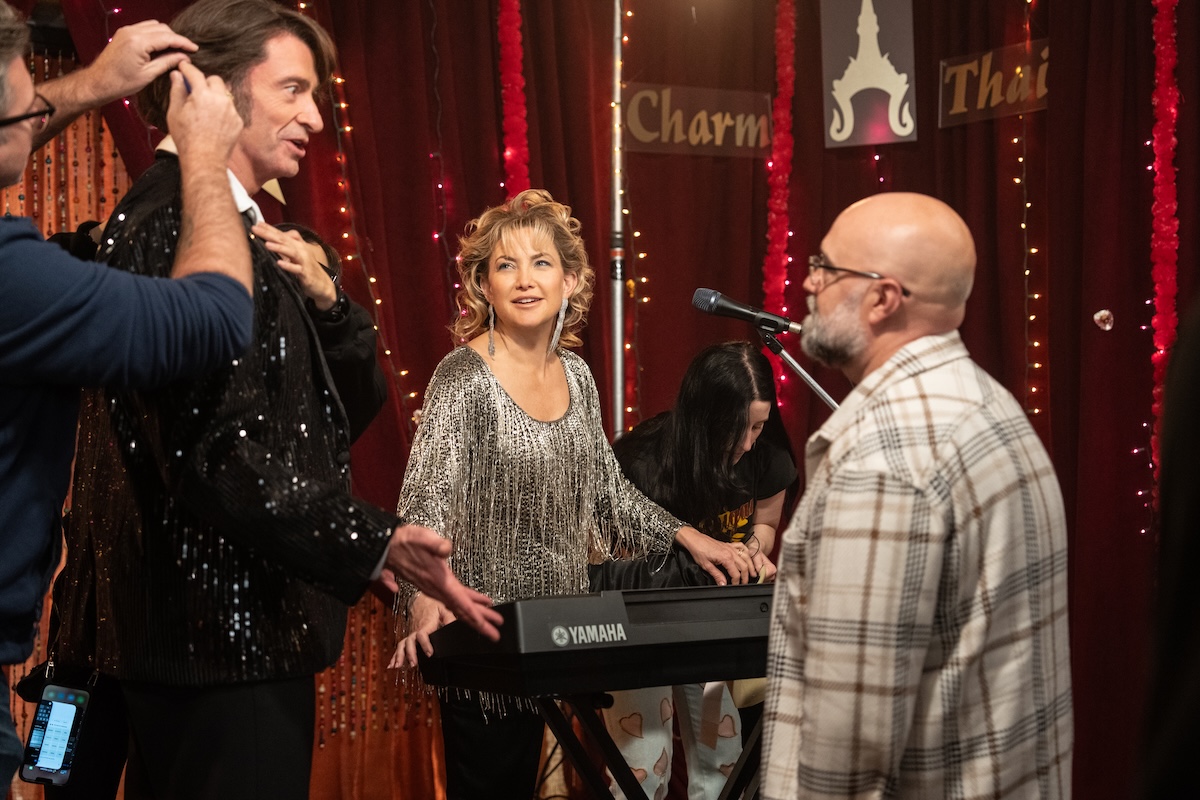
But when I heard he was helming the narrative adaptation of the deeply moving 2008 documentary Song Sung Blue, I knew in my heart he was the right guy for the job and that I’d want to talk to him about the passionate story of Mike and Claire Sardina (played by Hugh Jackman and Kate Hudson, in a truly revelatory performance), a Milwaukee-based couple who made a big splash in the 1980s-90s as Lightning and Thunder, a Neil Diamond tribute act. They played all around the Midwest and became so popular that they even got to play with Pearl Jam in the summer of 1995—a fact I knew before seeing the documentary because I was at that concert. That moment—and many other highs and lows in the Sardinas' lives—are faithfully re-created in Brewer’s Song Sung Blue, which is part love story, part family drama, part appreciation of Diamond, a tribute to bar bands, and a borderline musical with Jackman and Hudson singing their hearts out on an array of Diamond classics and deep cuts.
The Sardinas go through all manner of peaks and valleys in their lives together, but they could always count on music to see them through so much hell. The film not only shows us their lives, but let’s us see them as they saw themselves on stage—larger than life, lit by lights brighter than the sun, playing to rooms bigger than they were actually playing to. It’s a glorious, heartfelt movie that I firmly believe could catch on if people check it out and spread the word.
As I mentioned, several months ago, I put out the word that I wanted to interview Brewer about this project, and thankfully the opportunity presented itself recently. Honestly, I could have talked to him about this movie for hours, but we still managed to cover a lot of ground. I hope you enjoy our conversation, and implore you to catch Song Sung Blue, which opens Christmas Day.
Hi Craig.
Hi Steve. Is that your real background?
It is.
Isn’t it funny how all filmmakers and all people who love film have the shelves?
I think you mean people of a certain age.
Right. Physical media, man.
I will never get rid of mine.
Nope.
Good to see you again. I want to tell you real quickly, I have a long and loving connection to the documentary your film is based on. The director, Greg Kohs, reached out to me right after he finished it, when I was with Ain’t It Cool News still. He emailed me, and said, “You’re the guy in the Midwest. You would probably appreciate this story.” He explained what the film was about, but when he got to the part about them playing with Pearl Jam, I wrote back and said, “I was at that Pearl Jam show.”
No way! Wow.
I still have the ticket from that Summerfest show.
That’s so fantastic and wild.
And Lightning and Thunder used to play around Chicago, so I knew the name.
Just so you know, the biker bar scene takes place in Chicago.
That’s awesome. Anyway, I think I gave that film its first review anywhere on the planet. Roger Ebert saw it a few months later, and he loved it. Then Ebert booked it at Ebertfest a couple years later. Greg Kohs reached out and asked me to moderate; Claire came down for that as well, and on stage, at the beginning of the Q&A, I pulled out my Pearl Jam ticket from that 1995 show and asked her to sign it, which she did: “Thunder.”
It totally makes sense that you’re that Forrest Gump presence who just happens to be at all of these events.
That concert was 30 years ago. But we’re not here to talk about Pearl Jam. How did the original doc get into your hands, and what do you remember responding to the most?
The big victory of this movie is a victory of the smaller film festivals. I know that you have your Sundances and Tellurides and everything, but for many independent filmmakers making movies by hook or crook, it’s sometimes the smaller film festivals where people see your stuff. There was a festival called Indie Memphis in Tennessee, and Song Sung Blue was programmed at that festival. Not only did I see it there, but the programming director knew that I loved it and he gave me a DVD of it, and I wore that DVD out, because it was a screener, so I ordered it from Greg. Back in the day with physical media, that’s how you were able to watch things. He didn’t get a distribution deal; it wasn’t like you could just download it. I’m not even sure you could order a Blu-ray or anything fancy. I saw it, I fell in love with it, I felt it very much to the core, and I felt like if I was ever given an opportunity to do a movie, I knew I could do it. I really believed in the characters and felt I understood them in a really profound way. Some people may be put off by certain elements of their extremity of living, I felt very comfortable with it. Maybe because of the way I live with my family.
I just saw unique characters who were reaching for something that was so outside their grasp, and that’s what I’ve always loved about movies. I loved it about Rocky, and I tried to put that same element in Hustle & Flow. There’s nothing better than when an audience says, “I don’t think you’re going to get what you want” and then every once in a while, they get a little bit closer to it, and then they get kicked back two steps—it’s just that struggle. And that’s really how it came to be. I made Dolomite Is My Name, and the producers on that were very much interested in doing something else with me, and I had just turned 49, which is the age where my dad died unexpectedly of a heart attack, and I was in a special space. I was thinking to myself that I really need to focus on a movie that I want to make and not just on a movie I can make, not just a movie where I could get paid, get something easy at a time where it’s difficult to get a movie made. With Dolomite behind us, we could have gone to the marketplace with something simple and have an easier track to getting a movie greenlit, but instead I said, “I’d really like to do this movie about the Neil Diamond tribute band, and all of these bad things happen to them and they still persevere,” and the producers just fell in love with the idea, but they also made it clear that this was going to be a hard film to get made, and they were correct.
So you’re an OG fan of the doc.
Yeah, 2009 is when I saw it. And it was that movie where, friends would come over and I’d say, “Do you have about an hour and 20 minutes? Can I show you this?” That’s what it would be. It was a true love of this documentary.
How much of the film did you actually shoot in and around Milwaukee?
I have to come clean on that. We shot the movie in New Jersey, but as somebody from Memphis, Tennessee, who has seen movies and television shows that take place in my city but they shoot in Los Angeles with California mountains in the background, I was so dogged that we couldn’t have anybody from Milwaukee look at this movie assume it was shot anywhere but there. I took great pains to make sure the locations looked exactly right and the buildings were in the right space when we digitally put them in the background. We did go to Milwaukee for the premiere and had a great time.
Let’s talk about your way of shooting in small locations. Their house is a bit cramped, the places they’re playing are small. I feel like you had to get creative with how you shoot so much of this film. How did you use that to your advantage?
The advantage of shooting in those places is tricky. I have a really good cinematographer with Amy Vincent, who insists that things look beautiful and rich, but also we have a special combination where there also needs to be grit and grime and a particular type of saturation that makes you feel like you’re in a lived-in space. The problem is that to capture those lived-in spaces in terms of attitude of performance and aesthetic is that they’re small spaces, like 8- or 9-ft.-high ceilings; it’s very hard to light these places. They aren’t sets where you can move a wall out and light how you want to. It’s difficult but it creates a certain energy on set that contributes to the naturalism of the performances. I think that Kate and Hugh have a different type of performance in this movie because they are in real locations. It wasn’t like they were going to a soundstage that was dressed a certain way. They had to move past extras to narrow staircases because that’s the only way to get to this bar. They felt of the place and spirit of it.
We lucked out with this house, because my production designer, I told him that this house that they live in, I didn’t want a place where the interior and exterior don’t jive; I want it to look like the same place. There needs to be a big bay window in the front wall, and it needs to be on a street that comes up to this house and hands a right. Can you imagine that those are the parameters that you have have to find a location that is available? Not only did he find all of that, but it was a house that was about to be demolished, and we had free reign to do what we needed to inside. He did a fantastic job with it and it created such a wonderful energy on set.
Speaking about working with Amy Vincent again, talk about the visual language you two created. I feel like there’s a different look to the music numbers.
We definitely wanted to give them the magic that they felt. That they were struggling through a life of, at times, poverty, illness, and injury, and they didn’t have health insurance or the means to make their lives any better, but they’re all struggling to fight for the music. One thing that we established with Hustle & Flow is that different songs have different energies, especially depending on where you are in the story. I’ll give you an example: in Hustle & Flow, the first time you see them come together and make a beat with a song called “Whoop That Trick,” it’s very raw. It doesn’t have a studio sound. Terrence is rapping live on mic and on camera, and for that, Amy felt like we needed a handheld energy. But by the time you get to the recording of “It’s Hard Out Here for a Pimp,” we are moving slowly, more smoothly.
So if you watch Song Sung Blue, we took a cue from Hustle & Flow, so when they first start playing together on “Cherry Cherry,” we have some energy because they’re messing up a little bit. They’re trying to figure out the best way to sing. But by the time they get to the song “Play Me,” where she’s plugging in her keyboard, she’s realizing what the sound needs; she’s putting the right calypso beat behind it on her Casio. She’s bringing up the right keys to play with him. We’re gliding through this magic and we need to give them that aesthetic that this is what they’re fighting for, this moment where it finally just works. I would say the same thing for when they’re at a bar or a Thai restaurant, we needed to give it a lo-fi magic, where a mirrorball or Christmas lights in the background, if you film it correctly, it can look absolutely magical, and that what we wanted to do.
At a certain point, there’s a huge emotional and tonal shift when we get to Claire’s accident—and I think it’s a moment that’s going to shock people. I know how movies are made, which is not chronologically, but were you able to shoot those moments later so that you can feel their highs before you get to those lows?
We were. Because we had that location all to ourselves, we could shoot somewhat in chronological order. I have to say, the interesting thing about the way the movie is set up, it’s kind of like a giant misdirect, and I think that that’s happening as people are watching the movie more and more. I am fully aware that there’s a big chunk of movie watchers who are watching the trailer and going “This is not for me.” And I’m sure everyone is nervous about me saying that, but what I mean is that I think people are thinking this is going to be a big fun joy ride and don’t see any substance to it.
The movie definitely takes you on that journey for the first half of it. You are rooting for people and feeling that excitement and seeing these musical sequences where you’re like “I would totally go see this band on a Friday night if they were in my town.” But then this tragedy strikes this family that they have to deal with, and the movie takes on a shift for a moment. I knew going into the project that there would be this concern with the studio or even my producers: “Is this too much?” But I still feel both that it’s truthful to the story but also, that’s what love is. There is that time where everything is perfect, and then you make a commitment to be with somebody, and it’s still wonderful. You’re building a home together and a life together, you have your children and everything is going well. Then suddenly life comes along and kicks you in the gut. To me, that’s where real love is tested. That’s why we’re together in the first place. Yes, there’s attraction and comfort, but when you’re saying vows like “Better or worse, sickness and in health,” there’s a reason that over the decades and centuries that’s been told to us, because life will come along. Luckily, Hugh and Kate perfectly calibrated their performance for that, so you don’t feel like you saw two different movies. It’s still very much the same movie, but I think it surprises people that it goes in that direction, but when they come out the other end, they’re so grateful for it.
This is also a tribute to locals musicians. As I put it to someone, it’s about musicians with day jobs. Coming from Memphis, you probably knew a lot of people like that.
Yes! Of course you would bring it up because it’s exactly what I believe. I have so many friends who are in bands that do have day jobs. They’re serving me coffee during the day and are rock gods at night. There is not any sort of judgement or feeling that somebody has not made it. I could look at a band or pop star that has million and millions of views of their songs or likes on their Instagram or sold out arenas, and I could ask “Are they happy?” And then I could turn to somebody in Memphis who is holding down a day job, has a family, kids, gets to play on the weekends, maybe every once in a while they can save up some money and put an album out. They have a record release party at a local bar, they have barbeques where the kids are in the kiddie pool while they’re playing in the backyard and people are showing up with PBRs, and I’m telling you, there is genuine happiness there. The thing that we need to do more than ever, especially today, is recognize them, and what I mean by that is that our communities need to turn to our local artists and bands and give them a lot more support than we give them, We need to show up to their shows, put money in their tip jars, buy their shirts and wear them, we need to say that they are our local band.
I’ll give you an example. My son, he turned 20 and he’s really into Memphis rap. Because he was a pandemic kid, meaning he graduated from high school during the pandemic, he didn’t get to have a graduation. So when he turned 20, I gave him a couple of grand and said, “Let’s have a party, man.” My son went out and got all of these unknown obscure rap artists that he’d been following on Instagram and going to their shows and supporting them. I was there on the day when I saw him put $300 into the hands of this girl who was going to do a couple of songs at his show, and her name was Glorilla, who now sells out arenas and is the biggest star on the planet, but there was a time when she needed $300 to come do a couple of songs, and now my son has this connection with her, and I’ve known her a long time. I guess what I’m saying is, if your idea is to win the lottery by knowing somebody, yeah, go ahead and support local musicians if you want. But there’s just enough joy in supporting people in your community if they don’t become Glorilla. They’re there for you and show you a great time and entertain you.
Craig, it was great to see you again. Best of luck with this.
Hey, we’re still doing this. After all of these years, we’re still loving movies and doing movie stuff. It’s always great to talk to you. Good to see you.
Now through December 31, Third Coast Review is raising money to support the diverse roster of writers you know and appreciate for their thoughtful, insightful arts and culture coverage in Chicago and beyond. Everything raised during this time will go directly to paying these writers a well-deserved year-end stipend; you can make a contribution here. Thank you!
