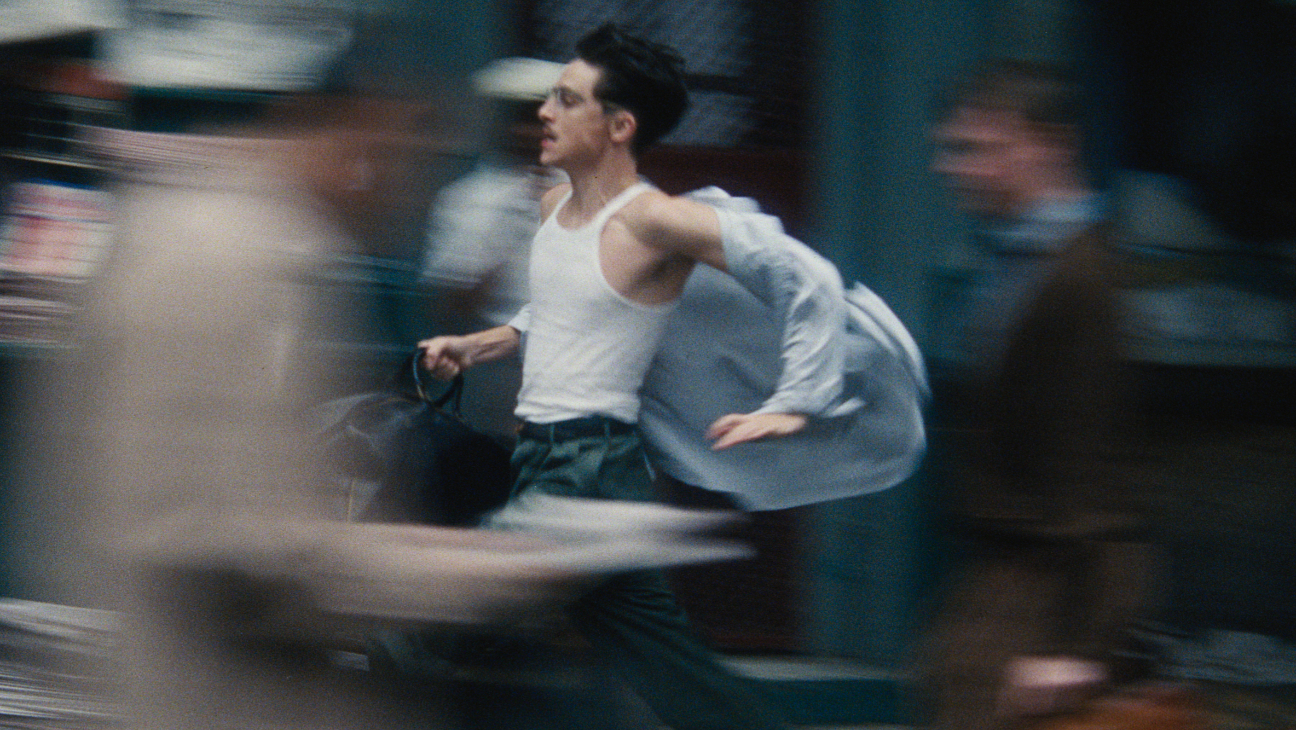

As Americans, most of us are suckers for stories about underdogs or comebacks or rising up from great adversity to triumph in the end, and certainly, the debut solo film from Josh Safdie (who made works like Uncut Gems and Good Time with brother Benny) Marty Supreme has those elements contained within it. But somehow, Safdie makes it almost impossible for us to fully like lead character Marty Mauser (Timothée Chalamet), a champion table tennis player living in New York City in the 1950s. He’s a character who believes in himself completely, never so much as even entertaining the idea that he could ever fail, even as he’s actively failing. His passion for what he does so well and belief in himself so dominate his personality that he’ll do anything and destroy anyone to get where he knows he needs to be. Based on the real-life player Marty Reisman, Mauser is a user, emotional abuser, taker, con artist, and terrible son.
Within minutes of meeting Marty at his job at his uncle’s shoe store, we witness him having illicit backroom sex with his married neighbor Rachel (Odessa A’zion); refuse to run home to take care of his supposedly ailing mother (Fran Drescher); and steal money from his uncle that he needs to fly to London the next day for a major table tennis tournament. Granted the money is owed to him, and the uncle is a bit of a crook, but stealing is stealing. Without realizing it, Marty leaves a great deal of unfinished business back home when he heads overseas and makes his way to the finals, where he unexpectedly loses to a deaf Japanese competitor named Endo (Koto Kawaguchi), who uses a new style of paddle and playing. Endo’s elevated skills force Marty to better his play, but not before he is defeated.
While in London, he meets and falls for a retired famous actress, Kay Stone (Gwyneth Paltrow), who is married to mega-rich Milton Rockwell (Kevin O’Leary from Shark Tank), and the two have a brief dalliance, after which Marty attempts to sell the husband on sponsoring him and paying for his trip to Tokyo for the next championship and a rematch with Endo. By the time he gets back to New York many months later, he finds out Rachel is pregnant with his child, his mother resents him for being gone so long but still expects him to stay with her, and his uncle has called the cops on him and will only drop the charges if Marty returns the money and then some, leaving Marty penniless once again.
What follows is a series of misadventures in and around New York during which Marty must do anything he can to make the money to take a plane to Tokyo. Some of his schemes are illegal but even the ones that aren’t are morally depraved and compromised. Along the way we get appearances from the likes of director Abel Ferrara, an almost unrecognizable Penn Jillette, Sandra Bernhard, Tyler Okonma (aka Tyler the Creator), Emory Cohen as Rachel’s perpetually pissed-off husband, Fred Hechinger, and playwright David Mamet as a stage director working with Rachel. Safdie is a collector of great faces and casting creative types not normally known for acting in fascinating roles that seem perfectly suited for their image. Co-written by regular Safdie Brothers partner Ronald Bronstein, Marty Supreme is a worthy excuse to put all of these incredible artists in the same spaces and see what happens—quite often, it’s magical.
And all the while, you can’t take your eyes off of Chalamet, whose normally good looks are obscured by subtle makeup work. You can see Marty’s brain working all the time, and even when he gets blatantly caught in a lie, he pivots and comes up with a new and better lie that people still buy (well, most of the time). Even Kay is taken with him when she sees right through him as a desperate, broke, opportunist gigolo; yet somehow, she still adores him…to a point. They don’t love each other, but they get something they need from the relationship, even if it is superficial and selfish.
Eventually, all roads lead to Japan, where Marty must decide what is more important: winning everything or escaping a harrowing situation with some dignity and cash. With Marty Supreme, you can tell which of the Safdies was responsible for the nerve-wracking qualities of something like Uncut Gems, and with Chalamet steering the ship and doing the best work of his career (a year after his previous best work playing Bob Dylan), this film rarely takes its foot off the gas or gives us time to catch our collective breath. And I was fully along for every anxiety-laden minute.
Now through December 31, Third Coast Review is raising money to support the diverse roster of writers you know and appreciate for their thoughtful, insightful arts and culture coverage in Chicago and beyond. Everything raised during this time will go directly to paying these writers a well-deserved year-end stipend; you can make a contribution here. Thank you!
