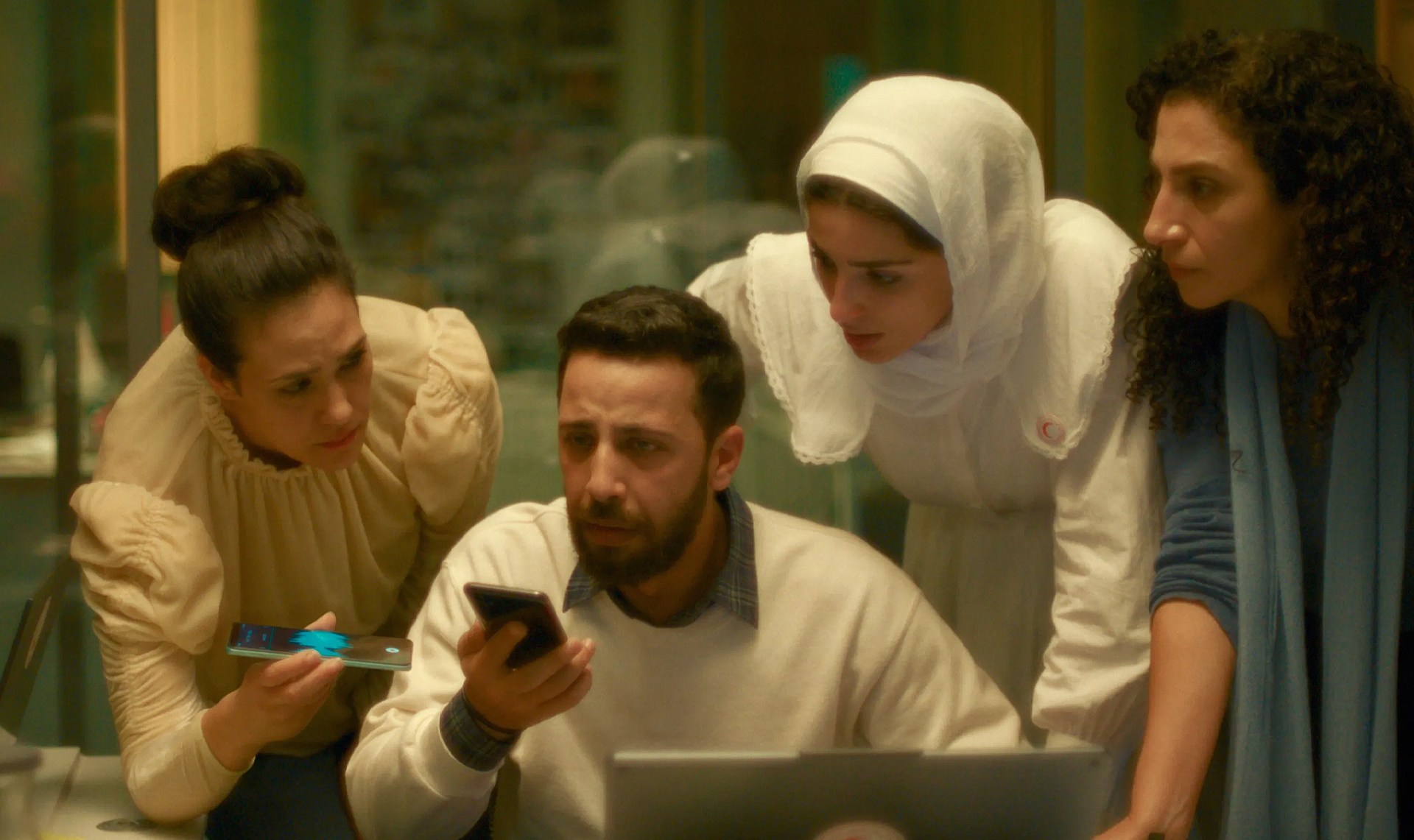

I’ve seen The Voice of Hind Rajab categorized by some as a documentary, which it absolutely is not. But I can see why some might react to it as if it were, since it uses real 911 calls (well, their equivalent) as part of its narrative, along with select doc footage from the day being re-created in this expertly constructed retelling of the events in Gaza on January 29, 2024.
Based on real events and set almost entirely in a call center of Palestine Red Crescent Society volunteers, the film constructs the work done to rescue a child named Hind Rajab, trapped in a car that came under fire by the Israeli army in a part of Gaza that the army has demanded be evacuated. The 6-year-old girl is the only living person in the car, which is otherwise filled by the dead bodies of family members. She’s understandably terrified, desperate to be rescued, with the sounds of gunfire and tanks clearly heard in the background. And every single second of audio you hear of her voice is real.
The call center is populated with volunteers trying to negotiate with various Red Cross and military liaisons in an effort to find a safe path to the little girl so that an ambulance can rescue her without getting blown up in the process. Saja Kilani (as Rana) and Motaz Malhees (as Omar) play the primary operators talking to Hind, while taking turns pressuring their supervisor (Amer Hlehel) to hurry up the process of arranging transport.
With a furious pace, emotionally driven tension, and heightened, unforgettable performances (as well as a runtime coming in at only 90 minutes), The Voice of Hind Rajab (Tunisia’s official Oscar submission for Best International Feature, recently shortlisted) is one of the more unforgettable and harrowing experiences you’ll have in this or any year. Writer/director Kaouther Ben Hania (Four Daughters, an Oscar contender two years ago) doesn’t hold back in showing the mistakes and miscalculations the Red Crescent team made in plotting this rescue and how emotions may have gotten in the way of cautious planning, but she does illustrate the use of an in-house therapist (Clara Khoury) who helped keep tempers in check (sometimes) and allowed the anxious operators to vent when necessary.
I’ve honestly never seen a film quite like this one, and you should make every effort to see it in a theater with other people, because somehow being around other humans feels like it would be a comfort after experiencing such a gripping, high-stakes work.
The film is now playing in Chicago exclusively at the Gene Siskel Film Center.
If you enjoyed this post, please consider supporting Third Coast Review’s arts and culture coverage by making a donation. Choose the amount that works best for you, and know it goes directly to support our writers and contributors.
