
When you examine previous films from Nia DaCosta (Candyman, The Marvels, Hedda) and the now-four-film 28 (Days/Weeks/Years) Later franchise, you’ll notice one important thing: they rarely repeat themselves. Ignoring the fact that 28 Weeks Later wasn’t written by series writer Alex Garland or helmed by primary creative force and director of two of the installments Danny Boyle, each jump forward in time also constitutes a shift into a different type of horror. Each film moves away from the zombie-like antics of those infected with the so-called Rage Virus and toward a world in which the humans are far more dangerous to each other.
After reinvigorating the franchise last year with 28 Years Later, Boyle and Garland created a world (or at least a small corner of it) decimated by a manmade force that allowed human anger to explode unchecked toward everything. It makes the scenario all the more compelling to think that this is an only slightly exaggerated version of the world we live in today.
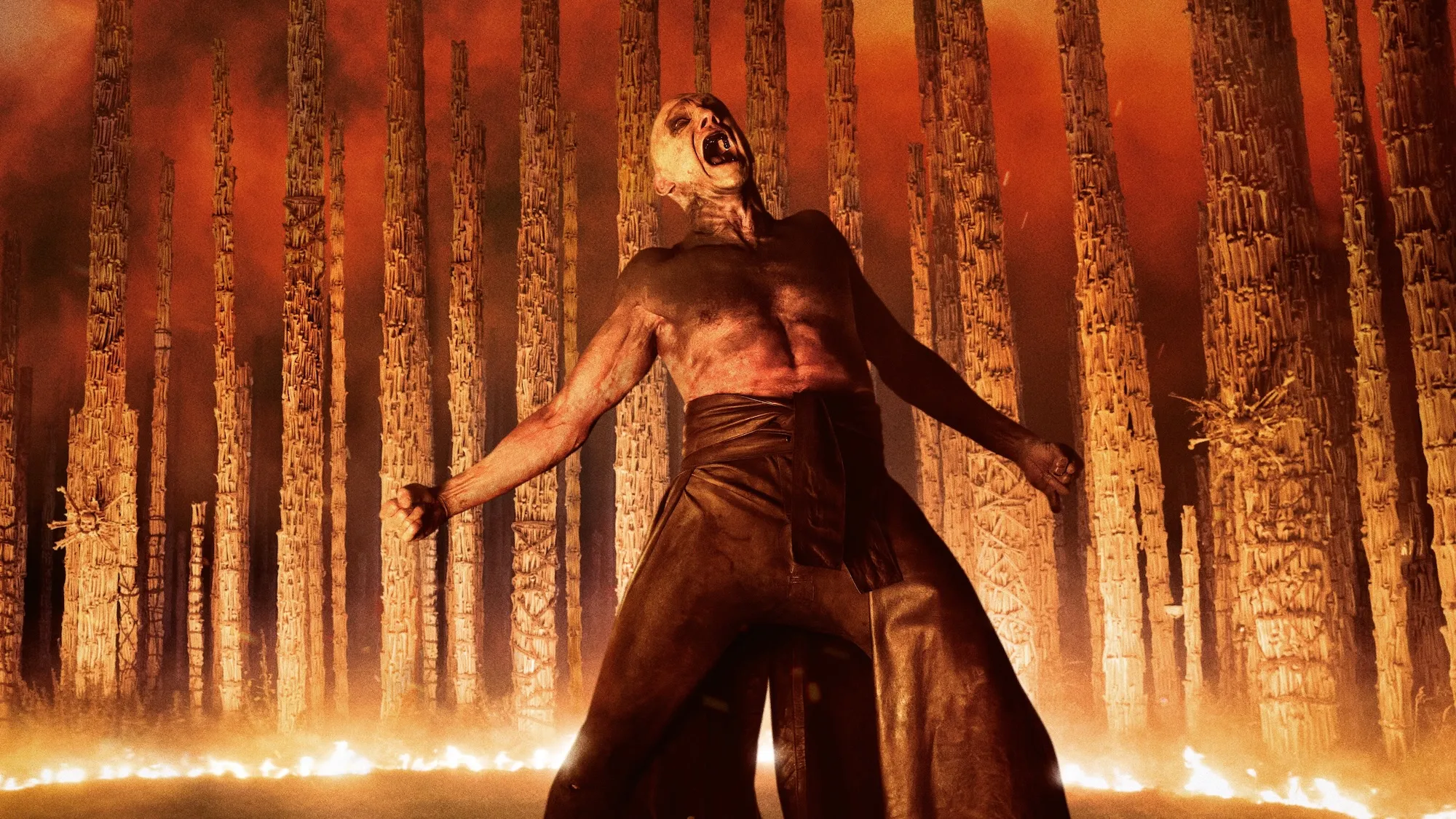
Then, the filmmakers introduced us to 12-year-old Spike (the terrific Alfie Williams), who ended that film running away from his safe home on an island off the coast of Britain after his mother dies from illness. In hopes of curing her, he had taken his mother to the recently discovered Dr. Kelson (Ralph Fiennes), who felt certain he might one day cure the virus. In the meantime, he has spent years building a memorial to the dead in the form of a temple of bones, as well as tree coverings also made of arm and leg bones. The visuals of that portion of the film are striking, haunting, and awesome, and by the time Spike decides it's time to leave Kelson’s protection, all we want to know is more details about the good doctor.
Again written by Garland, The Bone Temple picks up right were the last film left us, with Spike in the company of a roving band of well-trained killers known as The Jimmys (because they’re all named Jimmy), led by the flamboyant Sir Jimmy Crystal (Jack O’Connell), who believes himself to be the son of the devil. After proving he can protect himself (by accidentally killing one of the Jimmys in a knife fight), Spike dons one of the their required blonde wigs, assumes the name Jimmy, and begins to travel and do Crystal’s bidding, which usually involves torturing and killing whomever they cross paths with in their travels, all in the name of paying tribute to the devil.
Not far away from the Jimmys, Dr. Kelson continues his experiments with morphine and the infected (which seems to calm them down enough so they don’t to want to tear off his head and spine and eat his brains), in particular with a rather large Alpha specimen whom he names Samson (Chi Lewis-Parry). Kelson starts spending a great deal of time with Samson, with little fear of getting infected; he even falls asleep in his presence and wakes up in the morning untouched. The doctor is desperate to wrangle the creatures long enough to test out a drug cocktail on them in the hopes of curing, or at least bettering, their existence and making it safer for the non-infected, and initial results are promising. Kelson regularly listens to Duran Duran’s Greatest Hits album while he’s working and even throws on some Radiohead when he’s feeling especially productive. There’s no way I’m revealing the artist, title, and occasion of the final song played, but it’s about as epic a moment as any of these films have featured, and I was as shocked as anyone that it was part of a full-tilt, one-man dance recital.
Director DaCosta has done something remarkable in her Rage Virus entry, in that she’s made a film that is uniquely her own while still incorporating a bit of the style and technique used by Boyle in the past. She pays tribute to what has come before, acknowledges that this is a direct continuation of the films, and grows the mythology of both the infected and those who survive. The Bone Temple might also be the most emotionally resonant of any of the films so far. There is a beating heart at the center of the movie thanks to Fiennes' stunning performance, and although this is hardly going out on a limb, it confirms his status as the greatest actor working today.
Dr. Kelson is a living tribute to those who have been killed, either by the infected or because they were infected, and the melancholy he experiences every second of the day is immeasurable; Fiennes wears that soul-crushing feeling on his face and throughout his sinewy form (I’d guess he spends more time without a shirt in this movie than with). But hope also runs through him because he believes he may see a path to a cure, or at least a way to make the infected less grumpy, and that keeps him moving.
Although I don’t believe it has been greenlit, the film’s final sequence teases (in a major way) where the next—and possibly final—chapter of this series will go, and I may light myself on fire if it doesn’t happen. And a big reason for my excitement is that Erin Kellyman will be a part of it. In The Bone Temple, she plays one of Jimmy Crystal’s more vocal disciples, and she seems to be the only one who sees through most of his bullshit. She’s also the only one who seems protective of Spike, and where they land in the end of this film provides one of the great full-circle moments in modern horror history. And I need to see that story immediately.
The film is now playing in theaters.
If you enjoyed this post, please consider supporting Third Coast Review’s arts and culture coverage by making a donation. Choose the amount that works best for you, and know it goes directly to support our writers and contributors.
