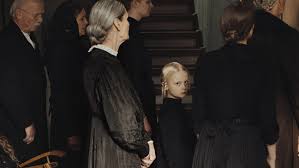
Towards the end of any given year, I find myself with a long list of films I want to see before the calendar flips over and not enough time to screen them all. I inevitably sift through the list and queue up films essentially at random; by this time in December, I've usually seen most of my priority films for the year and I'm looking for new discoveries or films I haven't heard much about but seem to be promising. Such is the case with Sound of Falling, a sprawling yet deeply personal journey through several generations of women by filmmaker Mascha Schilinski that I knew next to nothing about yet found myself completely enthralled by.
Shortlisted for the Best International Feature Film Academy Award (perhaps nominated by the time you read this), the German-made film is quite unlike any typical narrative American audiences may be accustomed to. Indeed, going into the film without knowing much about it, I found myself a bit lost in the film's first act as we're asked to follow several different storylines across several different periods. But Schilinski and co-writer Louise Peter do well to find through-lines among all the various players and stories and soon we are not only invested in each but recognizing the continuity across generations.
At its core, Sound of Falling is a story of girls, teenagers and women moving through a world that is not always kind to them, though the threats and sources of danger evolve over the years. The film takes place at the same countryside farm from the perspective of four generations between the 1910s and present day (the 1940s and 1980s make up the intervening years), and watching the way the land and space is used is as interesting as watching the family experiences.
In the earliest of the storylines, a young girl is haunted by the death all around her, observing quite a bit more than her little eyes should probably see and doing her best to try to understand it all. Though we see relatively little of the teenager in the 1940s, her story is no less daunting as she is left without any healthy outlets for her confusion around interpersonal relationships and her own future. Moving into the 1980s, we meet Angelika (Lena Urzendowsky) living on the farm with her parents and her uncle and cousin; she's a rebel and fully embraces every chance she gets to push boundaries and disobey her parents. There are sketchy family dynamics here, too, some of the most difficult to stomach in a film unafraid to be honest about the dark secrets inside every family. And finally, in the contemporary storyline, a family is renovating the old farmhouse while their elder daughter befriends a neighbor who, we learn, is struggling in her own way; despite the family's seeming healing from generations of trauma, these difficulties find them nonetheless.
Each of these storylines is moving in its own right; I found the relationship between young Alma (Hanna Hecht) and her grandmother particularly moving as they share quiet moments that seem to bridge any age difference. By the 1980s there's a communal and nearly jovial vibe on the farm with quirky group games played in the courtyard and Angelika's rambunctious energy seeming to bubble over into the world around her; it's deceiving, of course, as this is possibly the most dysfunctional generation depicted. But that just makes it all the more authentic, common as it is for danger to lurk under a façade of normalcy. Schilinski infuses each era with its own visual language with the support of production designer Cosima Vellenzer and cinematographer Fabian Gamper, but it's the sound design and score (by composers Michael Fiedler and Eike Hosenfeld) that is the real star of the show here. There are cues throughout that trigger an ache before too long as we understand it to mean that our heroines are teetering on the edge of losing it all.
Films that attempt to depict trauma and internal battles on screen are the most ambitious of all; realizing such an internal battle does not lend itself to visualization and a filmmaker can easily miss the mark. Though it differs in many ways, I found myself thinking of Barry Jenkins's masterpiece Moonlight while watching Sound of Falling, as they both move through the world on screen with soft yet brave intentions, aiming to surface the hard things that are no less true just because they're unspoken.
Sound of Falling opens in theaters in Chicago on Friday, January 24.
If you enjoyed this post, please consider supporting Third Coast Review’s arts and culture coverage by making a donation. Choose the amount that works best for you, and know it goes directly to support our writers and contributors.
