Enjoy our latest dispatch from the 2026 Sundance Film Festival...
Buddy

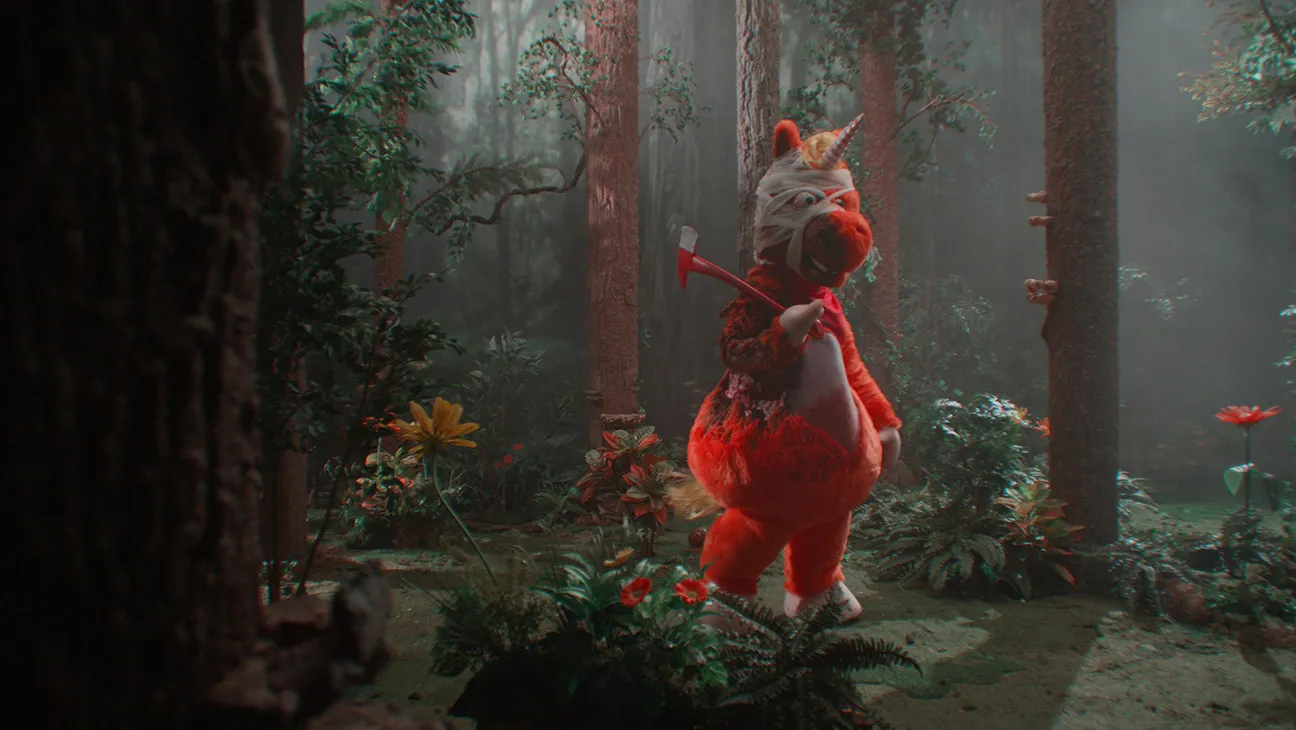
What begins as a fairly generic but quite authentic kids television show circa 1999 (a la Barney, with a hint of Pee Wee’s Playhouse), director and co-writer Casper Kelly’s first feature Buddy (part of Sundance’s opening night midnight programming) centers on the young cast of the show and their devotion to the show’s title character, a massive, bright orange, talking unicorn (voiced by Keegan-Michael Key, performed by Sergey Zhuravsky), who teaches them lessons about friendship, cooperation, and, most relevant to this story, being afraid (as one lesson song tells us, “You can’t be brave unless you’re afraid.”). After one of the kids refuses to wear magic dancing shoes that Buddy provides him, he suddenly disappears from the show and is replaced by another child who acts like she’s been on the show the entire time.
Director Kelly (who co-wrote the film with Jamie King) has contributed segments to V/H/S Halloween (“Fun Size,” arguably the best of that film), as well as helming the “Cheddar Goblin” sequence in Mandy, all of which makes sense when you see how dedicated he is to keeping the aesthetic and tone of an actual educational TV program here. There are a few talking pieces of furniture and other childhood staples (Patton Oswalt expertly voices a chatty backpack named Strappy). But when it becomes clear that the child stars of the Buddy show have been somehow kidnapped and brainwashed into being on the program, the movie switches to a more traditional story about a mother of two (Cristin Milioti) who is having panic attacks and nightmares that make her believe she and her husband (Topher Grace) used to have a third child, who turns out to be one of the kids on the show, and she sets out to find a way to rescue a daughter that no one else seems to even remember existed.
The back third of Buddy has the children escaping Buddy’s clutches and leaving the set for a magical place called Diamond City, where they believe they will be saved. Milioti does manage to get into the world of Buddy’s show but not exactly how she’d planned; the kids meet other escaped characters on their journey (hints of The Wizard of Oz); and eventually Buddy shows his true, horrifying form, and the film turns into a full-bore monster movie set in Buddy’s nightmare universe. Despite a slow middle act (although Milioti is a standout), Buddy is an ambitious, fun horror film that isn’t afraid to put kids in peril (something I fully endorse). The film seems built for watching with a crowd because when it’s good, it’s really funny and gory in a way a collective audience would devour. (Steve Prokopy)
Josephine

The first ten minutes of Josephine, the sophomore feature from writer/director Beth de Araújo, are some of the most difficult to ask an audience to watch, and the filmmaker’s choice to explicitly show the narrative’s inciting incident is a powerful—and unsettling—one. It sets the tone for a film that is as intense and assertive as it is frustrating and overwrought, a disappointing combination especially because what de Araújo is doing—giving women and girls a voice and an outlet for our constant subjugation to an abusive patriarchy—is so essential. More than the majority of what she’s doing here works, and for those who can stomach it, it’s a more than worthwhile film for many reasons.
Through the eyes of the titular young girl (Madison Reeves), Josephine becomes a harrowing journey navigating trauma, from behavior issues to haunting visions of the bad guy to family in-fighting that threatens to derail the legal system’s efforts to convict the man. Parents Damien (Channing Tatum) and Claire (Gemma Chan) are the most frustrating here, almost comically incapable of doing the right thing in these admittedly complicated circumstances; a more forgiving reading may be that if all of what we’re seeing here is through Josephine’s perspective, it would follow that her parents’ words and actions, all fumbling about and inexplicably harsh, are, too. It seems easier to stomach their ineptitude if one considers that it’s all an eight-year-olds’ interpretation, not what they actually said or did.
But that’s a generous take and a lot to expect from an audience already aching through this difficult premise; Tatum and Chan offer deeply committed performances, to be sure, with the former reminding us yet again that his acting chops go far beyond male strippers and the like. Greeves is the true revelation here, and some light reading into the making of the film makes it clear that de Araújo went to great lengths to protect the young actor from the real trauma the filmmaker based her script on. De Araújo clearly went to great lengths throughout the film; even as some moments hit the wrong notes, it’s nevertheless swimming in gorgeously filmed visuals, from lightscapes in Josephine’s city bedroom at night to a dry, tense courtroom scene that nearly sucks the life out of the room.
As Sundance premieres go, this one is sure to be remembered as a strong one, sparking conversations and eliciting a whole range of emotions from audiences. But I hesitate to join the chorus of those unilaterally singing its praises; no film is perfect (ok, few films are perfect), and Josephine is no exception, despite all it does get right. (Lisa Trifone)
Saccharine
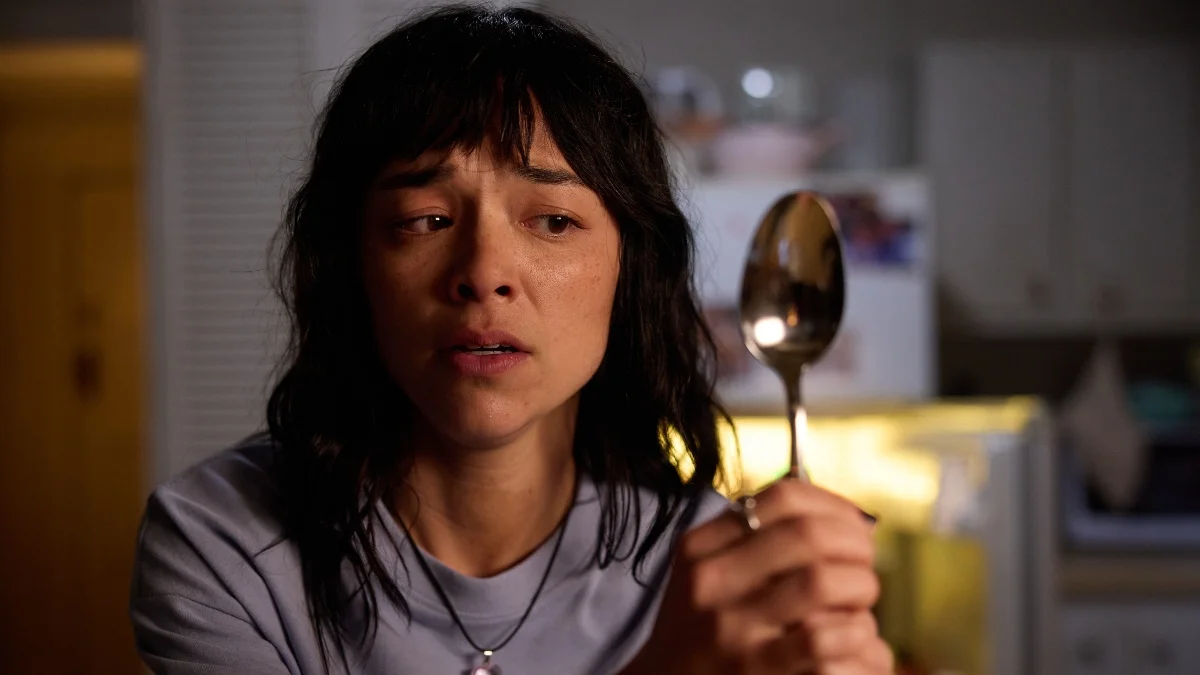
Taking a more cerebral approach to the horror game, the Australian ghost story Saccharine comes courtesy of scary movie veteran Natalie Erika James (Relic, Apartment 7A) and follows the troubled life of a young medical student named Hana (Midori Francis). She has spent most of her life chasing her goal weight after years of being teased about her it and commented upon by her “perfect” mother (Showko Showfukutei), while also having a father (Robert Taylor) who is morbidly obese. One day, she runs into an old friend whom she almost doesn’t recognize because of her weight loss thanks to some magical diet pill; when Hana runs tests on the drug, it turns out to be human ash from cremated bodies. But Hana’s body dysmorphia is so overwhelming, she takes the pills anyway, and the results are almost instantaneous. Because the pills are pricey and she has access to cadavers through med school, she begins to make her own using pieces of a rather large corpse that the students have named Bertha, and that’s when things go from gross to haunting.
Hana wakes up in the middle of the night in front of her refrigerator, having eaten everything in it, while still losing weight. She finally deduces that the ghost of Bertha is a part of her, physically taking her over while spiritually (and possibly literally) consuming her from the inside. Hana only catches sight of Bertha’s naked spirit when she looks at convex curved mirrors. It actually appears that Bertha is getting larger while carrying out this haunting and making her presence known by knocking objects around and making loud footsteps everywhere she goes. Saccharine tries desperately not to fat shame or otherwise make fun of anyone in the film who is concerned about their weight, but the film still feels a bit phobic about it, especially toward the end of the film when being heavy is the literal source of horror to Hana, who may only see Bertha in her mind and is running away from her life as a heavier person.
Still, the horror elements are measured and often effective, and the film attempts to give Hana a fully realized story, showing her at the gym frequently, partly because she has a crush on one of her instructors (Madeleine Madden), and the two do actually grow close before the film ends. The great Danielle McDonald is frequently on hand as Hana’s best friend and fellow med student Josie, who isn’t so much a fully realized character as she is a doubt/worry machine about everything Hana tells her. I’m also not sure the scenes with her parents work since one feels like a parody of an overly attentive Asian mother figure, while her father is basically just Brendan Fraser in The Whale—two sides of the same derivative coin.
By the time Saccharine turns into a full-bore monster movie in the final act, it has basically abandoned most of the psychological horror that informs the early parts of the film. The film is at its best when we’re not sure if Hana’s ghosts are real; it keeps us leery of our protagonist’s mindset and fragility. But once we know the truth, the movie loses something, including much of its power as a moving character study. (Steve Prokopy)
Support arts and culture journalism today. This work doesn't happen without your support. Contribute today and ensure we can continue to share the latest reviews, essays, and previews of the most anticipated arts and culture events across the city.
