Enjoy our latest dispatch from the 2026 Sundance Film Festival….
Ha-Chan, Shake Your Booty!

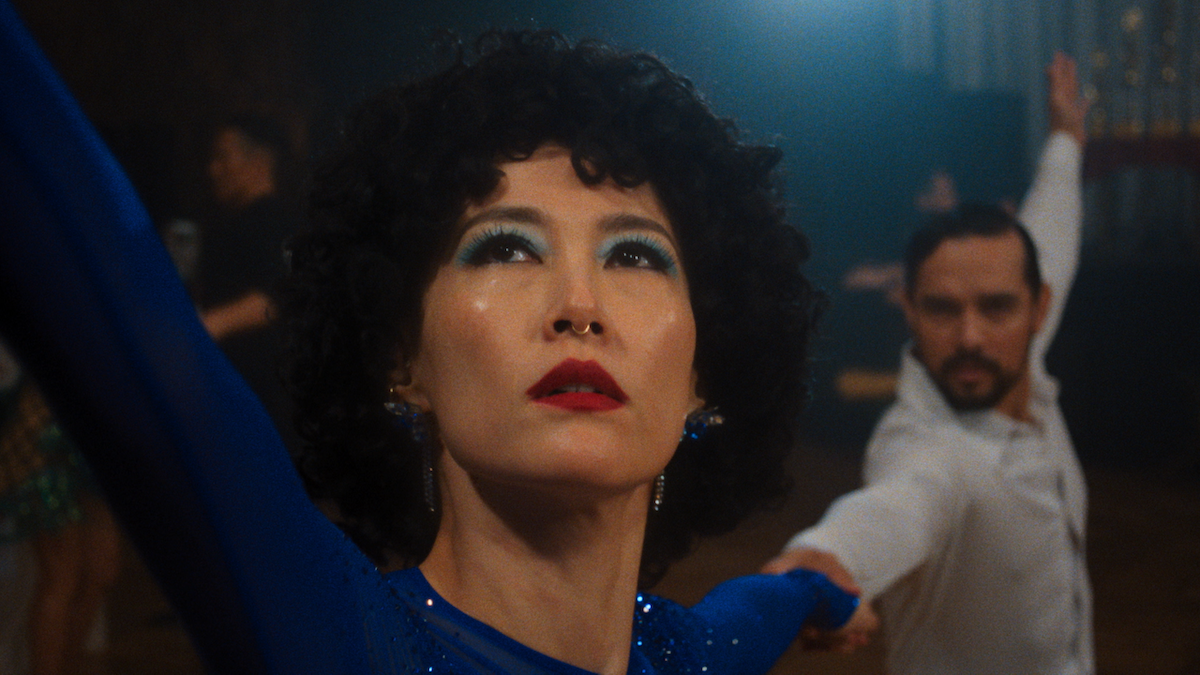
If Sundance Film Festival is about discoveries, a film like Ha-Chan, Shake Your Booty! Surely fits the bill. Directed and co-written by Josef Kubota Wladyka, who has primarily worked behind the camera on episodic projects, this oddball comedy-drama-musical is a cross cultural delight that knows just when to pull at the heartstrings.
Rinko Kikuchi stars as Haru (aka Ha-chan), a vibrant and outgoing woman (as her big, permed hair and bright, can’t-miss-her wardrobe would indicate) living in her native Tokyo with her Mexican husband, Luis (Alejandro Edda). They bond over ballroom dancing, but when Luis unexpectedly drops dead during one of their competitions (not a spoiler!), Haru’s life is upended and she finds it next to impossible to reclaim the joy they’d once shared.
Co-written with Nicholas Huynh, Ha-Chan, Shake Your Booty! takes plenty of left turns and offers more than a few surprises as we follow Haru through this difficult time in her life. There’s comedic relief in the form of her two besties trying to get her on dating apps and discussing the frustrations of being back on the market. There’s the heartbreak of losing one’s partner, as Haru finds herself in the now-empty apartment she shared with Luis. There’s romance and drama, of course, and most wonderful of all, there are big, bold musical numbers complete with costumes and choreography. It would be fair to think none of this should work so well together in the same film, but Wladyka and his talented cast and crew make it work with aplomb.
At the heart of it all is Kikuchi’s charming and earnest performance, fully embracing the unpredictable journey grief sends us on and making it easy to fall for her as she fumbles through how to move on with her life. The cynics will say Ha-Chan, Shake Your Booty! is too this or too that, not rooted in reality and too campy for its own good. But this movie is not for the cynics. It’s for the dancers, the lovers, the ones knocked down by life and willing to get back out on the floor anyways. (Lisa Trifone)
The History of Concrete
Having only been exposed to the wildly popular HBO series How to With John Wilson in bits and pieces during its three-season run, I had a fairly good idea what to expect from Wilson’s feature debut, The History of Concrete. The premise begins with him attending a workshop about how to write and sell a Hallmark movie—a deep dive into the elements it takes to create a successful Hallmark film, the more formulaic, the better. But like with his series, the best moments of humor and insight come from his tangential style of filmmaking, in which he allows himself to be easily distracted by his own curiosity, often to quite moving results.
He does actually tackle the history of concrete as a building material, but zeroes in on his beloved New York City to really see how the concrete infrastructure of the city is crumbling around its residents, often in potentially dangerous ways. And even those seemingly on-point observations lead him into a profile of a company that power-washes gum off sidewalks, a montage of scribblings in concrete sidewalks, and even construction right outside his own building. We also get deeply ingrained in his struggle to find financing for the very movie we’re watching, and even when he turns to his old friends at HBO, they demand an appearance by a known music figure (apparently, music docs are big on HBO right now), leading Wilson to search for just the right musician to profile and becoming its own weirdly tragic story.
Every step in Wilson’s journey is a fascinating and often hilarious exercise in impulsive filmmaking. We never know exactly which way the prevailing wind will take him, but he always finds ways to make the journey interesting and to find his way back to his original story about concrete. Of particular interest to me is a trip he takes to Las Vegas to the annual World of Concrete convention—an event I attended probably 15 times in a previous life when I used to write for business journals that focused on the construction materials industry. The History of Concrete is part education, part philosophy lesson, part strange tale about an environment that all of us walk upon every day but rarely look down and notice whether it’s sturdy or crumbling below us. To say Wilson makes the subject interesting doesn’t begin to cover his skills as a filmmaker or a comic force. (Steve Prokopy)
Wicker
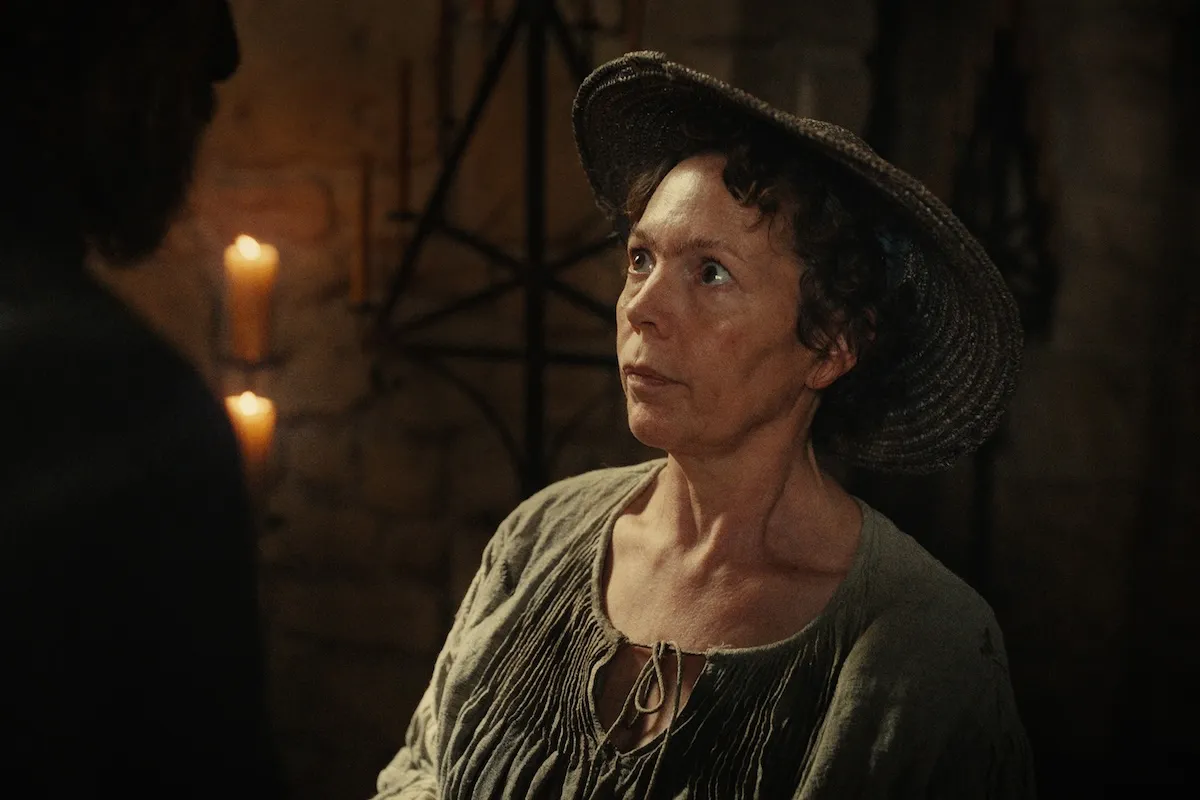
In their follow-up to 2020’s Save Yourselves!, filmmakers Eleanor Wilson and Alex Huston Fischer weave a truly bizarre but utterly captivating tale (adapted from an Ursula Wills short story) of a medieval fisherwoman (Olivia Colman) who has given up assuming any sort of love will ever appear on her doorstep. This isn’t the worst news, considering the relationships she sees in the village where she lives, in which women are expected to simply perform their wifely duties—including in the bedroom—with no real thought given to their own pleasure. One day, partly to be kind and partly to stir things up in the village, the local basket weaver (Peter Dinklage) creates an entire, fully functional man out of wicker (Alexander Skarsgård, behind expertly crafted makeup courtesy of the fine artists at Weta Workshop) and delivers him to the Fisherwoman (none of the characters in Wicker have names; they are all referred to by their occupation) as her husband.
Naturally, people are initially terrified of this creation, but as they get to know this wicker man and how much he truly grows to love his wife, people start to grow envious, especially the women, some of whom want a piece of this wicker action. Elizabeth Debicki plays the Tailor’s Wife, who can’t stand her selfish husband and sets her sights on this devoted Wicker being, with the entire film forcing us to unlearn what some think about when it comes to commitment, marriage, and actual romance. Although the wicker man only has eyes for his wife, she still gets insanely jealous when Dinklage makes a wicker baby for another woman in town who wants a child, and the Fisherwoman thinks the baby is the result of a dalliance on her husband’s part.
I’ve never seen anything quite like Wicker, and that’s fully a compliment to the creativity and eccentric, surreal atmosphere that the filmmakers and performers commit to wholeheartedly. The authentic period feel of the work, combined with the re-imagining of what a romance film can be, makes Wicker a true work of heartfelt art. Also, it’s impossible to convey just how good Skarsgård is in this part—sincere, a bit lost living among flesh-and-blood people, and made as much by love as he is wood. In the space of one week, I saw him in three film (Pillion and The Moment round out the trifecta), and each performance was both the best thing in those movies and uniquely different from each other. But this might be the best and most original of the bunch. (Steve Prokopy)
If you enjoyed this post, please consider supporting Third Coast Review’s arts and culture coverage by making a donation. Choose the amount that works best for you, and know it goes directly to support our writers and contributors.
