Enjoy our latest dispatch from the 2026 Sundance Film Festival…. Next year, it will be Boulder.
Knife: The Attempted Murder of Salman Rushdie

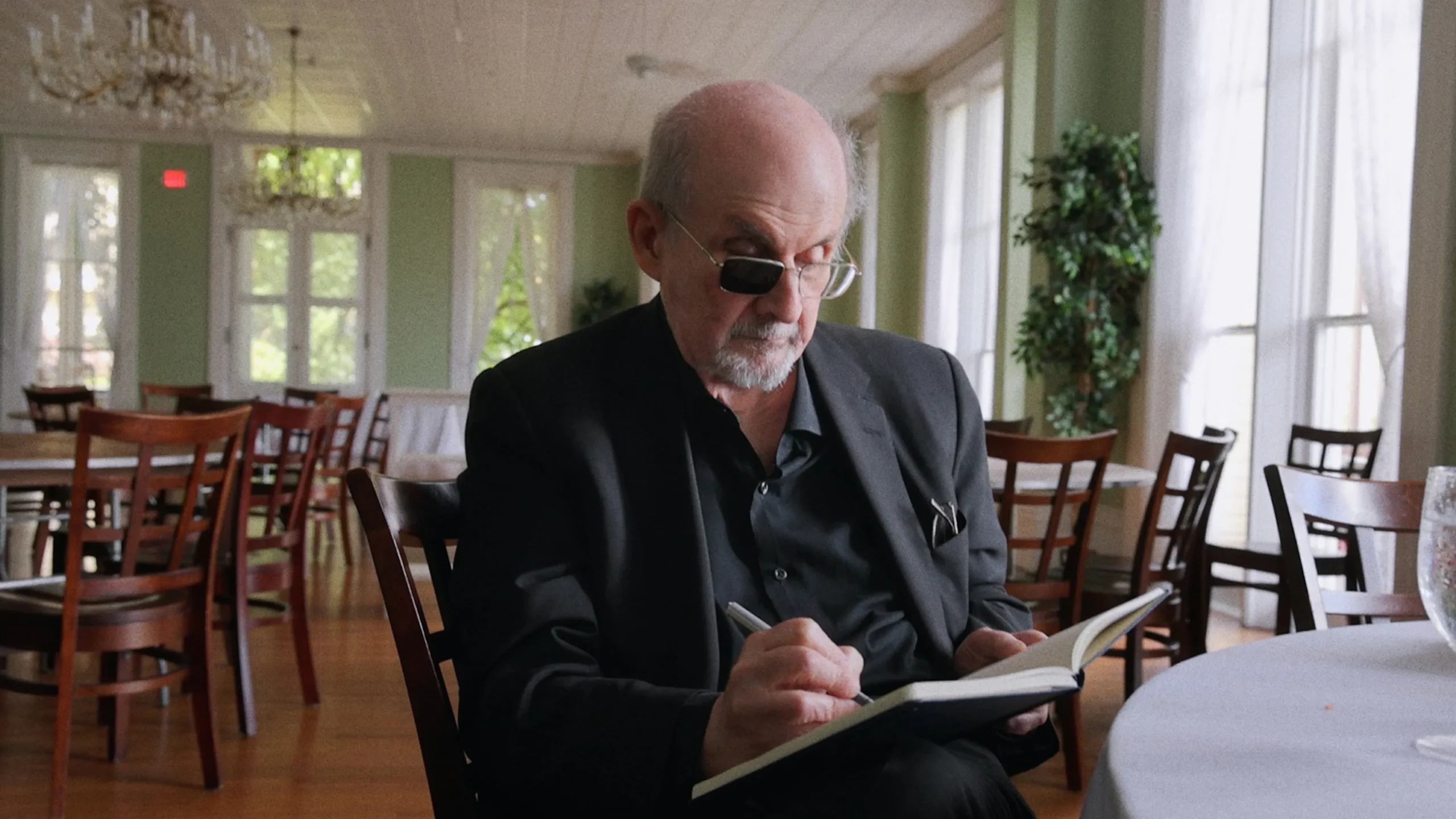
One of the strongest docs at Sundance this year comes courtesy of prolific festival regular Alex Gibney (Taxi to the Dark Side, Enron: The Smartest Guys in the Room, Wise Guy: David Chase and the Sopranos) and is based on Salman Rushdie’s memoir Knife: Meditations After an Attempted Murder. Whereas Gibney often narrates his own documentaries, with Knife: The Attempted Murder of Salman Rushdie, he turns the narration over to Rushdie, who was stabbed multiple times in 2022 while on stage at an event; the film allows him to tell his own story of the events in his life that led to the attack, the attack itself, and his long and painful recovery with wife Rachel Eliza Griffiths documenting every intimate detail.
Rushdie chronicles the controversy and subsequent death threats against him after the publication of his 1988 novel, The Satanic Verses, which was inspired by the life of the Islamic prophet Muhammad and resulted in the entire religion calling for his death. He details his career, writing process, popularity, and his slow, cautious journey back into public life. He makes the point that the man who stabbed him wasn’t even born when Verses came out, so his anger was learned over time. Using his recovery as the framework to tell his life story, he also uses the opportunity to reflect on religious violence, free speech, and the artist as a vulnerable public figure. He makes it clear to his wife during the filming that he wants to show it all, so some of the footage is fairly gruesome.
By the time Rushdie gets to the point in his story when he recounts the attack (which was captured on video and is held until the end of the movie), his thoughts and discussions turn to forgiveness and wanting to have a conversation with his would-be murderer. He even imagines what that conversation might be like, and Gibney does a remarkable job approximating the two of them, separated by glass, talking to each other. Knife captures Rushdie as a loving husband, grateful to still be alive, and having a supportive spouse who rarely leaves his side. The overwhelming emotional toll of such an incident on both Rushdie and Griffiths is captured with sensitivity; things even end with a sense of optimism as Rushdie not only repairs his body but also his soul. Less a film and more of a healing journey, Knife will make you cry and soar, sometimes both at once. (Steve Prokopy)
Gail Daughtry and the Celebrity Sex Pass

Although David Wain’s (Wet Hot American Summer, They Came Together) latest comedy is most definitely R-rated, there’s something oddly wholesome about his approach and the characters, which is probably rooted in the fact that the film is a rough retelling of The Wizard of Oz, complete with easter eggs and other, more direct parallels that I won’t go into here. Some will certainly enjoy looking for the two stories to line up, which is certainly a distraction from the fact that Gail Daughtry and the Celebrity Sex Pass isn’t a particularly good film.
Gail (Zoey Deutch) is a Midwestern bride-to-be who enters into a playful, hypothetical game of “celebrity hall pass” with her fiancé. But unexpectedly, her fiancé meets (and sleeps with) his designated celebrity, thinking Gail is cool with it but actually sending her into an existential crisis. She and her best friend and fellow hairdresser Otto (Miles Gutierrez-Riley) decide that the only thing Gail can do to snap out of her relationship panic is to head to Los Angeles to find and seduce her celebrity pass, Jon Hamm. Along the way, a pair of mob enforcers (one of whom is played by Joe Lo Truglio) are after them after Gail accidentally switches cases with them at the airport, theirs belonging to a major mob boss. On her journey toward Hamm, Gail and Otto pick up a few weary travelers, including Wain’s co-writer Ken Marino, Hamm’s Mad Men costar John Slattery, and Ben Wang, who help them on their quest. They also run into an assortment of random celebrities that provide fun cameo appearances but not many actual jokes, which is a big part of the problem with the film.
Gail Daughtry and the Celebrity Sex Pass has a few laughs scattered throughout, but so much of it depends on broad humor about people laughing too long or performers overacting. There are a few choice sight gags, but the film isn’t unhinged enough to be truly considered a proper screwball comedy. There are forced gags about being a Hollywood hanger-on, and Wain and Marino’s screenplay has some commentary about caper movies and wacky sex comedies, but even those don’t hold together the way Wain’s previous films have. The hardest I laughed in this movie was at a random cameo thrown in during a wedding scene; there’s something about the random nature of it that struck me as absurd, and I wish more of the film had been like that. Even Deutch, whom I find charming and funny in pretty much everything she does, seems to be forcing things here. The jokes are plentiful; the laughs are scarce. (Steve Prokopy)
The Weight

One of the most unexpectedly solid works at Sundance this year was The Weight, the feature debut from Padraic McKinley (an editor on series such as American Gods, The Good Lord Bird, and Poker Face), which takes the basic structure of Wages of Fear/Sorcerer and transfers it to walking through the deadly wilderness of the Pacific Northwest circa 1933. Ethan Hawke plays Samuel Murphy, a single father of daughter Penny (Avy Berry), who is sent to prison after a mishap with Oregon police. Murphy is sent to work on a road gang clearing rocks for a road when the prison official in charge of the gang, Clancy (Russell Crowe) decides he trusts Murphy enough to lead a special assignment after he selects a couple other prisoners to join him on this perilous mission. If they succeed, they get paid handsomely and get out of prison early, which is something Murphy wants desperately so he doesn’t lose his daughter permanently.
Taking place during the Depression, the job involves hauling backpacks full of gold bars across the mountainous terrain trying to avoid all forms of hazards, both natural and manmade. The point of the mission is to keep the gold out of the hands of the government, and if they lose even one bar, they will all be killed by the overseers who are traveling with them. Austin Amelio, Alec Newman, and Avi Nash play the other convicts, while Julia Jones plays an indigenous woman who had been working at the gold mine and was ready for a change, and she ends up becoming one of the most important members of this ragtag bunch. By the time the group reaches a perilous rope bridge that forces the group to throw each gold brick individually across a deep ravine so as not to break the bridge, I was physically exhausted from The Weight, which is absolutely a high compliment.
Every step of this film is tense, no character can be trusted; Hawke is our entry point into this story, even though we rarely know exactly what he’s thinking from moment to moment. Each of the characters is given enough of a backstory that we understand a bit about what drives them and why they’re risking their lives to make this haul. Their survivalist instincts (or lack thereof) are well defined, and the writing is better than most adventure films. We expect violence to erupt out of almost every scenario, and quite often, it does. It’s a film with heft and menace and muscle and stunning landscapes and a bit of the old gold fever that makes sane men lose their minds. The morals in The Weight are ever changing and keep us on our toes for the duration. If I had one complaint about the film, it’s that it probably is too epic to play at Sundance, but that doesn’t keep me from being glad it did. (Steve Prokopy)
If you enjoyed this post, please consider supporting Third Coast Review’s arts and culture coverage by making a donation. Choose the amount that works best for you, and know it goes directly to support our writers and contributors.
