This article was written by Nick Glover.

17 Again and Freaky Friday better be watching their backs, because the body-switching flick might have a new all-timer.
The new release from Ladyworld and Please Baby Please filmmaker Amanda Kramer, By Design follows a loose-knit cast of revolving central characters, each of whom momentarily attach themselves to this film’s MacGuffin: a one-of-a-kind chair.
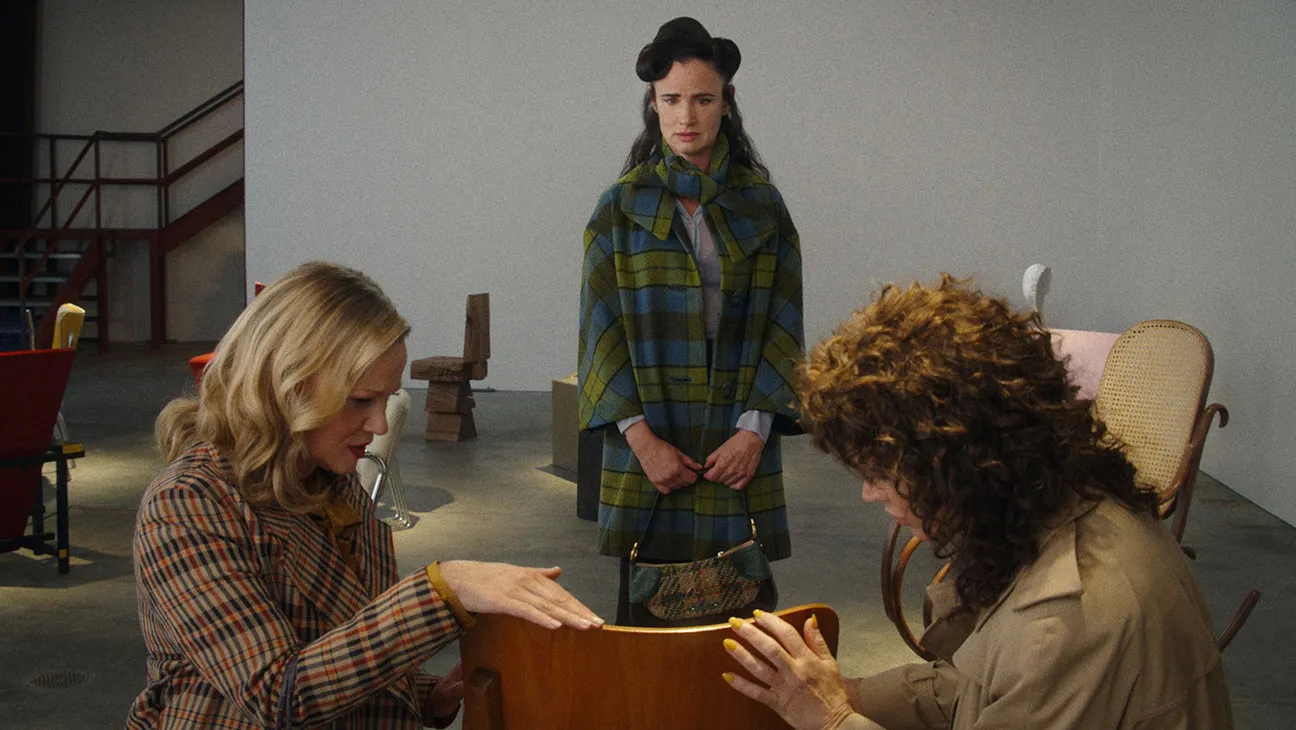
One of the two major pieces of the film’s plot is Camille (Juliette Lewis), a lonely career woman. Camille finds this weirdly special chair while out shopping at a chair store with her two best friends. Though at first disappointed by the selection of seating around the trio, she sees, from across the room—romantic music and all—the chair she was just meant to find.
After finding out the price of this item that quickly becomes all that matters to her, Camille returns the next day, money in hand, ready to purchase the chair. When a return sticker is tied around the arm, Camille breaks down and there’s seemingly only one option left: swapping her soul into the chair. The chair, which now contains Camille’s soul, is given to Olivier (Mamoudou Athie) as a parting gift from his partner (Alisa Tores). Olivier quickly forms a deep bond with the chair and typical body-swap hijinks happen from there.
Though the central feature of the film might read a little contrived on paper, on the screen, there’s not a doubt that body-swapping into a chair actually works as a plot, somehow. The film’s spacious set design and wide-angled, almost painted scenes are the key to this. A mystifying performance from Lewis is certainly not a detractor, and Melanie Griffith’s narration never hurt either, though.
Most importantly, for the film to succeed and hook a viewer's attention for a full 90 minutes, the chair, of all things, must be stunning. And, I've got to give it to Kramer and the crew: their chair truly is. The miraculous invention of the film is that it treats each piece of the set as if it were its own actor, its own unique world. Kramer readjusts our eyes from the human figures—boring us with a splayed, motionless Camille—to the chairs, the shadows on the walls, and the sights out the windows.
Because of this turn to aesthetic and physical beauty, when people appear on screen, they feel artificial and made-up, their movements dance-like and rehearsed. A mix of ballet, interpretive dance, and miming, moods and feelings are passed to the viewer, not through dialogue or even plot, but through the subtle hints and cues of arms and legs.
By Design is excellent, joltingly alive, and enchanting. It captures something uniquely real about what it feels like to be different and to feel like you don’t fit what you’re supposed to be. Griffith’s narration adds to this emotional depth, unveiling layers and layers of what is means to be flawed and still living through it.
If you enjoyed this post, please consider supporting Third Coast Review’s arts and culture coverage by making a donation. Choose the amount that works best for you, and know it goes directly to support our writers and contributors.
