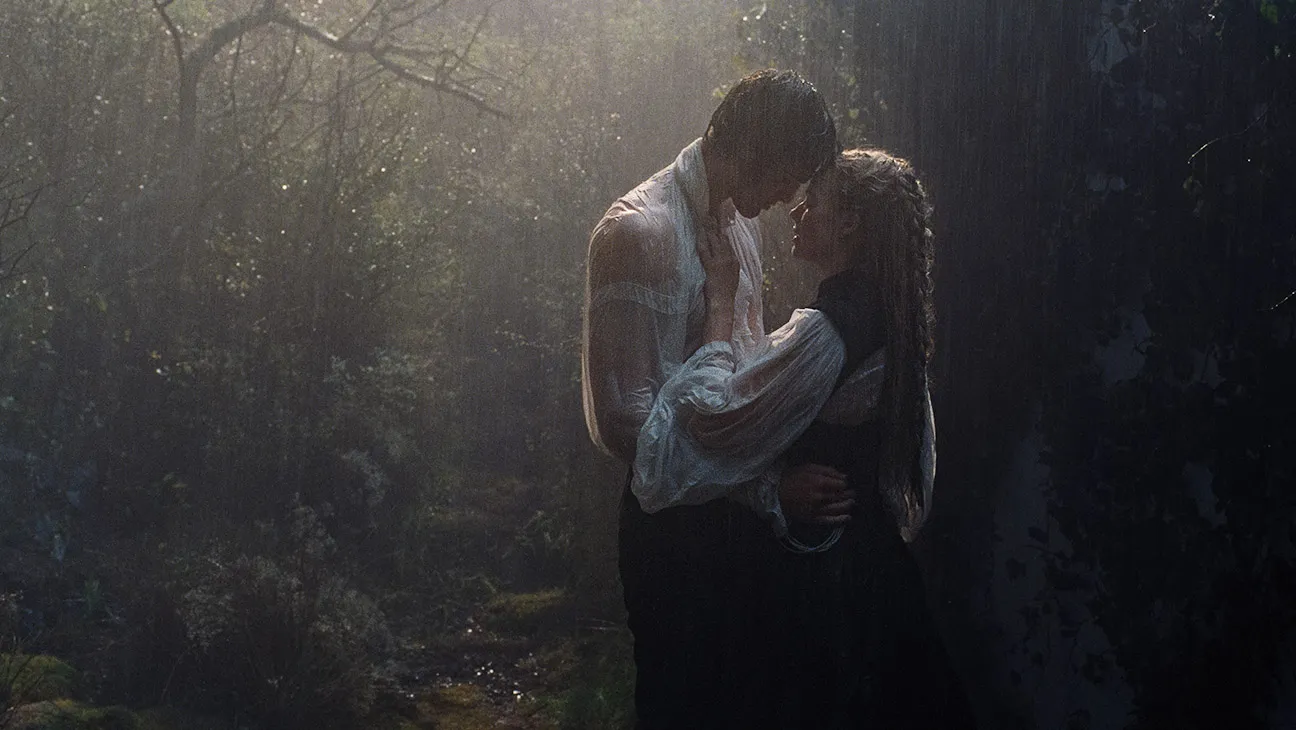

Whether or not you read (or were forced to read) the 1847 novel by Emily Brontë doesn’t really factor into the viewing of writer/director Emerald Fennell’s adaptation of Wuthering Heights. It should come as no surprise that the filmmaker behind Promising Young Woman and Saltburn has put her own twisted spin on the tragic love story of Cathy (Margot Robbie) and Heathcliff (Jacob Elordi), whose passion for one another is initially forbidden by class. But when their status in society becomes about equal, the taboo nature of their relationship becomes more about outsiders’ eyes judging them for their history together. And the fact that she marries someone else doesn’t exactly help the situation.
Growing up together since childhood, Cathy was the daughter of a glutton of a father (Martin Clunes), who drank, gambled, and just generally misbehaved. But he did have a soft spot for wayward youth, taking Heathcliff in as something of a pet for Cathy, who already had a companion in the form of ladies' maid Nelly (Hong Chau). Even as a child, Heathcliff was madly in love with Cathy but could do nothing about it. When they grow up a bit, thinking Cathy wants nothing to do with him, Heathcliff leaves Wuthering Heights to seek his fortune abroad and return a gentleman, worthy of her. Thinking he was gone forever and watching her father’s estate crumble beneath them, she agrees to marry Edgar (Shazad Latif), who has a young ward of his own in Isabella (Alison Oliver).
Inevitably, Heathcliff returns ready to rekindle whatever feelings he and Cathy may have had, but when he discovers that she’s married, he grows possessive and threatens to take out his sexual aggression on the vulnerable and eager Isabella. Eventually, their passions can no longer contain themselves, and Cathy and Heathcliff start a torrid affair, having romantic encounters on every horizontal (and vertical) surface in their little corner of the bleak Yorkshire moors. No rock or patch of tall grass is safe from their lusting. And yes, I get that these two insanely attractive people are drawn to each other, but give us something more than animal magnetism that connects them. Fennell has stripped away a great deal of the shared trauma and socioeconomic strata of these characters and replaced it with wild groping.
However much Wuthering Heights (Emily Brontë’s only novel) might be historically looked upon as a wildly romantic work with a touch of madness, the truth remains (perhaps with this film more than any other adaptation) that it’s a story front loaded with truly awful, selfish, vengeful characters—a specialty of Fennell’s. Perhaps they are meant to represent the worst of us while we’re involved in toxic relationships, and that’s fine, but it makes it near impossible to find an entry point into this tale of people doing one terrible thing after another to each other in the name of love. Some audience members might find it sexy or erotic, but I doubt anyone will leave the film seeing it as a roadmap to romantic fulfillment. (Sidenote: the best film version of this story remains William Wyler’s 1930 adaptation, starring Merle Oberon and Laurence Olivier.)
Fennell knows how to compose a shot, make her actors looks exactly as desirable or deplorable as she requires, and make the landscape surrounding her performers appear vast, foreboding, even threatening. The costumes in Wuthering Heights are award worthy, and I had no real issues with the performances. My greatest hesitation about the movie is the nasty tone that asks us to empathize with terrible human beings. I certainly don’t have issues with having unlikable characters at the center of certain films, but the filmmaker still has to invite me into this place where they want me to spend more than two hours. The emotional volatility is a great deal of clanging and rattling with nothing to show for it in the end. I wanted any type of connection from a movie that seemed more interested in pushing us away.
The film is now playing in theaters.
