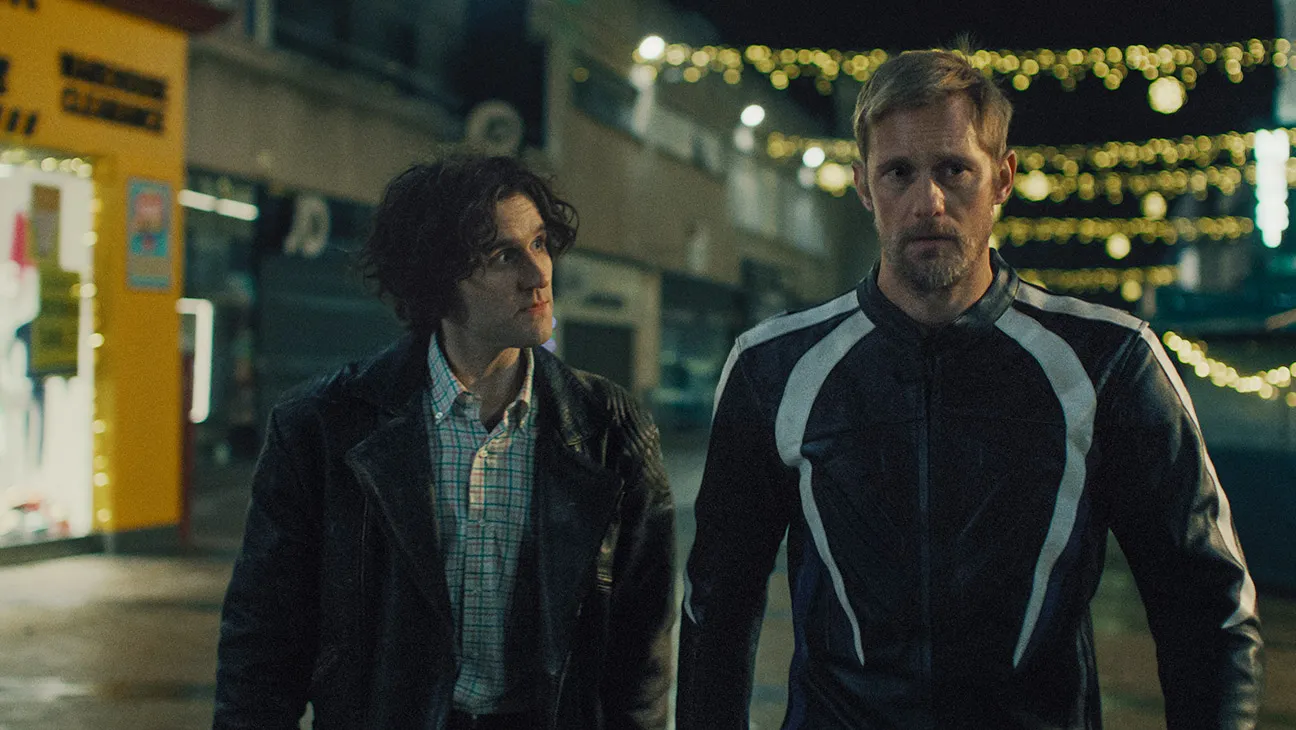
At its heart, Pillion is the story of a timid, gay British man named Colin (Harry Melling, the Harry Potter films, Please Baby Please, The Pale Blue Eye) who is swept off his feet when enigmatic, impossibly handsome biker Ray (Alexander Skarsgård, who can also be seen in The Moment right now) takes him on as his submissive. The film’s look at the queer biker subculture and the BDSM lifestyle may shock some, but if you can release your pearls and loosen up a bit (something Ray would heartily encourage), you’ll find that Pillion is a deeply moving, resonant love story about giving over control to someone else out of trust and possibly love. Melling and Skarsgård are funny together, both because they are charming in very different ways, and their physical stature when standing next to each other is amusing. Read our full review of Pillion now.
Based on the book Box Hill by Adam Mars-Jones, Pillion also marks the feature writing/directing debut of British filmmaker Harry Lighton, who has won numerous awards for his many short films and was just named one of Variety’s directors to watch for 2026. The world watched Harry Melling grow up as he appeared in the Potter films as Harry’s awful cousin Dudley Dursley, but he went on to play a variety of roles in film, television and on stage, including The Lost City of Z, The Current War, The Ballad of Buster Scruggs, the His Dark Materials series, The Old Guard, The Queen’s Gambit series, The Tragedy of Macbeth, and the Wolf Hall series.
I had the chance to talk with both Harrys recently in Chicago, and we went into the minutiae of what it took to adapt the book, researching the gay biker club world, and working with the fearless Skarsgård. Enjoy our conversation.
I saw the film the day before I flew to Sundance, where I saw Alexander Skarsgård in two other films, so I saw him in three movies in one week.
Harry Melling: Wow, a week of Skarsgård!
I was stunned to discover how fearless he has become across these three very different roles. He throws his entire body into all of these performances.
Harry Lighton: I haven’t seen the other two, but I’m going to see The Moment the minute I get back next week.
Both of you, talk to me about working with him as a collaborator. What’s it like to work with someone who seemingly never says no.
HL: Yeah, once he says yes to the script, he’s in. He is very up for finding the most interesting way to do something. “Fearless” is definitely the right word. From some perspectives, there is stuff to be scared about in a script like this, but he and Harry never had a conversation about it being intimidating, maybe because he didn’t find it intimidating. There’s a lot of narrative meat in the sex scenes, and I think that became the center-point of our discussions around them.
HM: Yeah, it wasn’t ever about how to look good whilst having sex. In fact, it was probably the opposite: how do we make this as clumsy and awkward as possible, because we’re telling the story of this guy who doesn’t know what he’s doing, aka Colin. That to me alleviated a lot of the nervousness and stress of making it sexy, because it was pushing the narrative along.
One of the things I noticed about the film was that every sex scene is forwarding the story in some way, or giving us information about these characters, well beyond whether they’re good at sex or not. When you were adapting this, was that something you kept front of mind?
HL: I worked it out early on, because the communication between Ray and Colin is deliberately faulty because Ray is refusing to give Colin any information. I thought the sex scenes would be a refreshing moment of relief for the audience when communication is actually direct between. In all of the sex scenes, they’re learning things from each other, and the audience are also learning things about them. They were the first scenes I wrote, and I used them as something of a three-act structure almost, and then filled out the material in between.
HM: Also, to take the sex scenes out of this movie, the movie doesn’t really exist. They’re so vital for how the entire movie exists.
Let me back it up to when you first got your hands on this book. Were there themes that you were already thinking about in terms of something you wanted to explore in a film that you found in this story? How much leeway did you give yourself to putting things into your screenplay that you wanted to explore?
HL: I gave myself lots of leeway, but at its core, I thought the book was a story about someone coming of age through a sexual experience that exists outside of the norm of both gay and straight culture. I knew that was something I wanted to look at. Then the next question for me was, “If that’s going to be the core and I’ve found this tone that excites me—which is also in the book, between humor and sincerity—what other changes can I make to tell the story I want to tell?” The parents would be a good example of that. In the book, the parents sweep Colin’s sexuality under the carpet, but I felt like I’d seen that before, quite a lot. I have quite a short attention span as a viewer, so I wondered what would be a more interesting or original version of that parents-of-a-queer-kid narrative. And extreme acceptance followed by the parents withdrawing their acceptance seemed more interesting.
I can’t think of any version of this story where I’ve seen that dynamic occur before. You do not expect that shift, but you also understand it to a degree. That’s got to be scary for parents to see their child going through something like that.
HL: It’s a very defensible reaction from the parents, but I also think Ray has a point—they are mapping their idea of what makes a good relationship onto their son. At the same time, can you have a relationship with someone who refuses to tell you their last name or anything about them? How much longevity is there in that? Their concerns are valid, for sure.
Let’s talk about power dynamics for a minute, because I feel like in any relationship there is a balance of power that is constantly in flux, hopefully in a healthy way. The thing I’d never considered until watching this story of a power dynamic that is all on one side is that there’s an incredible trust that has to be given by Colin in order for this to work. Tell me about this relationship in those terms.
HM: What’s really important when I was playing Colin, especially in the early stuff when he’s inexperienced as to what this dynamic is, was to make sure it was clear that he was a willing participant, although he doesn’t know quite what this is or where it’s going, but he’s up for it and he wants it. So in the alleyway scene when Ray asks him, “What am I going to do with you?” and Colin says, “Anything you want,” that is a genuine answer. He literally saying “I am game; I’m ready.” And after the blowjob, but not a very successful blowjob—a no-job . After that, Ray leaves, and Colin is left on his knees and the camera is quite close to him, and he looks up as Ray leaves, and there’s a massive smile on his face. He’s thrilled at what has just happened, and you’re right, he doesn’t quite know the parameters, that’s ahead of him in terms of his journey to understanding the boundaries of what he needs and wants. Still, he’s very much an active participant, even though he doesn’t make the rules. It’s a complex, knotty thing that Harry has written, which is great.
Giving over that much trust to someone is romantic in a lot of ways. Was that something you wanted to get across?
HL: There is a romance in it. The thing about romance, though, is it depends on your perspective. So Colin and Ray have two different ideas of romance, so that Colin giving himself over to Ray is a sign of enormous romance—Love with a capital L. As for Ray, it’s a sign of a sexual power exchange that works for him, and he tries to divorce from the idea of romance. Those competing ideologies about romance are what drives the conflicts in the film.
Speaking of that, I want to talk about that Day Off sequence, because it comes late in the film. You save your rom-com montage trope for nearly the end, which is weird because when we get there, that feels like the kink, like the fantasy. It doesn’t feel like reality in this scenario. Did you put that at the end for that reason? It legit threw me.
HL: I watched a lot of rom-coms, and when I was writing, I would think “How would this specific relationship chafe against rom-com tropes?” Normally, that honeymoon sequence, that perfect-date sequence happens at the very beginning of the relationship. But putting it at the end, when it’s colored by everything you’ve seen before, it exposes the performative aspect of that kind of date. Hopefully it asks a question of “Where does performance exist in all types of romantic relationships, not just ones where role playing is such a significant part of it?” Also, there’s a bit of a melancholic tinge to it, because you’re seeing something that occurs at the front of a romance movie happen at the end, and there’s a bit of foreshadowing that it’s not going to last.
It’s the only part of the movie that made me nervous. You’ve been on the festival circuit for the better part of nine months. Are you relieved to finally get this in front of people? And having had this in front of people for so long at festivals, people have access to you and can tell you what their reactions are. Have there been any responses that surprised you?
HL: Honestly, they’ve genuinely been lovely so far. It did get released in the UK in December, so we’ve had that kind of wider release exposure to a degree. But in terms of people coming up to us, I wouldn’t say it surprised me, because I’d always hoped for it, but what’s been nice is that the screenings we’ve been attending have had people turning up in the leathers, alongside people from reading clubs who are 65-year-old women who haven’t spent much time in the kink scene, and they’re finding as much to engage with in the movie. I love when someone comes up to me after a screening and says, “That wasn’t at all what I expected,” because they thought it was going to be something too confronting. I wanted it to be a bit confronting for people who aren’t used to this kind of thing; I didn’t want it to be a sanitized version of kink, but I wanted people to come out having been surprised by the affinity they felt with the emotions of the characters, even if those characters exist in a very different world than their own.
HM: The Q&As after the screening are always fascinating because it feels like a place where people really want to express their experience watching it, especially that Sunday dinner scene with the parents. That definitely is a scene where that debate is very much alive: the pro-mom and the pro-Ray. You get to hear where they stand and how they feel about it. It’s been a fantastic movie to experience through the audience as well, because at every festival we go to, there’s a slightly different response to it, in a very exciting way.
There’s a look in your eye, especially in the first half of the film, that is a wild combination of very turned on, scared, intrigued. How do you get into the headspace that has to cover all of these things at once and show it on your face?
HM: I just look into Alex’s eyes . No, no. I know all of those things exist in Colin and his world, and so it’s just a question of listening to the scene and hopefully those things will arrive. I didn’t spend weeks in front of a mirror trying to hone those looks, but you do your preparation, and you hope that some of that is living in the world. But honestly, playing off of Alex puts you halfway there because he’s such a generous scene partner.
Besides what was in the book, what other research did you do into this queer-forward biker world?
HL: Lots. There’s a group called the GBMCC, the Gay Bikers Motor-Cycle Club, the biggest gay bike club in the UK, possibly even Europe. I went and initially spend a weekend with them, riding pillion behind them. There was something like 120 people out at this hostel, and I chatted to them. And as I was casting the bikers in the film, I pulled people from that group or from the London kink scene, other than Harry and Alexander and a couple others. And then they became our research repository whenever we had questions about something, they would volunteer their experiences and poured themselves into their characters and provided leathers and became massive collaborators for me and the actors.
Did you do that same kind of research as an actor, or did you find it made more sense not to so that it felt new to your character?
HM: I did the research, but at the same time, in the back of my mind, I was thinking “Remember, this is all going to be new to Colin.” In a way, learning things like how to lick a boot and that stuff was fascinating because I could use it in the scene with Alex, albeit Colin is not licking a boot very successfully. I was trying to gather up as much information as possible, and they were unbelievably generous in terms of sharing their lives with us. It was incredible that they wanted to be in this movie because that’s a scary thing to do.
The visual of you and Alexander side by side is funny. Who did you cast first, and were you going for something that visually would look so opposite?
HL: It’s definitely okay to laugh at that. The movie is supposed to be funny. In the book, Colin is described at 5-ft. 5-in. and Ray is described as 6-ft. 6-in., so I was actually worried when I cast Harry because he is not 5-ft. 5-in. What are you?
HM: 5-ft. 11-in.
HL: So then I realized there were only so many actors where I could create this physical disparity, so thank god Alexander said yes . I definitely wanted to play into all sorts of contrasts in the film, both in terms of the physical contrasts between Ray and Colin, but also the contrast between the bikers and Colin’s parents, and deliberately allow the audience to laugh and not just at Colin or the bikers. Laughter is used to bring the audience closer to the characters and endears them to the audience.
I think the measure of any good relationship is if you come out the other side having grown a little bit, unless you have recessed somehow. But I think it’s pretty clear at the end of this which is true for Colin. But there might be some people who watch this who think this is an unhealthy relationship. Why are they wrong?
HL: I don’t think they are wrong because it’s all a matter of perspective. Some people might argue that it’s not better to put yourself through a relationship which has the capacity to damage you in order to achieve growth. But some people would argue the opposite. For me, I’ve had relationships—romantic or otherwise—that have had significant problems in them, but looking back at them, I can see I learned something important about myself that better equipped me to negotiate what I want in the present. That’s how I view what Colin has got from this experience. Ray has been a net-positive in his life, in that it has enabled him to push forward.
HM: Without giving too much away, the last look Colin gives, we do end on a note where we feel hopeful knowing Colin is going to be okay, but at the same time, we don’t want to deny the impact of the movie. It has impacted him and is going to be with him. Hopefully, those two things live in that moment.
When you spend this much time on the festival circuit, it often means you don’t have time to think about what you’re going to do next, unless you had an idea before your movie was finished. Have you given any thought to that?
HL: I’ve tried to. I definitely fall into the camp of failing to figure that out, but I’m taking the next six months after I finish this to really crack down and start writing something down, but I don’t know what yet.
I have to ask about this movie Stuffed. Is that happening?
HM: It’s happened. We’ve made it, and they’re cutting it now. But it’s shot and in the can.
I can’t wait to see that. Is it really a musical?
HM: It’s a musical about a taxidermist that wants to stuff a human being. It’s myself and Jodie Comer, directed by a fantastic young director called Theo Rhys. All original music. I’m super excited.
Gents, best of luck with this. Thank you so much.
HM: Thank you very much indeed.
HL: Thanks.
Pillion is now in theaters.
If you enjoyed this post, please consider supporting Third Coast Review’s arts and culture coverage by making a donation. Choose the amount that works best for you, and know it goes directly to support our writers and contributors.
