Though short-form filmmaking doesn't get much recognition by mainstream audiences throughout the year, when Oscar season rolls around there are always three good reasons to head to the movie theater and screen the films nominated for Best Live Action Short Film, Best Animated Short Film and Best Documentary Short Film. From a deep well of filmmaking talent (nominees can come from any country, with any runtime, genre or production budget), selecting just five films for nominations in each category seems incredibly difficult. But here is a brief take on those selected for the 98th Academy Awards.
All the Empty Rooms
There was an era in my life where Sunday mornings were defined by coffee, breakfast and my Sunday shows: some political chatter and of course, CBS Sunday Mornings, where each episode was capped off by a feel-good story from Steve Hartman. In All the Empty Rooms, a 34-minute film directed by Joshua Seftel, Hartman drops his aww, shucks, persona to reveal that making lemonade out of lemons all these years actually does take its toll. In particular, his countless stories over the years trying to find heroes and something good in the aftermath of school shootings, one after another after another, are wearing on him and, in an effort to go beyond the superficial, he decides to enlist a photographer to capture the now-empty bedrooms of the children lost in these senseless tragedies. All the Empty Rooms is a gut-punch of a half-hour; if the darkness and sadness of the world can get to Steve Hartman, what chance do the rest of us have? But Seftel's film is also a call to remember, a call to keep the conversation going and not let these lives cut short be forgotten even as time passes.
Armed Only with a Camera: The Life and Death of Brent Renaud
It's not quite clear how one can posthumously direct a short film about their own life and death, but if anyone could manage it, it's wartime photographer and journalist Brent Renaud. It's his younger brother, Craig, who picks up the camera after Brent's death in Ukraine in March of 2022, seemingly targeted by Russian forces for covering their unjust invasion into neighboring sovereign territory. Through archival footage, we learn about Brent's childhood and early calling to photography and chronicling the world around him; through some of the most harrowing footage depicted in these nominees, we see Brent in the moments after he dies and his body prepped for a funeral and burial. It's a shock to the system, but it's also the kind of no-holds-barred documentation Brent was known for, being willing to take his camera into the most challenging moments in history and capture the reality for the rest of the world to see. A story like Brent's could easily fill a feature-length documentary, but this honest, vulnerable short version is a worthy start.
Children No More: Were and Are Gone
Like many other entries in this year's documentary short film category, Hilla Medalia's documentary tackles a heavy subject with grace and objectivity. Children No More: Were and Are Gone follows the Israeli citizens voicing their opposition to their country's attacks on Palestine by displaying in silent protest the photos of the children killed in the attacks. In interviews with the women organizing the protests, the directive is clear and impossible to argue with. These are someone's children, these are babies and toddlers and school age innocents who didn't ask to be caught in the crossfire, and Israels continued attacks are the reason they were once with us and now are gone. But this seemingly clear-cut sentiment is anything but in Tel Aviv, where the protesters are met with the ire of their fellow countrymen who call them traitors and have no sympathy for a country and people they see as the aggressors. It's a stark but very real contrast and a reminder that geopolitics, borders and war are never as straightforward as any one group would have you think.
The Devil is Busy
When Roe v. Wade was overturned, several states saw their laws concerning abortion also change or disappear entirely; in Georgia, it became illegal to get an abortion after a heartbeat is perceptible on an ultrasound, or at about six weeks. Nevertheless, a clinic in Atlanta remains open thanks to the heroic commitment of its staff and doctors, chronicled with great care in The Devil is Busy, directed by Christalyn Hampton and Geeta Gandbhir (a two-time nominee this year, also up for Best Documentary for The Perfect Neighbor). From the office manager who arrives at six every morning to open the clinic and ensure those arriving for appointments can safely get from their cars to the clinic, to the phone operator directing inquiries by women they can't help to clinics in other states, to the doctor who finds joy in the help she's offering to people who need it, this is a place bearing a much-needed torch in a very, very dark night.
Perfectly a Strangeness
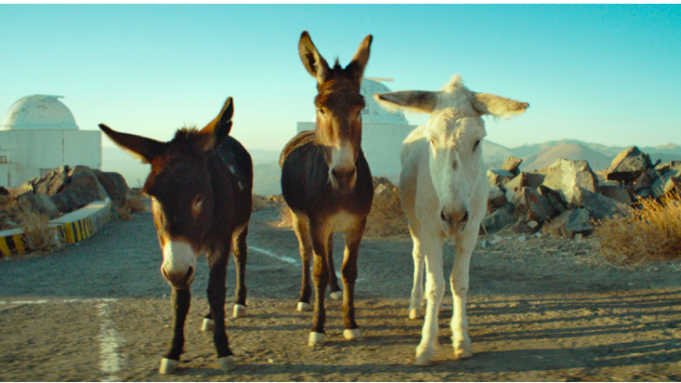
After the heaviness of its fellow nominees, Alison McAlpine's Perfectly a Strangeness seems almost quaint. The film, just fifteen minutes long, is a dialogue-free observation of three of the sweetest donkeys you ever did meet as they traverse a desert and stumble upon an abandoned astronomical observatory. This clash of nature and science is an almost spiritual meeting as McAlpine contrasts the existence of the donkeys, just going about their business and wandering through land in search of their next meal or destination, with the existence of this man-made complex built to explore the heavens, a realm essentially ignored by the donkeys. The footage is both pensive and awe-inspiring, and sometimes even silly, as in when one of the donkeys scratches an itch on the side of a signpost. With all the doom and gloom in the world—and in these nominees—Perfectly a Strangeness is just perfectly strange enough to be captivating.
The Oscar Nominated Documentary Short Films program is now playing in theaters.
If you enjoyed this post, please consider supporting Third Coast Review’s arts and culture coverage by making a donation. Choose the amount that works best for you, and know it goes directly to support our writers and contributors.
