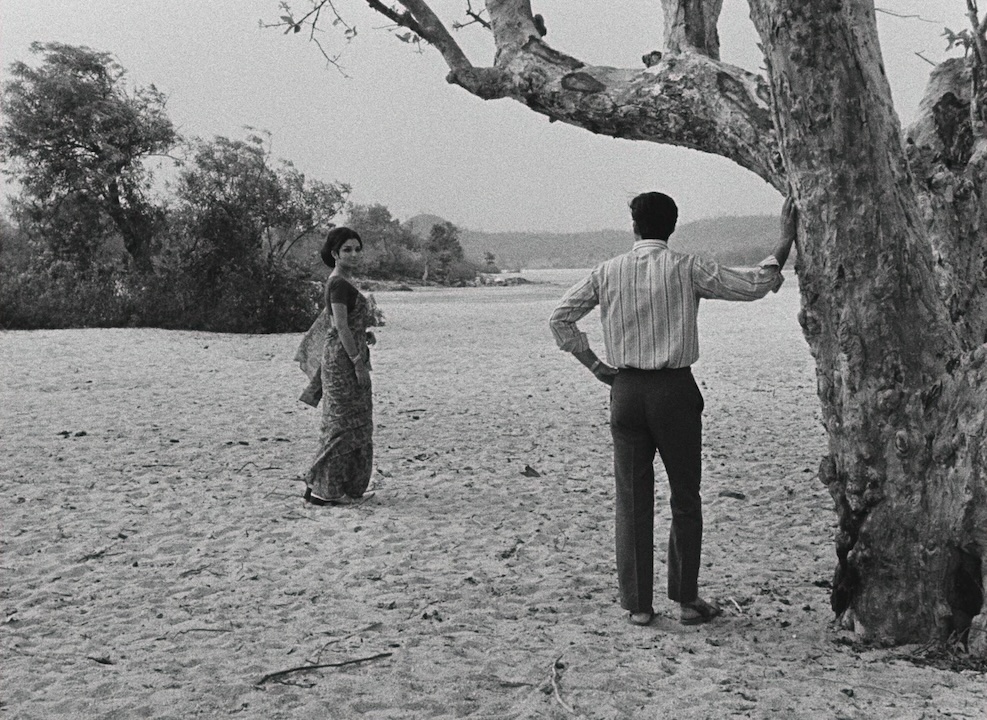

Days and Nights in the Forest has emerged from the wilderness. Sayajit Ray’s film was not widely available following its 1970 release, but with special thanks to Wes Anderson and the director’s son Sandip Ray, Janus Films and the Criterion Collection present the movie in a new 4K master. The revitalized film made the rounds on last year’s festival circuit, and now it will grace the Gene Siskel Film Center’s screen from March 6 - 12.
“Bengalis only ever see meadows.” Shekhar (Rabi Ghosh) reads from a book of legends about the “tribal land” he and his friends are about to explore. Ashim (Soumitra Chatterjee) and Sanjoy (Subhendu Chatterjee) work in offices; Hari (Samit Bhanja) is a cricketer; Shekhar himself is jobless. But they all seek an escape from the big city of Kolkata, and each finds great interest in the book’s description of scantily clad tribal women of Palamu.
These men would find themselves at home in 2026. Constricted by the rules of urban society, they feel the need to bend rules when on break, consequences be damned. They fetishize the people and places they consider “exotic” but deign to engage with them. They foretell the “yuppies” of the 1980s and the frat boys who thrive still today. Above all, these thirty-somethings demonstrate the strain that binds generation after generation of entitled young men: casual cruelty toward those they feel are beneath them.
As he does with any character, Ray takes a patient look at these guys. He never fails to note they contain the same flesh and blood as the objects of their scorn. The filmmaker encourages us to chuckle along with the desk jockeys as they boldly decide not to shave during their trip, only to break out the razors once they spot two beauties staying nearby their vacation bungalow in the forest. It’s all bluster and machismo, but these are broken boys underneath.
As portrayed by Sharmila Tagore, Aparna exudes grace and intelligence. Her Beatles records and scientific literature baffle Ashim. He wonders how a “tribal” woman could contain such dimensions. Once she finally lowers her walls to him, however, he catches a glimmer of the struggle people endure outside his metropolitan bubble. She holds a mirror to his naivete but spares him from embarrassment. Tagore’s performance unfurls seemingly without effort.
In Aparna and her sister-in-law Jaya (Kaberi Bose), Ray depicts the remnants of the traditional Bengali life, a world he pictured in earlier films like Pather Panchali (1955). The wildlife that once flocked to their grandfather’s forest home has vanished, perhaps due to the encroaching bustle of cars and pollution. The pair finds amusement in the city visitors but likely pities them. We get a sense these women come from a time already gone—in Jaya’s words, they are ghosts, and they see through the men’s superficialities.
As ever, Satyajit Ray draws from a spare toolkit in crafting Days and Nights in the Forest. He lets nothing intervene between his story and the audience. In early scenes, he clamps his camera to the men’s car, framing the rural scenes with gas pumps and hood ornaments. He and cinematographer Soumendu Roy then let the beauty of the landscapes cascade over the film. It takes a master to make such a tale, so universal yet so suffused with time and place, look simple. But that’s what we have here, now crisper and more beautiful than ever before.
As ever, Satyajit Ray draws from a spare toolkit in crafting Days and Nights in the Forest. He lets nothing intervene between his story and the audience. In early scenes, he clamps his camera to the men’s car, framing the rural scenes with gas pumps and hood ornaments. He and cinematographer Soumendu Roy then let the beauty of the landscapes cascade over the film. Their lone flourish offers a 360-degree view of the men and women playing a game of memory. Ray tells us remembrance may be the most powerful force in the human language. But how easy it is to forget the mistakes and the pain of the past.
It takes a master to make such a tale, so universal yet so suffused with time and place, look simple. But that’s what we have here, now crisper and more beautiful than ever before.
The film is now playing in theaters. Tickets to Days and Nights in the Forest are available through the Gene Siskel Film Center.
If you enjoyed this post, please consider supporting Third Coast Review’s arts and culture coverage by making a donation. Choose the amount that works best for you, and know it goes directly to support our writers and contributors.
