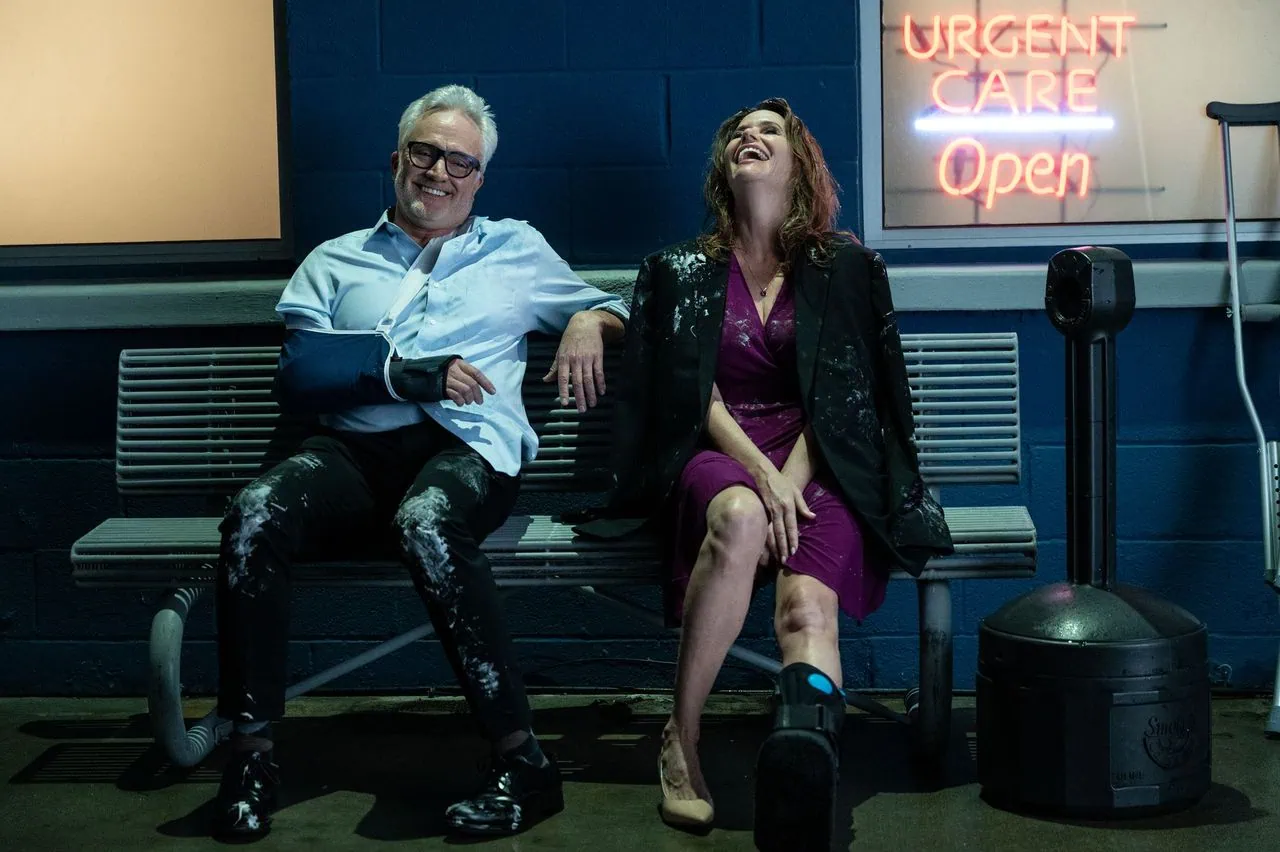
Although actress Amy Landecker (Transparent, The Handmaid's Tale, I Love My Dad) has dabbled in directing television, shorts, and web series in recent years (most notably Tig Notaro’s hilarious Under a Rock show), her current film, For Worse, marks her writing/directing debut. A Chicago native (broadcaster John “Records” Landecker is her father) and veteran of stage productions at both the Goodman and Steppenwolf theaters, Amy eventually moved to New York, then Los Angeles, where she got roles in such films as the Coen Brothers’ A Serious Man, Nicole Holofcener’s Enough Said, and the HBO series Curb Your Enthusiasm.
With nearly 100 credits to her name (so far), Landecker tapped a few of her famous friends to co-star along side her in For Worse, including husband Bradley Whitford, Gaby Hoffmann, and Missi Pyle, among others. The film follows recently divorce Lauren (Landecker) from acting class to dating a much younger man (and fellow acting student, played by Nico Hiraga) to going as his date to a wedding of another one of their classmates (Kiersey Clemons), where Lauren ends up connecting with a fellow divorcee (Whitford)
The film is mostly a comedy, but Landecker the writer was sure to include a few painful truths about what life is like for a divorced, middle-aged person who still sees themselves as viable and not at the tail end of their social life. I had the chance to sit down with Landecker just before the Chicago premiere of For Worse last week at the Music Box Theatre, and we walked through the writing, directing, and acting process that she went through to get this micro-budget indie done in 11 days. The film is now playing in theaters; please enjoy our conversation.
You have dabbled in directing before this. Was directing a feature always the end goal?
No. What I thought I wanted to do was direct episodic television, and I was supposed to direct an episode of Transparent, but then it got cancelled. I actually was really afraid to write a screenplay because I felt like I didn’t know structure, and I ended up taking a screenwriting class. I had this idea and made a short out of it, but I didn’t like the short, and I couldn’t stop thinking that there was movie in there, but I didn’t really know if I knew… one of the things I’m most proud of about this script is I feel like the math of the structure is working; I see it work for people. That’s what I was afraid I’d get wrong—will it make sense? Do I know how to sequence events? Can I pull things together and really tell a story? And I’m most proud of watching it function, because I wondered if I was capable of that.
It sounds like whatever form it took, you wanted it to be something that you wrote; it had to be personal.
Daisy Gardner, who is an incredible comedy writer, we did start this project together, and she said, “You need to write this. This is your story.” Because it’s so personal, and you don’t have the time for someone to figure out what a certain scene is about, I had to know. I’m the only one who could act it quickly enough and tell other people what to do quickly enough in order to work within 11 days, which is mind-boggling—we did like 12 pages per day, which is insane. Writing it was a big accomplishment. I have another idea, which I’ve started, but this one felt like a baby, and I needed the whole birth to finish. You know what I mean? Unlike my friend Jay Duplass who has already made his next movie. I’m like, “Jesus Christ, man.” I don’t think he wrote that one, but still. I’m not that prolific.
Could you have written this specific story if you hadn’t gone through parts of it in real life?
That’s a good question. I’ve written one script, but it was a pilot script that was not about me in any way. Most of the stuff that I’ve written has been very personal. I think I’ve come from the school of Pamela Adlon and Larry David, where it’s autobiographical at its core, but then completely expanded into absurdity. But I think this had to happen, and then the idea came to me.
When you sat down write this, were there things from those experiences that you wanted to make sure got into this story that people could take away?
Absolutely. Part of what’s really important to me and at the root of what I wanted to say is that you’re going to act like an idiot in your life. And normally, that’s triggered by some pain, and that’s okay and you can laugh at it and come out the other side. You can heal. The movie has very sweet messaging; it’s not dark, although it has dark moments, but really, ultimately everybody gets a happy ending. That’s what I love about rom-coms; everybody gets a happy ending. So there was that theme, but there was also this idea that there are a lot of older women/younger men movies, which is funny because I wrote this way before any of that was happening. I’ve had to hang out with young people because I’m an actor, and all of the sudden, you realize that you’re the oldest person in the room, and it’s very disconcerting .
Now, I’m the mentor; I’m the maternal figure. So I had a very minor dalliance—maybe a kiss—with a younger person, but I remember felling that it was so weird. I didn’t feel comfortable in it; I don’t want to take my clothes off in front of a 25 year old; I’m not Nicole Kidman or Anne Hathaway. So this movie is about the other side of that, exploring what it’s like to be older in a young culture. Also, I wanted to make sure that the message was that you shouldn’t be discarded; you can still be viable and in it, but you also can be true to yourself.
Those are definitely the messages that I latched onto, that people in their 40s and 50s still want to be out there.
Good, then I did my job. And people are staying young. I made a movie in my 50s, for god’s sake.
You alluded to it earlier, but did you see any other choice than doing all three jobs?
I tried not to do all three—I really did—but I was told, mostly by other people, that I needed to do all three. And for two years in a row, I made movies with 25-year-old men who wrote, directed, and starred in their own movies, and they both went to SXSW, and they’re both great movies. I read an article that said statistically men will jump in not having experience, and even women with a lot of experience think they can’t do it. I felt like that’s what was going on. I was afraid, but I had way more experience than I thought I did and could easily do it if I jumped in, and I’m really glad I did.
Did I read somewhere that some of this material started in a stand-up act?
Well, yeah. My ex- immediately started dating this lovely woman who was very kind, and Iris just loved her, and I would hear about how sweet she was and how good she smelled, and my kid was too small to know that all of that felt like knives in my stomach. The stand-up was about how, if you don’t have kids, divorce is just breaking up; it’s just an expensive breakup, I don’t want to hear about it. The real pain of divorce is that you have to share this child with someone else, and you also have to continue to talk to this person forever. You can’t just stop seeing the person you just broke up with, if you’re healthy.
I didn’t know I was a writer at all until I got an email from my ex- and his new girlfriend on set of this movie called All Is Bright, with Paul Giamatti, and I started crying on set, so I read him the email. And whatever it was about, it was absurd—I think it was about TV watching. It was a ridiculous communication where everyone was being passive-aggressive, and Paul was like “That’s really funny. You should write about that.” And coincidentally, my friend was teaching a standup comedy class in LA, and I’m in the class thinking I’m never going to perform this. But the final presentation was at the Laugh Factory, and it destroyed; it was crazy.
And I knew I had touched on something. If you watch Better Things, it deals with a lot of those themes; there’s a thirst for women my age to tell stories from our perspective. There are so many people going through divorce now and so many people with blended families, and just to be able to talk and laugh about it, I could feel this deep desire from so many people to have this experience. So that turned into a script for FX called Angry MILF, which did not get made, because I was doing Transparent. But I learned that I could write; I found a new skill in my 40s. I feel like I’m poster child for not stopping at any age. Just keep trying shit.
I want to ask about the acting class scenes. As someone who is as experienced as you are as an actor, was that the hardest part to get through because you have to pretend to not be a great actor?
When she’s doing the scene the first time, she’s not a bad actress. But she’s rusty. You know what’s hard? To be like “Oh, I’m acting well,” to say that about yourself. Thematically, that also goes toward that idea that you find out you have a skill later in life. She hadn’t done it since high school, but now she’s like “I’m fucking good. Who knew?” It was actually hard to act like I didn’t know how to act.
A big part of this film takes place during a wedding. Was there an event like that where some of these things happened to you?
Yes.
Oh, is that where your dalliance happened?
Yes. None of this happened. I ended up falling apart internally and a little externally, but nobody was really witness to that other than my friend. I wasn’t publicly melting down. An easter egg in the movie is that Angelique Cabral, who plays my ex’s new girlfriend, it was her wedding I went to in real life that started this. She knows it, everybody at the wedding knows it. I’ve been talking about this idea since that wedding, so everybody has known that I was going to make this movie, inspired by this wedding. I literally left the wedding knowing there was a rom-com in there; that was one of the first thoughts that I had, because weddings are absurd. There were things that happened at this wedding, I couldn’t even put in a movie, it’s so cliche. One of the gay guest his on a trucker at the bar at 4 o’clock in the morning, and there was a giant brawl that happened. I had to take the guy home because no one else could drive, and he vomited all over me. It was classic wedding stuff, but I was twice as old as everybody there.
I’ve noticed that when a known-quantity actor directs for the first time, they often call a bunch of their friends to be in it, so it’s always fun to figure out who your friends are or connect you to people you’ve worked with.
I have to say, I didn’t know Ken Marino. I would say 90 percent of this cast is either people I knew or had worked with. Ken was my fantasy because I saw him in The Other Two, and he looks like Alec Baldwin to me and has major comedy chops. I felt like if he sat down next to her at a wedding, you would go “Oh!” and then you would go “Oh no.” I felt like he could toggle that like nobody else, and I was so excited when he said yes. Bradley and I made a little video together begging him to do it.
When so many of your friends and Ken are such great improvisers, it makes me realize that you aren’t especially precious about getting every word of your script in there.
Absolutely not. That was part of the process of casting. I knew I wanted people to play; I’ve always played. Unless you’ve written something super-specific, that’s different, if you have a p attern, like Aaron Sorkin. But if you’re just trying to make something funny, why wouldn’t you let the funniest people in the world loosen your dialogue a little bit? That’s how we got Ken saying “Twat”—Ken just tripping on the word “trot,” intentionally obviously. I had no idea he was going to that, and it’s one of my favorite parts of the whole movie. The one thing that surprised me was Gaby Hoffman, who I’d given the script to to give me notes, and she suggested that she wanted to play the acting teacher. In my wildest dreams, I didn’t think someone as cool and indie as Gaby would play my whackadoo acting teacher in my little rom-com. She’s so good and she had so much fun, and it meant so much to me. Doing a show like Transparent, you just get incredibly close; it’s such an intimate show. And she put me at ease the first day; she was so joyful and so easy to work with. I felt like she had a good time, and that really launched me into the rest of the shoot.
How did you land on Nico as your love interest?
Nico was also a very specific idea. I met Nico doing a movie called Rosaline, which Bradley and Nico did together, shooting in Italy. And I went to visit Bradley in Italy, and this guy walks into the lobby in with no shirt on and was like “Dude, what’s up? You’re a hottie.” Right in front of my husband. He’s a flirt and very easy-going and adorable, but also someone you know you should never build a life with . No offense. He’s a free spirit; I’m not going to try and pin that thing down. So I felt like the Sean character was a very difficult needle to thread. He’s the young actor who my character hooks up with and goes to the wedding with, and he basically abandons her as soon as they get there.
For Claudia.
Right, for Claudia Sulewski. Who wouldn’t? I grabbed her from I Love My Dad! But that’s what that guy should do, right? He’s not an asshole; he’s just a kid doing what he should do at a wedding. So I wanted him to be somebody who people wouldn’t think was the biggest asshole. I want you to understand everybody from some perspective.
A lot of times when you talk to someone who makes a smaller-budget indie film, time is the greatest enemy. Did you find that to be true?
Oh yeah. That was the biggest enemy. It never rains in LA, ever. And we had a monsoon when we were shooting the wedding. And we were like “If this doesn’t stop, we’re never going to finish.” And there were prices that had to be paid that literally all got fixed in post—coverage I never got. The beautiful montage of the toasts that are given and all the reactions were not on the same day; the reactions were not to the toasts, we didn’t have time for that. I’m just yelling out emotional notes, and then you go through and piece it together. There’s a big cake drop moment; that never happened. We almost didn’t make it because of that rain, and that’s not an exaggeration. I did one take of my big breakdown at the wedding.
Similar the question about pretending to not know how to act, when you’re meet-cuting with your husband like you don’t know him—and for a while like you aren’t getting along—how was that for you?
I was worried. It was easy, but my biggest fear about going around the country and showing this movie and talking about it is that I don’t want to jinx it, because I have nothing but good things to say about how it all turned out. We felt a lot of chemistry still, and I think that was a surprise to us. When we watch the movie, I think we love playing. I always have him help me with auditions because I’m so self-conscious; I’m sure people think I’m bad. So I was worried that I would bring that insecurity into the shoot, but I didn’t have time. There was no time to think like that. You just had to be where you were and had to jump in. It’s such as Chicago, Steppenwolf thing. We don’t have time to bullshit, so it all was fine and fun. I liked pretending I didn’t know him. I get so excited every time his entrance is coming; I get girlie about it: Bradley’s coming!
I always ask this of anyone I interview who has roots here: What do you think is the most Chicago thing about you?
Mmmm. Honestly, my lack of vanity when I’m acting. I have no Hollywood in me, and it’s to my detriment—I look really shitty in some stuff. When I get out of hair and makeup on a set, I don’t look in the mirror again. I come from throw-down theater—you fucking throw down and don’t worry about your hair and look. So my willingness to jump in is the most Chicago thing about me.
So are you now an actor who dabbles in writing or directing, or the other way around?
Oh, I’m an actor who dabbles. The question is, if I’m ever going to take a directing job, I have to ask myself: “If you got a great acting job, and you couldn’t do that because of a directing job, is it worth that?” Honestly, it’s only been worth it twice of all the things that have been sent to me. I’m very picky. Writing is a little easier and it’s helpful because acting relies on someone else giving me something to do, so I’m always dabbling in writing. It’s therapeutic, it’s fun, it’s hard, but it’s something I can do by myself and no one can take it away from me and no one has to give it to me. But every time I’m on a set and someone is paying me to do what I would pay to do, I’m blown away. I’m never not grateful on a set.
Thank you so much. Best of luck with this, and have fun tonight.
This was great. Thank you.
