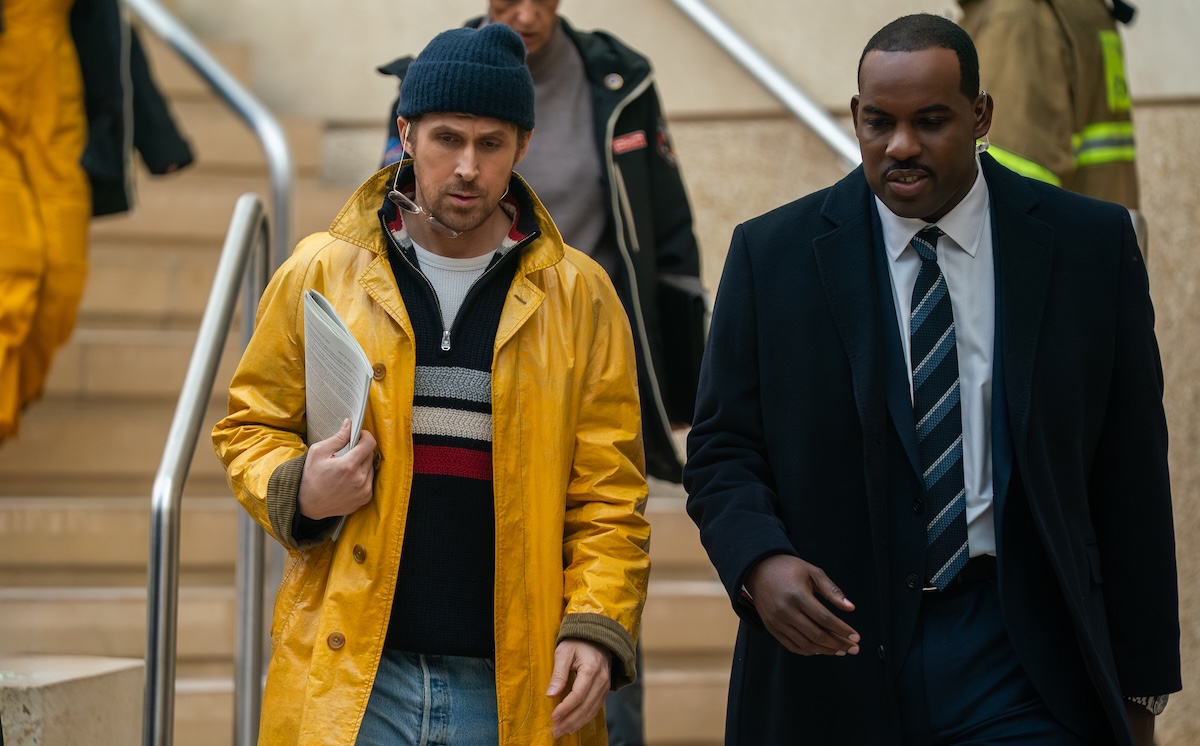
Actor Lionel Boyce is likely best known by most Chicagoans as the kind-hearted pastry chef Marcus Brooks on the series The Bear, for which he received an Emmy nomination in 2024. Prior to joining that celebrated show, Boyce had worked on projects such as The Jellies! and Hap and Leonard, and he’s done a guest spot on HBO’s Curb Your Enthusiasm. The California native was also a member of the hip-hop music collective Odd Future, thanks to his high school friendship with Tyler the Creator.
In more recent years, Boyce has started taking bigger roles in feature films as well, including the as-yet-unreleased Motor City and this week’s science-fiction adventure work Project Hail Mary, based on the 2021 novel by Andy Weir (The Martian), adapted by Drew Goddard (also The Martian), and directed by Phil Lord and Christopher Miller (the Jump Street movies, The Lego Movie). The film concerns Ryland Grace (Ryan Gosling), a middle-school teacher who somehow ends up on a long-range spacecraft light years from Earth with no memory of how he got there. Without getting too deep into the plot, he slowly begins to remember that he’s on this journey to save the Earth’s sun from a microorganism that is causing it to dim, threatening all life on the planet. But the anomaly isn’t just happening to our sun; it’s happening to all suns, save one, and that’s where Grace is headed. But as he gets closer, it becomes clear that he may not have to solve this problem on his own, thanks to an alien creature he names Rocky.
Boyce plays a security officer named Carl, who is part of the team on Earth charged with figuring out and solving this problem before the mission begins—a team led by Eva Stratt (Sandra Hüller). Carl is effectively Eva’s right-hand man, but he also works closely with Grace after he’s recruited onto the team and uses his outside-the-box thinking skills to figure out what is happening with the sun. Project Hail Mary is a fantastic tribute to science, outsider problem solving, intelligence, and collaboration, and Boyce is a big part of its success.
I had the chance to sit down with Boyce recently while he’s in town shooting Season 5 of The Bear (rumored to be its final one), and we talked at length about his work on the film and the power of storytelling and great storytellers. Please enjoy our conversation…
One of the other things that I do besides this is handle PR for the Music Box Theatre, and I remember a year ago you were there for the whole day shooting a scene that ended up getting cut from the show. A tiny bit of that scene showed up in the trailer for Season 4, but not the sequence. We were all waiting eagerly for the episodes to drop, and you all basically disappointed our entire staff. So when I heard you were doing interviews for this, I knew I had to ask you what you were going to do to make it up to us.
Yeah, yeah. I have to do something. That was so cool to spend the day there, and I was right there with you, looking forward to seeing it, and then someone told me that all that stuff ended up getting cut for whatever reason.
But we are playing the film in 70mm, so maybe we’ll get you out there to introduce a couple showings, if you’re still in town.
I can do that.
So you play Carl, who is not actually a character from the book.
I haven’t read the book, but I don’t think he’s in it. It may be a combination of characters, but basically it comes down to: Stratt has a guy. It seems logical. I think what Chris and Phil do best is find a way to take anything they work on and make it feel like them. Some people you hire are more like a ghost in the machine, and other people who put their DNA all over it, and that’s what you love them for. Chris and Phil are the type of filmmakers who do that. The role on paper was supposed to be small, but I think they chased the rabbit down the hole with my character; that’s the magic of film, and somehow it all makes sense. On my side, and I say this now, having seen the movie, was me having the best experience ever, whether it’s in the book or not.
When you adapt a book, you want to have a couple of unexpected things in there so that the people who read it still have some surprises. You’re this character we don’t know anything about. He’s the only one on the team with the tiniest bit of menace when we first meet him. They only refer to him as a government agent, very nebulous. How would you describe his function in the film?
I asked them that too . What simplified it for me is that he’s Stratt’s right hand. Wherever she works, whatever she does, he’s the right-hand. Whatever level of government access she has, he does too; he works with her.
At first, he seems like he’s just security, but later, he’s actually building things.
That’s the fun of it. I don’t think he intended to do that. It’s like one of those friendships that happens when you’re nine years old, when you meet this stoic, stand-offish kid, but you open him up and soon he’s helping you do whatever. That’s what he is.
Initially when we meet him, we think he’s going to be, like you said, stoic. But you and Ryan have these great one-on-one scenes where you’re just tooling around, and it looks like so much fun. That must have been great just hanging out in the middle of this epic project. Tell me what that was like.
That was cool. It really did feel like it was its own thing. How it exists in the movie is this small chapter—you meet this person, you do your thing, and you continue on to the next portion of your journey. I also like where they placed it in the context of the other story, plus you have this great banter and humor—it helps establish this tone as it continues. The movie has this bittersweet tone, which I love about it, and obviously while we’re making it, I don’t know what the score it going to sound like, so hearing it all put together finally really…the movie does not feel daunting at all, but it has all of these elements where it easily could have felt like that. And that’s where I credit Chris and Phil, because they found a levity to thread through the film, weaving through with earnestness; combining all of that kept it buoyant, as much as they could.
Because this friendship happens between these two guys, it sets up something of a betrayal much later down the line. Without getting specific, was that particular day when you have to show that humanity comes first, does that stand out to you as an important day of shooting?
It does, but it’s funny because those scenes of us hanging out didn’t exist in the beginning. Him doing that initially was just about a single person executing a thing, but then we built all of these moments in between with us, so that later there would be a contradiction to the relationship, for that moment to land even more.
Let me back things up a bit: how did this role come to you initially?
I heard there was a small part in this, and, to me, I would hold peanuts in the background to be in this . I’m a huge fan of everyone involved. I read the script and thought it was so cool. As I said, the part was initially really small, like a day or two, so I was just excited to spend 10 hours observing this cool thing. But it was a blessing in disguise that kept going, and once they heard that I was down to do more, Chris and Phil’s minds just starting running and finding fun things for me to be a part of. It organically bloomed.
For a character like this, is there even research you could do?
No, that’s the thing. I’d just read the script. To me, it was just about having a perspective on that kind of guy. I feel like I know that kind of guy. A lot of security guards look so serious, but they’re really a teddy bear in a combat uniform. If you start talking to them, they crack within moments. It really built organically once we go there, and helped us define the relationship. That’s when it gave us more perspective of how he would be involved in things. It was about connection, different kinds of connections and friendships, so that’s just another one of them, simultaneously happening while he’s with Rocky.
Your delivery of the line about having a budget might have been the first time I laughed out loud. That’s actually a turning point, not just the beginning of a friendship, but your character saying that you believe in this guy and his wild ideas; maybe he’s on to something.
Carl is just watching him. Stratt already believes in him. She sees something in him, and she’s really smart. In this world, Carl is watching this guy do these things, and he’s an observant person, and you don’t get that kind of job unless you’re highly observant. So he’s like “Okay, this guy knows what he’s doing.” The backdrop of this story is that the earth is dying, so you see that this person might have hope, whether he shows it or not, externally. Internally, he’s feeling the same things everyone is feeling. He has a family that’s also worried, etc.
Lord and Miller are comedy geniuses, but they’re also fantastic storytellers, and they find a great way to combine those two things in this movie. From your perspective, what was different about their approach to directing and storytelling that was different than anything you’d seen before?
Like you, I’ve been a fan of theirs since Clone High. And I’ve always been curious how two directors work together at once. That was really cool and seeing their approach. You see how they are psychic in ways where they have a shorthand, and I’m sure there are disagreements, but the way they handle it is not a fight or about ego. There’s a shorthand where they are trying to dig a tunnel together. They also delegate. It’s about understanding their strengths and knowing that they are one. One person might be better at dealing with some things, and the other deals with that. Also, the freedom and looseness with how they riff is so good. That’s what really gives their films these isms; their movies feel like them, and that’s because they aren’t precious about how they’re making it. They take it serious without being precious—it’s a great balance.
Do they divide the duties—does one deal with actors more and the other with production? Or are they interchangeable in that respect?
You can ask either one, but one deals with actors a little more and the other deal with the technical side, but they also understand the other function. You’re almost always talking to both. It’s a structure that is not rigid.
I’m also a massive Sandra Hüller admirer, in German films and the work she’s doing in English now. But I feel among actors, she’s more well known and just starting to get noticed by the general public thanks to Anatomy of a Fall. Again, you spend a lot of time next to her. Tell me about her approach.
She was the coolest. I had a running joke that I want to be best friends with her, that’s how cool she is. She was very sweet and so intentional, but then I’d get to see how she works and thinks, and I’d see her come alive. This movie, like I said, is egoless. You see these people like Sandra, who’s just so cool, just sitting there talking to people about her life. To me, that was special. I haven’t done a bunch of movies, so I’m not jaded yet; to me, that was special. This was my first time on this kind of set and getting to observe it all and taking it in. And with her, she’s legit, she’s so good, and her being so open meant the world to me, and hearing how she approaches things and breaks them down. I knew that was valuable. How cool is it that you get to see these people’s process?
You said you’ve seen the finished film, but you’re only in certain, earth-bound parts of it. What do you remember being the most impressive thing about what you saw that was new to you?
When you read anything—a script or a book—you’re competing against your imagination when you watch the film. But once in a blue moon, something can beat your imagination, and this was one of those things that superseded my imagination. When he’s in the Petrova line and he’s floating in it…there are a couple of sequences in space where I thought it was incredible, really capturing the Wow factor. Later down the line, when they’re grabbing sample from the other planet, I was so impressed. There were several. Even the way the sound is handled, that was another thing I hadn’t factored in. And the way they use silence in a couple spots, it’s so intentional. And then there are other moments where they use harsh sounds too.
What do you hope people think about when they leave this film?
I said before this movie is about connection, and I hope people examine openness and connection for themselves. That’s such an important thing that I feel gets cut off because we get used to our groove and routines in life. And having a connection to something outside of yourself and what you know is always innocent and could lead you what saves your life or just find something that’s missing, something great.
I always ask this of anyone who has some kind of connection or roots to Chicago—I know you’re not from Chicago, but you’ve spent a fair amount of time here. What is the most Chicago thing about you?
Wearing a crew neck when it’s 45 degrees outside . That’s me now. Oh, it’s a little warm outside, let’s go.
Do you have any sense of what you might do after you’re done shooting this season of The Bear?
No, but let’s see. I always enjoy the unknown. I don’t right now, but the cool thing is, August will not look like today, and I’ll have so many hours. Plus, the release of this and other things, let’s see where that takes me.
I have to imagine this will open up a few doors for you.
Hope so.
When you’re deciding on roles, does variety and mixing things up from role to role mean a lot to you?
That’s important, and I’m just a fan and student of all things film, so there are people I’d like to work with. Mixing it up, the filmmakers you’d like to work with, and telling the story you want to tell. At the end of the day, it’s about chasing a feeling using one or more of those three things.
Is fear a contributing factor?
Yes. I run toward fear. That’s the only sure sign you should do something, within reason, when it comes to artistic endeavors . Being sure means you’re safe within your nucleus.
Do you remember the last time you made a decision based on fear?
Yeah, around the time they were shooting Project Hail Mary, I did this other film called Motor City. It took an unconventional approach, and I thought “This might not work.” But it’s fun doing something you have no reference point for. It went to Venice last year, but I think it’s supposed to come out at some point this year.
Thank you so much. It was really great to meet you.
Good to meet you too.
If you enjoyed this post, please consider supporting Third Coast Review’s arts and culture coverage by making a donation. Choose the amount that works best for you, and know it goes directly to support our writers and contributors.
