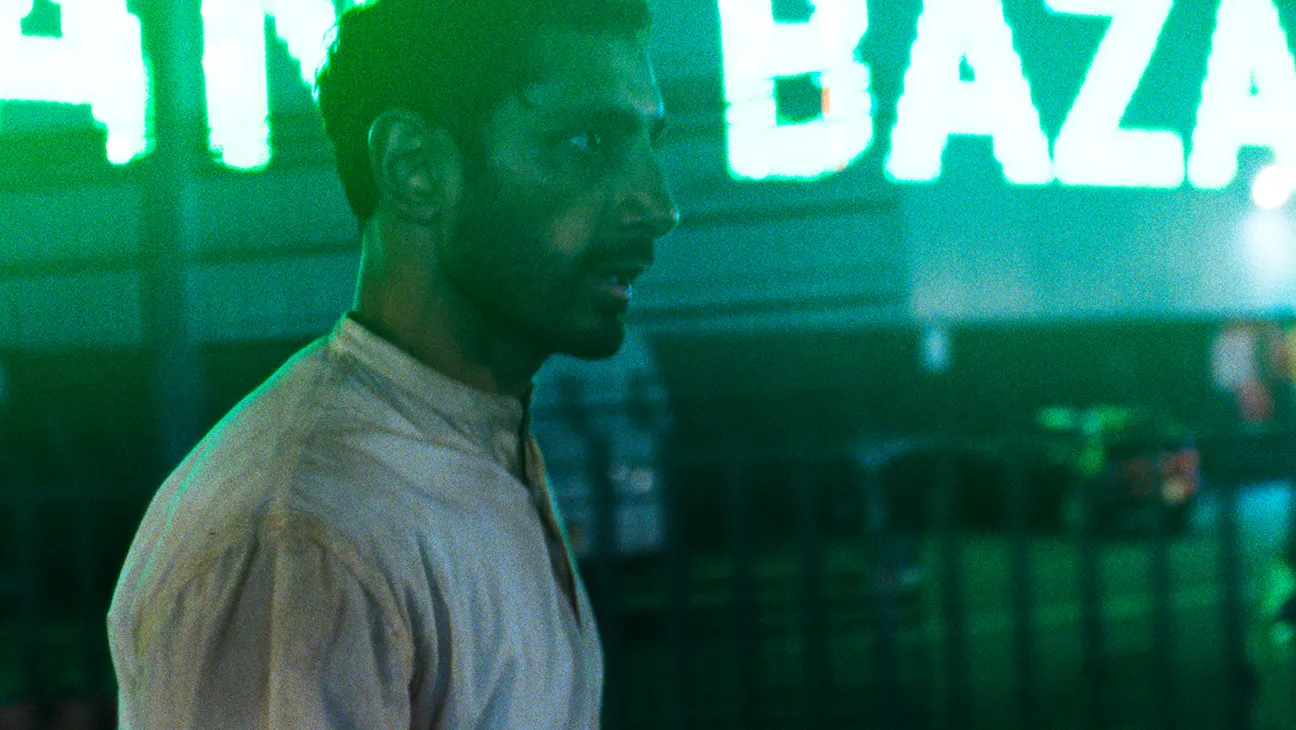

If you know anything about me, you should know that I love live theater, and my favorite subsector of live theater is the works of William Shakespeare. But the only way to keep some of the Bard’s better-known plays interesting is to reimagine them to varying degrees, whether it's updating the time period, changing up the costuming, or simply doing a radical reworking of the material. Director Aneil Karia (with his second feature after Surge) has updated his version of Hamlet (adapted by Michael Lesslie, who co-wrote The Hunger Games: The Ballad of Songbirds and Snakes, and the version of Macbeth with Michael Fassbender from about 10 years ago) and made a few alterations using a little bit from each column. Set in modern-day London, within the city's elite South Asian community, the film opens dramatically with a Hindi death ritual, during which the father of Hamlet (Riz Ahmed) is not a king but the head of a powerful construction company.
A great deal of this Hamlet remains unchanged in terms of plotting, but it’s the execution that's so impressively original and bold. The ritual, which includes a body washing, painting, and cremation, is far more tragic and somber than any version of the play I’ve ever seen; often the king’s funeral is never shown, and considering how much Karia’s version takes out or truncates, it’s a nice moment to include. Ahmed’s version of Hamlet the man begins more stunned and melancholy, but as the film goes on, his anger and bitterness intensifies, sometimes gradually, often in bursts. When he learns from the ghost of his father that he was killed by his uncle, Claudius (the great Art Malik), one of the great unravellings in dramatic history begins, and Ahmed is exactly the right age and temperament to deliver a performance worthy of both smolder and fire.
Rather than simply kill Claudius for revenge, Hamlet decides to expose and take down the corrupt family empire even if it drives him insane. When it’s announced that his uncle is marrying Hamlet’s mother (Sheeba Chaddha), he concocts a scheme to illustrate Claudius’ crimes not with words but with the help of a South Asian dance troupe. Instead of the traditional play-within-a-play scene, the troupe’s hypnotic, sinister, and eloquent performance is pure cinema. Hamlet doesn’t have many allies, but he does have Ophelia (Morfydd Clark), her brother/his best friend Laertes (Joe Alwyn), and to a lesser degree, their father Polonius (Timothy Spall), whose eventual death at Hamlet’s hand is far more graphic and much less accidental than we’re used to seeing. Clark is the standout from this collection of supporting players, although her part is severely reduced, and she’s even denied a proper death moment, which seems clumsy on the part of the filmmakers.
Even Hamlet’s “To be or not to be” monologue is handled in a way that I applaud for its ingenuity, even if I’m not entirely sure it works. He's driving at full speed on a highway with oncoming lights threatening to flatten him, while he screams words about contemplating suicide. I love Ahmed’s delivery (he basically has to scream to be heard over the car’s revving engine), but it lacks anything resembling subtlety. Even the play’s climatic sword fight is substantially altered to be something less flamboyant but not necessarily better (although it does provide a nice redemptive moment for Hamlet’s mother).
Scenes are cut, lines normally said by one person are given to another, and whole characters are excised—none of which is unusual for a Shakespearean adaptation—and keeping this Hamlet to well under two hours feels like a solid choice. The director and Ahmed both won well-deserved Oscars in 2022 for the live-action short The Long Goodbye; it too featured Ahmed digging into his cultural roots and giving us a harrowing poem that gave the film a mighty punch of an ending. By its conclusion, Hamlet is more of a blunt instrument than a precise weapon used to take down a dynasty, but Ahmed is one of the better versions of this character, and the film is worth checking out for that reason alone.
The film is now playing in theaters.
If you enjoyed this post, please consider supporting Third Coast Review’s arts and culture coverage by making a donation. Choose the amount that works best for you, and know it goes directly to support our writers and contributors.
