A Chicago native (Naperville via Berwyn actually), actor-comedian-screenwriter-director-author-producer Bob Odenkirk is an artist who wears many hats. In fact, at any point in his career when you think you’re fully aware of his capabilities and limits, he adds one or two more just to keep us on our collective toes. During a stint working as a writer on Saturday Night Live, he came back to Chicago during his summer breaks to write and perform at Second City, with fellow alums Chris Farley and Tim Meadows. Famously, Odenkirk wrote the “Matt Foley, Motivational Speaker” character for Farley at Second City, and Farley would later bring it to SNL.
I believe I first caught wind of Odenkirk as a performer on the old Fox variety show The Ben Stiller Show in 1992, and soon after on The Larry Sanders Show as Larry’s sleazy agent Stevie Grant. But it was HBO’s Mr. Show (co-created with David Cross) where people got a true sense of Odenkirk’s power as a writer and performer. After years being known as a comedic performer, Odenkirk did what he does best: he pivoted, this time into drama as recurring character attorney Saul Goodman on Breaking Bad, and later on FX’s anthology series Fargo. He later reprised the Goodman character on his own spin-off show, Better Call Saul. On the big screen, audiences could catch him in such films as Little Women, Nebraska, The Spectacular Now, The Post, and The Disaster Artist.
In more recent years, Odenkirk acted in the FX series The Bear playing Uncle Lee, and in 2025, he made his Broadway debut as Shelly Levene in a revival of the David Mamet’s Glengarry Glen Ross, headlining opposite Kieran Culkin, Michael McKean, and Bill Burr. Odenkirk's performance earned him a Tony nomination as Best Featured Actor in a Play, marking the production’s sole nomination. (I saw it, and he was fantastic.)
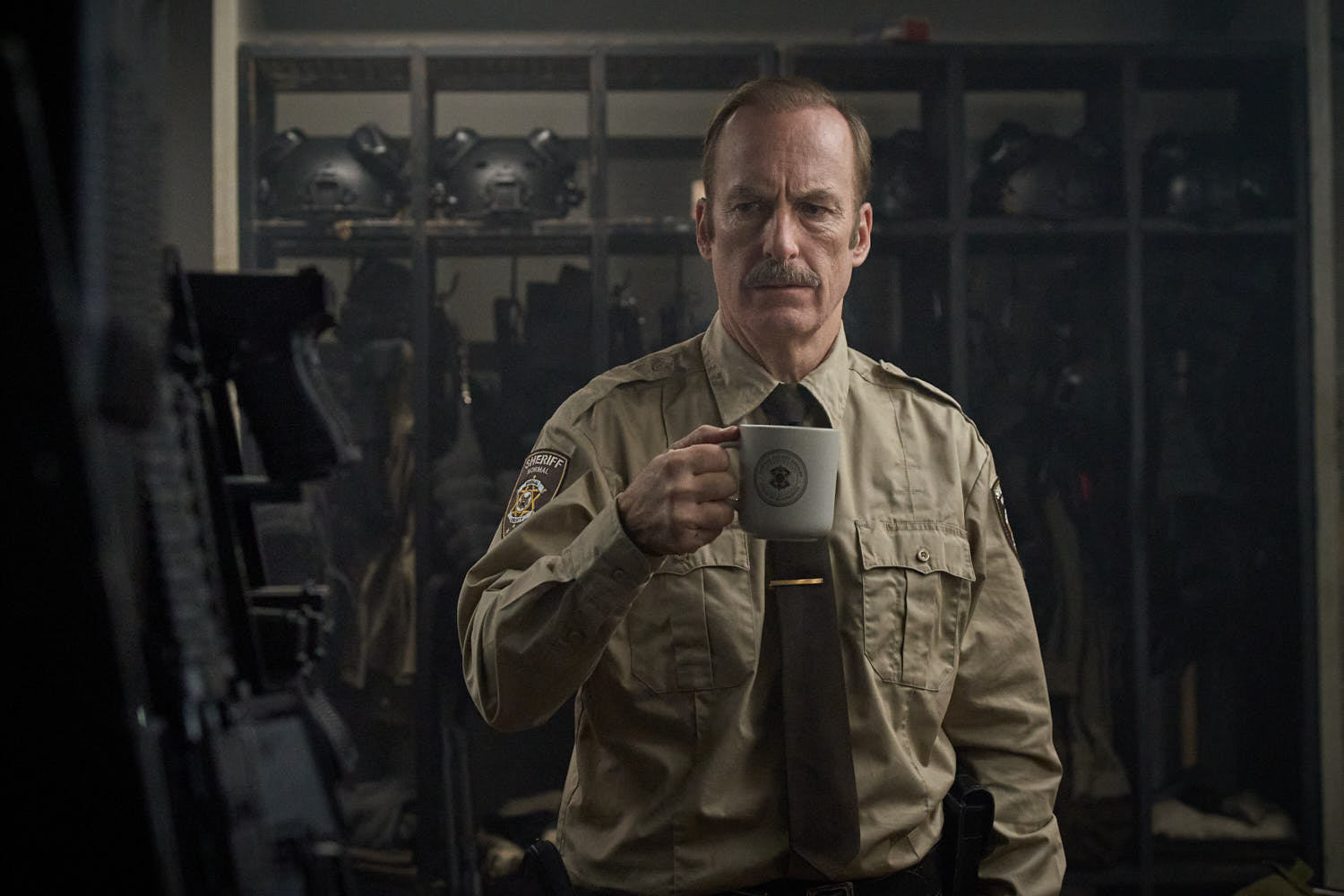
But as Odenkirk was fast approaching 60, he decided to pivot once again by becoming a late-blooming action star, playing Hutch Mansell in the action-thriller Nobody, written by John Wick scribe Derek Kolstad. The film was a surprise pandemic-era hit and spawned a less-successful sequel (also written by Kolstad), Nobody 2. Now, the two have recalibrated and created a new action character for Odenkirk in Ulysses, a substitute sheriff in a sleepy town that has a crooked mayor—a crooked everybody, actually. Directed by Ben Wheatley, Normal paints Ulysses as a reluctant hero with a dark past, who must battle practically everyone in the community, which it turns out is under the control of the yakuza. This time around, Odenkirk gets a story credit on the film, and the film certainly leaves open the possibility for sequels.
I had the chance to sit down with Odenkirk and Kolstad on a recent visit to Chicago to attend a screening of Normal as part of Beyond Chicago (the first-ever satellite version of the wildly successful L.A. genre festival, Beyond Fest). We spoke about Odenkirk identifying with the underestimated Ulysses, his partnership with Kolstad (who is a Wisconsin native and also lived in Chicago for a time), and what about both of them is uniquely midwestern. The film is now playing in theaters. Enjoy our talk…
I feel like the common thread between Normal and the Nobody movies is that your characters are underestimated by everyone…
Bob Odenkirk: Sure, that’s the common thread. The uncommon thread is that Hutch in Nobody, if there’s a fire, he's going to run into it as fast as possible and get in to fight it. Ulysses in Normal is going to sit there and think “Gee, I hope somebody puts that thing out. Maybe someone will; that’s happened, right?” And then at the last minute, when it’s almost too late, he’ll go in.
When it comes to playing or creating a character who is underestimated by both the other characters and the audience, what’s fun about that?
Derek Kolstad: What’s fun about it is that he underestimates himself as well. This isn’t Clark Kent secretly being Superman. It’s a guy who finds himself in a certain situation, and he has the training to deal with it, but not in a Ethan Hunt/John McClane type of way. It’s in his own skin, and we want to make sure that every time he lands a hit, we know full well it hurts his hand, and he takes more hits than he delivers, and more importantly he gets up and we track it throughout.
BO: I love playing him. I don’t know what I’m doing in action films if I’m not bringing this flavor of a vulnerable person who is not sure if he’s going to survive the moment but has to go on for different reasons. I have no place in that world unless I’m playing that guy.
Do you identify with being underestimated? For years, people thought of you as only being a comedic guy, and so you moved into more serious acting. And now that you’ve proven you can do that, you’ve moved into action movies.
BO: I think I identify…I just think I’m estimated . Sometimes I feel like “No, you got me,” which includes some doubt about what I’m capable of and justifiably so. I think what I really relate to with Ulysses is this sense of life handing you some setbacks or you watch around you, and if you’re paying any attention, you know things can go pretty wrong, and you get a little hesitant about your own bravado and willingness to risk or put yourself out there because you’ve seen life go south and circumstances go south. That’s where he’s at. When we meet him, he’s looking at the world and going “I’m going to step back from my instincts, from danger; I’m not going to give this woman a parking ticket. I’m just going to say ‘Park better. I don’t want to get in a fight with you or argue or know what went wrong with your day.’” So I don’t know whether it’s empathy for people around you or just life. You see things go wrong, and you know how bad things can go.
DK: When you have our initial inciting incident, you can see that the character does care. But it’s this begrudging notion of “If no one else is going to do anything…,” and the reality is, as soon as he makes the choice, he doesn’t waver.
BO: I love what he does in the bank robbery, which is kind of nuts. He goes “I’m going to go talk to them.” Because some part of him is thinking that he can talk them out of this. He knows who they are, he’s met them, which changes things a little. He’s met them, so he’s not just talking to any bank robber. He knows them and knows they’re people, they love their dog. Also, part of him is thinking “I’d rather talk to them than shoot them or have them shoot me.” Of course, the other cops think he’s out of his mind.
How did you land on the Yakuza as the big bad of this thing? Did you just go through a list of the least likely group to be running everything?
DK: Originally I was thinking of just a random cartel. They had sicario coming up from Chicago on a train. And I think it was Bob that said, “Let’s go even farther and make it Yakuza,” which seems even more unlikely. Once we talked about it and moved things around and have that opening scene that sets the tone so perfectly by way of Ben mastery. I was smiling the first time I saw it go down, realizing it was the best idea.
Speaking of great ideas, you have some great kills, whether it’s about the specificity of the weapon or the scale of scene. How much of that is in the screenplay?
DK: It’s all in there, but also, it was Ben, Bob and I focusing on it and wondering how we could make it a little unique and familiar. Even though I don’t write horror movies, that’s the one genre I keep up with, I enjoy them. And I love the Final Destination movies and those scenes where the gun goes off, but it’s not the bullet that makes the kill but what the bullet hits that sets in motion a tiny little Rube Goldberg machine. With every kill, we wanted to make sure people also knew it was okay to laugh. Even when you get a brutal kill, you feel that guilty chuckle coming up, and that’s great.
How did you connect with Ben Wheatley? He’s a great action director, so that makes sense to a degree.
DK: We went out to various director meetings, we met some directors of note and we liked some of them. But when they said Ben Wheatley, I was like “Oh, Free Fire, Kill List, High Rise,” and I got a link to Free Fire to Bob, and he thought it was cool and what we were going for. We had a Zoom, and after Ben jumped on, within the first minute, we were texting each other “Dude, I like this guy.”
BO: He was such the right guy.
DK: And during pre-production, production, and post, that guy is just a wealth of knowledge, and on set, he’s approachable to everybody. He doesn’t cloister himself off in video village. The number of time we’d be sitting and watching a shot, and we’d saying something like “Hey, remember that scene in Long Kiss Goodnight where the guy walks into Union Station and he nods, and Samuel L. Jackson says ‘Do you know him?’ and she says, ‘I think so,’ and then he pulls a gun?” What we’re talking about isn’t the scene, it’s about the feel, and the number of times he’d say “Remember that scene in the movie?” and I’d go “No,” and I’d have to write down the movie. It was a masterclass.
Tell me about the difference between playing a guy who is trying to suppress his violent tendencies and someone who has to get motivated to do anything action oriented.
BO: I said I relate more to Ulysses than to Hutch, but the bottom line is, whether it’s Saul Goodman or Hutch or Ulysses, playing a character that has a very, very powerful energy that he’s struggling with in every moment—like it courses through him—in the case of Ulysses, it’s like he’s trying to distract himself entirely through life and recede, get away. He’s in the office doing paperwork and keeping the door closed. Anytime you have that undercurrent that’s powerful, it’s a great character. And then whatever happen on the surface is informed by this turbulent hole underneath. Eventually if you have a well-written piece, it comes out, but it’s great to have it running through everything that you do.
Tell me about casting Henry Winkler as the least likely villain of this or any year.
DK: I think it was a casting director choice, and as soon as we heard the name, we said yes. We sent him the script, and we got a call from the agent saying he was still cackling about it. He’s in.
BO: I was thinking, as you can image, that the character would be a big, scary guy who meets this new guy in town and wants to know if you’re on our side or their side. But then get Henry, who is so likable but also kind of scary. Even in the trailer when he says “Community,” and you’re thinking “I’ve never heard that word as a threat.”
Did I hear you guys compare this film to The Stepford Wives at some point? He fits into that mold perfectly.
BO: Yeah yeah.
It also has a great number of Western undertones. Talk about leaning into that.
BO: Ben Wheatley was all about the Western parts of this. My understanding of the film, the reference point I go to is High Plains Drifter, and for fairly obvious reasons. It’s a town, they need his help, and they are also difficult people to deal with and he has to get them involved. I think Ben and Derek’s reference points are High Noon and Bad Day at Black Rock. It’s the lone hero, who is very lonely, existentially alone.
DK: The other thing, too, in the best Westerns, the best movies, especially noir, is that the city/town is a character—the setting and location; the music is a character. And we spend a lot of time making sure that, even though it’s Ulysses’s story, every other character might think that they’re the main character of the movie. That’s what a Western does.
I always ask this of anyone I talk to who’s from Chicago or has deep Chicago roots: What do you think is the most Chicago thing about you?
BO: Look, it’s a chip on the shoulder. It’s a city that calls itself the Second City. Why would you do that? Let other people call you that, but don’t call yourself that. That makes me sad; I feel bad for you. And I have that. It’s that thing of like, we’re not New York, we’re not L.A.—fuck them. It’s a little bit of anger and chip on your shoulder that is helpful when powering through life, in pushing back, having some backbone and spine and strength in difficult moments. It comes from a sour place, but it can yield wonderful things, because it pushes you.
DK: There’s a durability about being Midwestern. Midwestern nice, if you really understand what that means, we have a bullshit meter. We’re nice to people who we know are going to be nice back to us, and we’re a little bit withdrawn around people we don’t trust, which makes us very quiet on certain days in Hollywood. But one of the things that I love about the Midwest is this notion of survivability, especially come winter. You help everybody because you have to, even with a chip on your shoulder, because you know full well, even like Ulysses, I’m going to be that guy.
Do you have any secret treatments in your back pocket that you want to reveal right now?
BO: He has about 300.
Specifically with the two of you working together again.
DK: We talk about it all time. We talk about Normal 2, 3 and beyond.
So you see Normal as a potential franchise starter?
BO: Could be, if it does well. I love it, I think it’s a crowd pleaser. There’s nothing more fun than seeing Normal with a bunch of people. I’ve seen it now a couple times, and the orchestrated reactions are insane. It’s a wonderful thing. I would like to play this guy again, I relate to him, I like him. So that would be great.
Thanks to both of you so much. Best of luck with this.
If you enjoyed this post, please consider supporting Third Coast Review’s arts and culture coverage by making a donation. Choose the amount that works best for you, and know it goes directly to support our writers and contributors.
