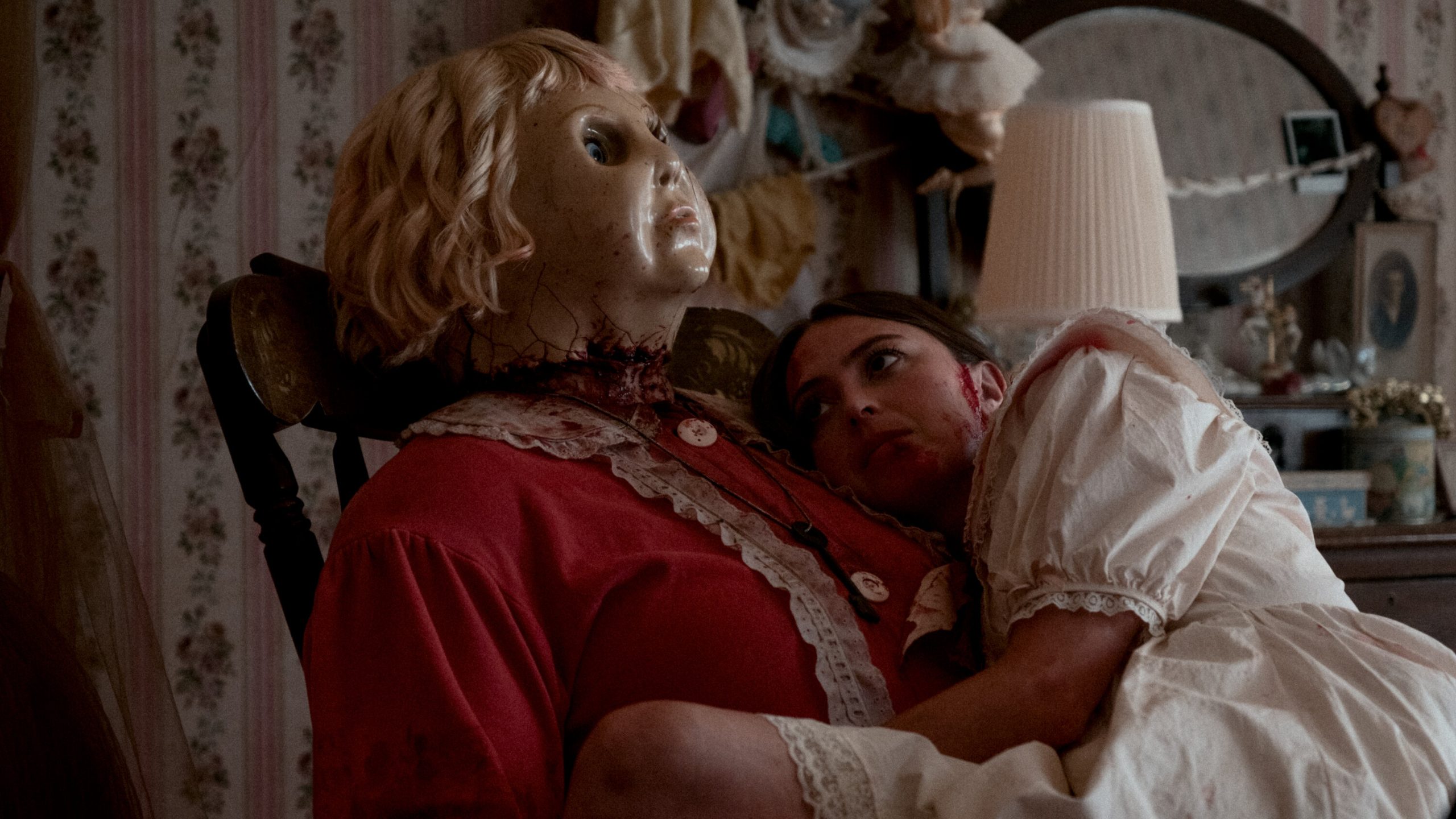
A bloody throwback to the simplistic and grisly pleasures of The Texas Chainsaw Massacre, Rod Blackhurst’s slasher Dolly is all gas, no breaks. It focuses on a young woman, Macy (Fabianne Therese), who is abducted by the titular Dolly (Max The Impaler), whose ceramic mask and laconic disposition are eerily unsettling. As she attempts to escape from the dollhouse prison Dolly has constructed, she learns more about the tragic, brutal origins of her captor.
Ahead of a special screening of Dolly at the Music Box Theatre, Blackhurst spoke with me over Zoom to discuss what changed between the short version of the film and the feature, building out the physicality of his movie monster, and how working on the project reframed his thoughts around the imperfection of parenting.
I know you didn’t grow up with a phone … I’m curious about how that shaped your filmmaking and creative life, but also your approach to how you want to depict phones on-screen. You feature them here, and a lot of filmmakers are trying to move away from depicting them.
I was born in 1980, and technology didn't rue the day. The things you engaged with were more primary and direct experience-based. I think about relative to how everything has become #content, where everything is all killer, no filler. It’s white bread that you eat, and you think will fill you up, and then it leaves you wanting more. Cell phones in horror movies do end up being used in a specific way; they’re often used to solve something, etc. They become an issue, for lack of a better word, that you have to account for. It's not for lack of cell phones in our movie; they just aren't available to the characters at a certain point.
But I do try to be intentional, and I do think some of that intentionality in being present with something comes from having grown up in an analog world where things are important and tactile and primary, and the things you're engaging with are very real because you don't have a lot of them or because you don't have access to everything. Dolly is ultimately a product of lived and learned experiences and influences.
I was watching the original short, Babygirl, and I’m curious how you discerned what you decided to bring in aesthetically from the short. The light felt colder in Babygirl, for example, but there’s a warmth to Dolly–due to the use of Super 8 cameras–that gives the film a different feel.
At the end of 2021, I was starting the process of raising the money to turn Babygirl into a full film. I found in my career that sometimes the best way to make somebody understand what you want to do is to show them a little bit of it. So we went down to my friend's property in Leapers Fork outside of Nashville, and we filmed in their woods for a day. My producing partner, Ross O’Connor, is playing Dolly, and you have an approximation of everything in Babygirl that ultimately ends up in Dolly. You've got a protagonist, you've got a love interest, etc. … The goal of that short was to give people a little visual representation of all the pieces that were in the movie. Then we were able to experiment and be a bit more wild with the aesthetic with the full feature.
Is Nicole Kidman’s Babygirl the reason for the name change?
That literally is it. We filmed Dolly in the early summer of 2024, and at a certain point, we're like, we will never be able to compete with SEO with the way search results work. I think it was a blessing in disguise because I think Dolly is far more punchier and fits the film a lot better.
I loved hearing the story of how Max the Impaler came to join the project, how they wanted to act for a while, and this was an opportunity for them to do so. Being a part of NWA means you often have to act with your body, so it makes sense you cast them, but I’m wondering if you can talk about how you came about coming up with Dolly’s physical mannerisms, from her gait to the little ticks she has.
Max deserves the credit for those mannerisms. In doing their research for the role, Max had come across a story inCalifornia of a young girl who was born in captivity. Baby Jeanie was subject to this horrific childhood until the point where they were found and freed. I actually think Jeanie might still be alive today and living a life of anonymity. If you watch those videos of Baby Jeanie when she was rescued, you start to see what Max drew on when coming up with the physical ways that someone came of age in a brutal environment.
Dolly’s backstory mimics the Baby Genie story or the things that we know about the Baby Genie story, and then the research that went into Baby Genie after. Actors writ large are making choices that I can't make. I'm not a performer. I have taste and intention and care that goes into this, but everyone else is bringing their own ideas and pieces to it, and it makes it better.
I’ll say this for the rest of my life, but people always ask, “Why do you love collaboration?” Literally, I can have an idea, someone else's idea is better, and then the result is even better than one plus one equals three in that situation. Dolly's physicality is exactly because of what Max brought to it.
To get into some of the film’s themes, I’m struck by a line about Macy being worried she’ll become like her mom. Your daughter has a role in this film, and I’m curious how that idea resonates for you. Parents can try to do their best, but they will inevitably end up hurting their kids, and I thought Macy’s fear was a moment of relatable honesty in this otherwise heightened film.
What you're talking about, Macy having said, is me as a writer and as a filmmaker reacting to somebody I know in life who has been trying to figure out how to navigate a situation like that. This person I know has wrestled with this question of “What if I am the monster that my mother was, and what kind of mother might I be? But they also had to navigate the very thing you then see in a fantastical way in Dolly, which is love as control.
That's a really terrifying thing to me when love gets used as a weapon. This is not happening to Dolly, but there are these sentiments of “Well, you want that toy? Well, you better tell mama you love her." I hear that stuff and I think that as a father, as a happily married man with two kids who loves my family more than anything else and who's made this movie for his family to be able to try to succeed better in life and find our way, I am always thinking about how I can be better and how I can be a better parent and not repeat the things that I've known.
I love my parents, and at the same time, my father would have these big emotional reactions to things, and I know that to be true inside of me. I've worked really hard to know when that's making an appearance and to change the way I then respond to that.
Horror movies are fun and playful, or can be fun, playful, and twisted, and everyone's fun is different. Everyone has a different brand of fun, or what they like and what they engage with. But I think deep inside of Dolly, there's real emotions and there's real darkness, and there's real reasons for why everything is happening on screen and why these characters are who they are, and why they're at this inflection point.
You’ve cited the French New Extremity movement as an influence, and as straightforward as the film is, I love how weird it gets. I love when Macy is crashing out, I love when she jumps from the window, and we get that really red, brief moment. I’m wondering where those moments came from and how you think through how much to show, when to be “weird?”
That section of the film you’re referring to, we've always called it the fever dream, because that's the way it must certainly feel to our protagonist at this juncture. It's sort of the reverse of Alice in Wonderland. Macy has gone through the rabbit hole through Looking Glass and is now coming back, and things are overwhelming. There are also other parts that we discovered after we shot the film that helped us better position and explain the story. That’s why you do feedback screenings.
A good example of that is the opening nursery rhyme that's on the screen. That's an idea that Noah, my producing partner, had to include. It was a way to make the lore and mythology a little more obvious. The things you’re talking about visually are about trying to bring a feeling to life. There are no rules, and it can be insane and weird as long as it's intentional. And there's some other visual iconography in that sequence that is a most obvious and apparent reference to another thing, but no one has mentioned it. I look forward to people discovering all the little pieces that are in the film because everything is for a reason. Everything is thought through.
Dolly is now streaming on Shudder.
If you enjoyed this post, please consider supporting Third Coast Review’s arts and culture coverage by making a donation. Choose the amount that works best for you, and know it goes directly to support our writers and contributors.
