
When it comes to music biopics, I don’t require or expect historical accuracy—leave it to the documentaries to get everything right. What I do expect is to discover something about the artist, something about what drove them to create and pushed them to a level of success and vision, and made us even want to watch a movie about them.
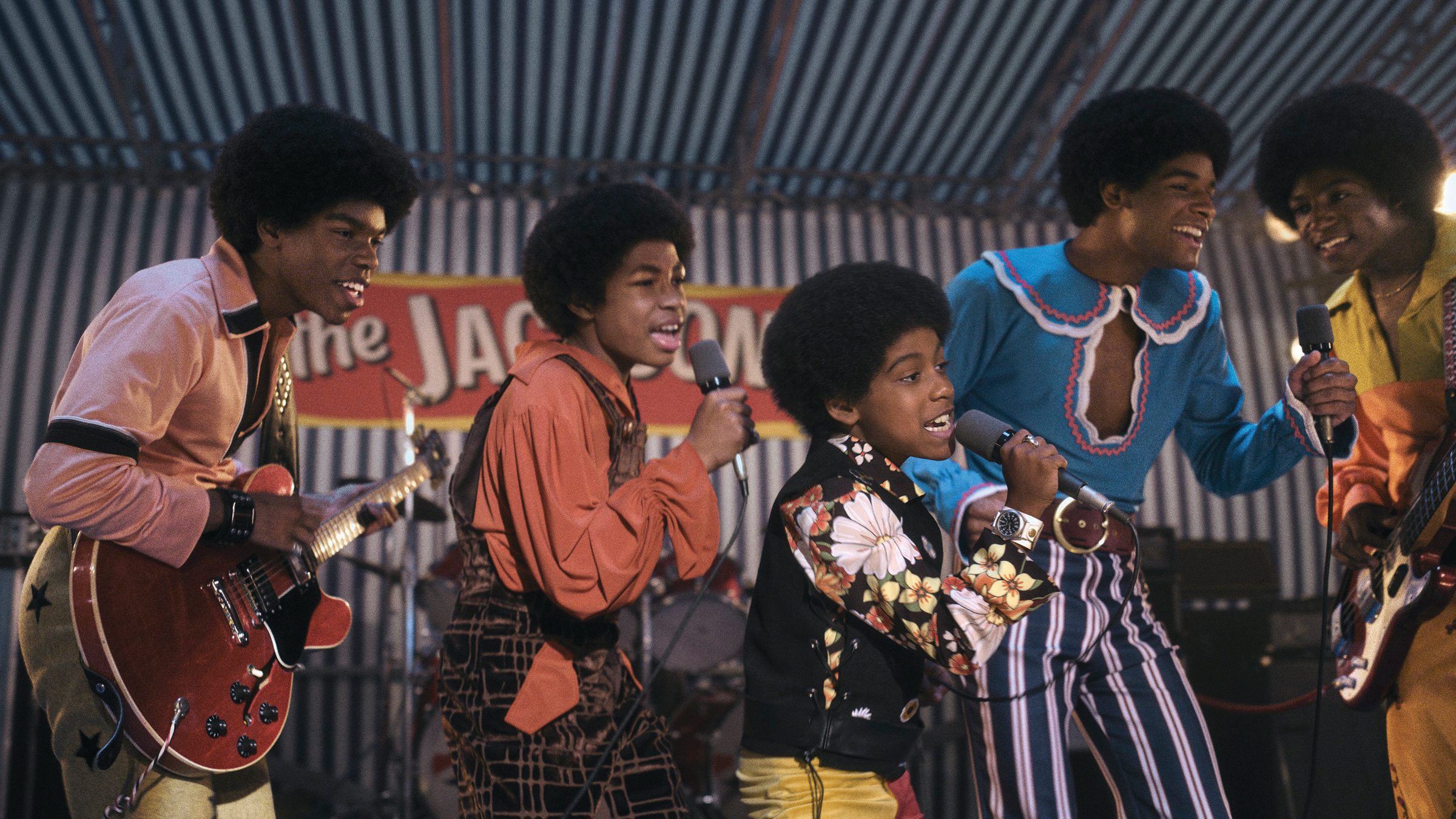
From director Antoine Fuqua (Training Day, The Equalizer movies) and writer John Logan (Gladiator, The Aviator, Skyfall), Michael purports to tell us about the early life of Michael Jackson, from a childhood fronting the Jackson 5 (and played magnificently by Juliano Valdi) to his first few non-Motown solo albums, including the biggest-selling album of all time, Thriller (Jackson as an adult, played by his real-life nephew Jaafar Jackson), which are all things I’m admittedly curious about. The problem is, Michael isn’t a biopic at all; it’s a jukebox musical, loaded with one hit song after another, separated by tiny bits of talking, just enough to let us know that, while the world outside saw the Jackson family as this talented collective, what was really going on was painful to Michael.
The issue of whether the film dives into the scandals and accusations leveled against Jackson involving children aren’t really a factor since the story ends before any of that news broke. What we’re left with is something more curious: the story of a man who was denied a childhood by his dictatorial father, Joseph Jackson (Colman Domingo), and finally got to experience his youth as a adult, after his financial security was in his own hands. Part of expressing himself the way a young person would involved hanging out with other children. In Michael, the only time we see him with kids is when he’s visiting them in the hospital.
After Jackson is severely burned while shooting a Pepsi commercial, he visits kids in the burn unit who have it much worse than he does. If this were a more cynical movie, and not one sanctioned by the Jackson estate, these scenes could be considered foreshadowing of something much more sinister to come. And while it’s clear the filmmakers would love to make a follow-up movie, I can’t imagine it wouldn’t gloss over Jackson’s legal troubles in the process and give us a work of complete fiction.
Still, this film does deal with issues I wasn’t sure it would, such as the early stages of Jackson’s addiction to plastic surgery. Honestly, the real star of Michael is Academy Award- winning makeup designer Bill Corso (A Series of Unfortunate Events, Foxcatcher, Species), who not only had to re-create Rick Baker’s groundbreaking makeup work for the Thriller video, but had to show us the various stages of Jackson's nose during the 1980s. He also turns Domingo fully into Joseph Jackson. Put up side-by-side photos of the real Joe and Domingo’s portrayal—there’s no difference. And the makeup goes a long way to selling Jaafar Jackson as his uncle. But the newcomer also mimics Jackson’s dance moves, voice, and low-key demeanor to absolute perfection, and I have nothing bad to say about his performance here. I only wish the filmmakers had given him a chance to dive a little deeper into the character.
Instead, Michael simply bounces from well-known moment to another, eliminating or overly simplifying any of the more interesting details of what went into Jackson’s music and drive as a performer.
Nia Long is almost silent as Michael’s long-suffering mother, Katherine, who simply allows the abuse her son endured at the end of his father’s belt; Laura Harrier is in the film briefly as Motown talent scout Suzanne de Passe, who discovered the Jackson 5 (at least the film didn’t perpetuate the myth that Diana Ross discovered the group); Larenz Tate plays Berry Gordy; Kendrick Samspon plays Quincy Jones; Miles Teller has an extended role as Jackson’s early-days manager John Branca; Mike Myers shows up in a ridiculous scene as Columbia Records chief Walter Yetnikoff; and Deon Cole plays Don King, who Joseph struck as shady deal with to get the Jacksons to tour together after Michael broke out on his own.
But the only relationship that I was actually drawn into because it seemed more brotherly that anything Michael has with his family was the one with bodyguard Bill Bray (LeiLyn Durrel Jones). The two of them were clearly best friends, and Michael’s only link to the real world seemed to be through Bray. It was tough staying connected to the real world when you have a houseful of wild animals like giraffes, chimps, llamas, and other exotic creatures that you refer to as your friends and not your pets. But just when you think something genuine and heartfelt is about to be explored, we get another musical number, and the crowd goes wild. It’s like no one involved in the making of this movie wanted things to get too serious, and when dark clouds were brewing, someone turned on a record player to let the sun shine again.
I’ve heard people call Michael a whitewashing, which I don’t think is accurate. If they make a second film, that one will for sure be an exercise in glossing over the naughty bits. Instead, Michael is a polished highlight reel, a greatest hits package of the highest order featuring the greatest Jackson impersonator available. Though he’s made bad movies in the past, I happen to think Fuqua is a really strong filmmaker; but Michael is painting by numbers in the musical biopic genre. Anytime a fact is introduced that doesn’t seem to have anything to do with the ongoing plot, that’s a sure sign it’s going to come up later in the movie and have more significance.
But the real problem with Michael is that most audiences are going to love it. There will probably be dancing in the aisles, people dressed in costume and singing out loud while Jackson moonwalks across the stage at the Motown 25 special, or performs “Bad” triumphantly on some random date on that album’s mega-tour (full disclosure: the only time I ever saw Jackson in concert was on that tour). It’s difficult not getting caught up on the nostalgia of it all; I imagine the MJ musical on Broadway and touring the country is much the same. It’s not about getting the details right; it simply about broad strokes and giving the people what they want, hoping they won’t remember history too well. Here’s hoping there is a sequel and maybe an outside chance at telling the whole truth and nothing but.
The film is now playing in theaters.
If you enjoyed this post, please consider supporting Third Coast Review’s arts and culture coverage by making a donation. Choose the amount that works best for you, and know it goes directly to support our writers and contributors.
