This article was written by Lauren Weiner.

Ah, the age-old adage of unrequited love. It’s familiar to some people: to be young and dumb and smitten for someone close by, dreaming up an idyllic version of what could be. It’s juvenile, but harmless. At the end of the day, love can’t be controlled—or at least not in the real world. In Curry Barker’s breakthrough film, Obsession, a person can put anyone they please in an infatuated daze with just a single wish. Such a world is not only horrifying, but invites questions about our moral compasses, wishful thinking, and love.
Bear (Michael Johnston) is a young man who’s crushing on his friend and coworker Niki (Inde Navarette), but is too chicken to show it. While trying to buy her the perfect gift, he stumbles upon ‘One Wish Willow,’ a tchotchke that promises it can grant any one wish to its user. Only thinking it's a gimmick, Bear buys it. After failing to give her the trinket, he jokingly makes his own wish: for Niki to love him “more than anyone in the world." Soon, Bear realizes his desire is not as idyllic as he imagined. This theatrical debut flaunts a wornout cliche in fresh, new fashion, creating nuanced fear.
Inde Navarette steals the show as Niki. She’s intensely frightening and anxiety-provoking as a spellbound girlfriend. The actor dons soulless eyes and an overly cheery smile that seems sewn into her cheeks. In fleeting moments though—when she has panicked, confused outbursts as she’s forced to love Bear—the audience is reminded of her humanity. In those blips, the horror comes from sensing but not seeing a lost and scared soul battle with something evil in the smallest, most vulnerable, and private place imaginable, the human body.
What really makes Obsession a stellar watch though is its lack of reliance on horror movie fads and cheap tricks. The characters aren’t making constant, nonsensical decisions, and there’s no tireless jump scares in every scene. Instead, Barker uses good old-fashioned technique: clever framing, intentional lighting, and tight editing as a few examples.
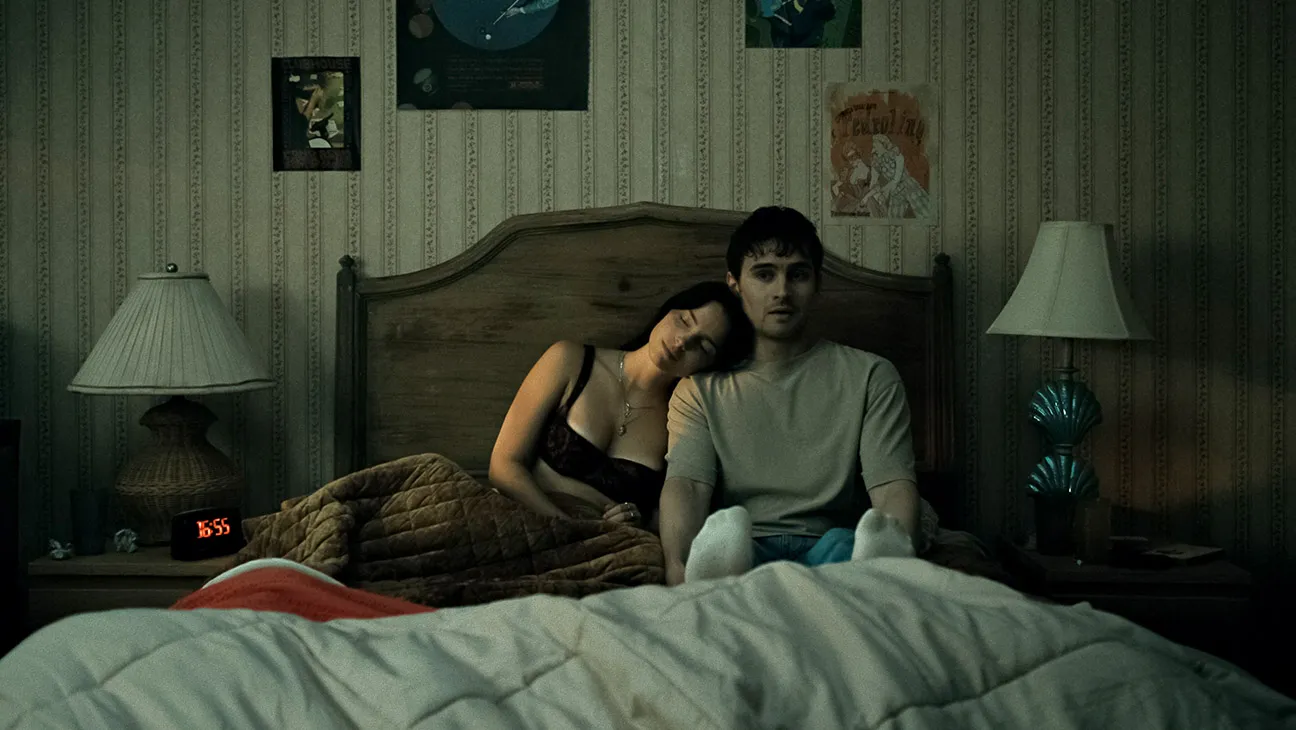
As the pair lie in a moonlit bed or snuggle up on the couch, the framing is tight and suffocating enough to make the audience crave a spacy wide shot. Shadowy lighting encompasses Niki while brightness surrounds Bear, making him seem even more exposed and vulnerable than he already is.
The tension throughout is palpable. Often, the audience can read it on Bear's sweaty skin and in his flitting eyes. But most of the time, the terror is off screen; a waiting game ensues where both the audience and protagonist know something bad will happen soon, but there’s no certainty in what it will be.
Relatedly, Barker creates so much uncertainty despite the movie relying on a big cliche, one that’s been seen countless times before in works like The Monkey’s Paw or Stephen King’s Thinner. The subversion of romance movie tropes is critical in maintaining the element of surprise throughout the film. Sometimes it’s stuff from the cutesy side of love, other times it’s the darker crazy, toxic lover stuff. In turn, Barker creates a unique swirl of humor and terror, two qualities that are rarely combined so subtly and seriously in the psychological horror genre.
For example, the recognizable sentiment “you’re cute when you’re sleeping” is twisted in a sinister way in one scene. In other instances, Niki’s intense jealousy is so dramatic and manic that it’s almost as if Barker is poking fun at dramas that romanticize adultery. At one point or another, there comes the realization that it’s Bear who is the real monster as he uses his accidental control over Niki to his advantage, despite his “nice guy” air.
It’s refreshing seeing a horror movie where the protagonist isn’t all that good, and the antagonist isn’t the root of all evil. Though there’s something truly insidious going on within Niki, it’s only acting on the whims of Bear’s wish. Bear isn’t the mastermind either though; if he could undo what he’d done, he would. Simply put, there is no hero and there is no villain. There’s just a horrific situation, shrouded in mystery, with no clear-cut solution. Some questions are never unanswered, and that scares us humans more than anything else.
The only other thing that strikes absolute, unadulterated fear into people as much as the unanswerable is a lack of agency. Not having the ability to control your mind and body like Niki; acting as a puppet while something or someone else pulls the strings sounds utterly terrifying. Though this is the stuff of anecdotes, folk tales, and ancient legends, somehow, it is still one of those things that sparks genuine fear.
In Obsession's case, it might be because manipulation and selfishness are not simply horror movie devices, but the stuff of real, living nightmares. The film uses some fantastical elements like wish granting and spell casting, but nuggets of truth are buried within the supernatural plot. That’s a big reason why it’s so unnerving.
The film shows a scary, unhealthy side of the human spirit, one that might do anything to get what it wants. It questions the desire for people to exert control over the uncontrollable, and warns us about dreamy expectations. If nothing else can be gained from Obsession at least one thing is clear: wishful thinking can be a dangerous thing.
Obsession is now in theaters.
If you enjoyed this post, please consider supporting Third Coast Review’s arts and culture coverage by making a donation. Choose the amount that works best for you, and know it goes directly to support our writers and contributors.
