
The Book of Leviticus in the Bible provides fodder for horror and noir writers and filmmakers alike. Of the 14 laws it sets down, 11 end up with the death of the accused party. You dishonor your mother and father? Then you must die. You commit adultery with your neighbor’s wife? You must die. And not only is lying “with a male as with a woman” a crime; it is declared a downright abomination that must end with the execution of both parties.
By titling his spine-chilling feature debut Leviticus (sending Bible agnostics like myself down a research rabbit-hole), Australian director and writer Adrian Chiarella explores how interpretations of that controversial book led to such inhuman and discriminatory practices as conversion therapy. However, as much as religion plays an integral role in Leviticus’ story about two teenage men stalked by an invisible monster, this is also a story about longing, about growing up and finding your identity. A diatribe Leviticus is not.
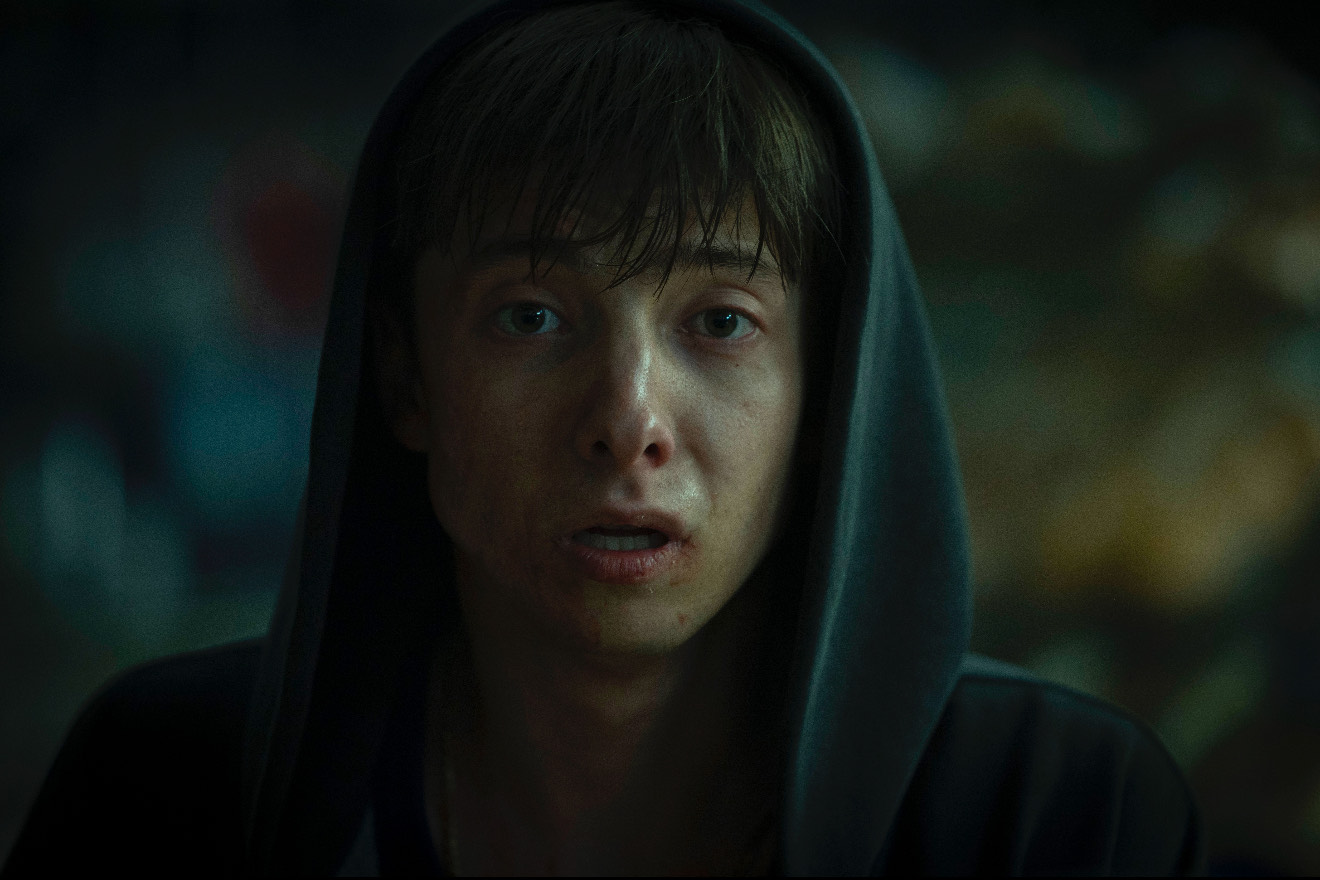
Naim (Joe Bird, Talk to Me) has just moved with his mother (Mia Wasikowska), a devout woman who only wears monochromatic clothes and who seems incapable of smiling, to a small industrial town in Australia that has seen better days. In search of community and setting up roots in their new home, they have joined (Naim more reluctantly than his mother) the small evangelical church where Naim has met Ryan (Stacy Clausen). Chiarella doles out his information after a teenage girl is killed in the local swimming pool by an invisible entity, and he cuts to both teens fooling around in the fields surrounding the town, breaking into an abandoned mill where, after much rough housing, they kiss.
Naim and Ryan must keep their relationship on the downlow, especially in school where Ryan deliberately ignores him. That doesn’t stop Naim from walking by Ryan’s house to catch a glimpse of him; instead he finds Ryan in a similar game of roughhousing with Hunter (Jeremy Blewitt), the preacher’s son, in the backyard, which also ends in a kiss. Overcome by jealousy and a sense of betrayal, Naim reports what he saw to Hunter’s father who immediately seeks the service of a so-called Deliverance Healer to pull the evil of homosexuality out of Ryan’s and Hunter’s bodies. The ritual ends up beckoning a being that takes on the shape of whoever its victim is attracted to. The entity not only taps into his victim’s desires and lust to kill him but learns to mimic the victim’s object of devotion.
Naim witnesses Hunter’s brutal killing at the hands of this invisible entity and makes the mistake of confessing his feelings for Ryan to his mom, precipitating another visit from the Deliverance Healer. Naim soon begins to be followed by this “other” version of Ryan everywhere as Ryan begins to see Naim’s doppelganger everywhere. Their search for the truth behind this monster leads them to Jessica, the girlfriend of the teenage girl killed at the beginning, now living in a mental health facility. But truly, Naim and Ryan are on their own, at the mercy of their own paranoia, their relatives’ homophobia, and the real possibility that in order to survive, they must give up that which they love the most…each other.
As a horror film, Leviticus has its fair share of traditional scares. Chiarella keeps the gore elements to a minimum and only when they are necessary; as many other practitioners of the genre, he knows that what remains unseen can be far creepier and more distressing than what is seen. Here, the horror is as metaphorical as it is visceral. This entity is not only the manifestation of this community’s (or for that matter, society’s) homophobia: it turns love, passion and even lust, into a deadly weapon against its victims. In some ways, this supernatural entity is no different from the all-powerful killer in a slasher film who punishes teens in the most imaginative ways for having sex. And yes, the old canard that in horror, the real monsters are the humans we interact with applies here as well. The cold, almost matter-of-fact way in which Naim’s mother turns her son in to the so-called healer followed by the hurt and the fear we see in Bird’s eyes as his character is dragged into a room, is one of Leviticus’ most devastating scenes.
Leviticus wouldn't entirely work without the inspired casting by Chiarella and his team of Bird and Clausen as the haunted and hunted teen lovers. Bird is our emotional anchor; he delivers a performance that is vulnerable, full of anticipation as to what this new experience means to him. Clausen, on the other hand, is asked to play both an uncertain but passionate lover who is forced to hide his true feelings, and a monster produced by his community’s violent prejudice towards what they see as a perversion. Which is what makes the uncertainty of the is he/isn’t he part of the story that much more disturbing. We end up caring for both Naim and Ryan, not just because they are being followed by monsters real and imagined but because their love feels true and we can't help but wish the best for them.
Leviticus is now in theaters.
If you enjoyed this post, please consider supporting Third Coast Review’s arts and culture coverage by making a donation. Choose the amount that works best for you, and know it goes directly to support our writers and contributors.
