
The final shot of six-year-old Frida crying her heart out, as she finally realizes that her mother is dead, in Carla Simón’s moving autobiographical debut Summer 1993 (2017) is perhaps one of the most devastating film endings I have experienced in my many years of moviegoing. You feel the void left by her mother’s absence; you would like to reach across the screen and hug her, offer her comfort. You even forgive her the many, at times dangerous, pranks she plays on her younger cousin because you now understand they are more than childish games. Those pranks, those games, are a coping mechanism for Frida, a way to make sense of the senseless and even keep those unexplainable feelings in check.
That six-year-old child is now a teenager named Marina (newcomer Llúcia Garcia) in Simón’s third film, Romería, a companion to Summer 1983. Her parents, like Frida’s and Simón’s, died of AIDS as a result of their heroin addiction during the heyday of La Movida in early '80s, that rather hedonistic post-Franco period where everything seemed possible for Spain’s youth, from a vibrant punk scene (represented in a haunting dance sequence towards the end) to the films of Almodóvar. But it was also a period where heroin addiction went up followed by the spread of HIV in Spain. And in places like the somewhat conservative coastal town of Vigo in the autonomous community of Galicia in Spain’s northeast, words like AIDS and heroin carried a stigma; causes of death among family members were kept under wraps if barely acknowledged.
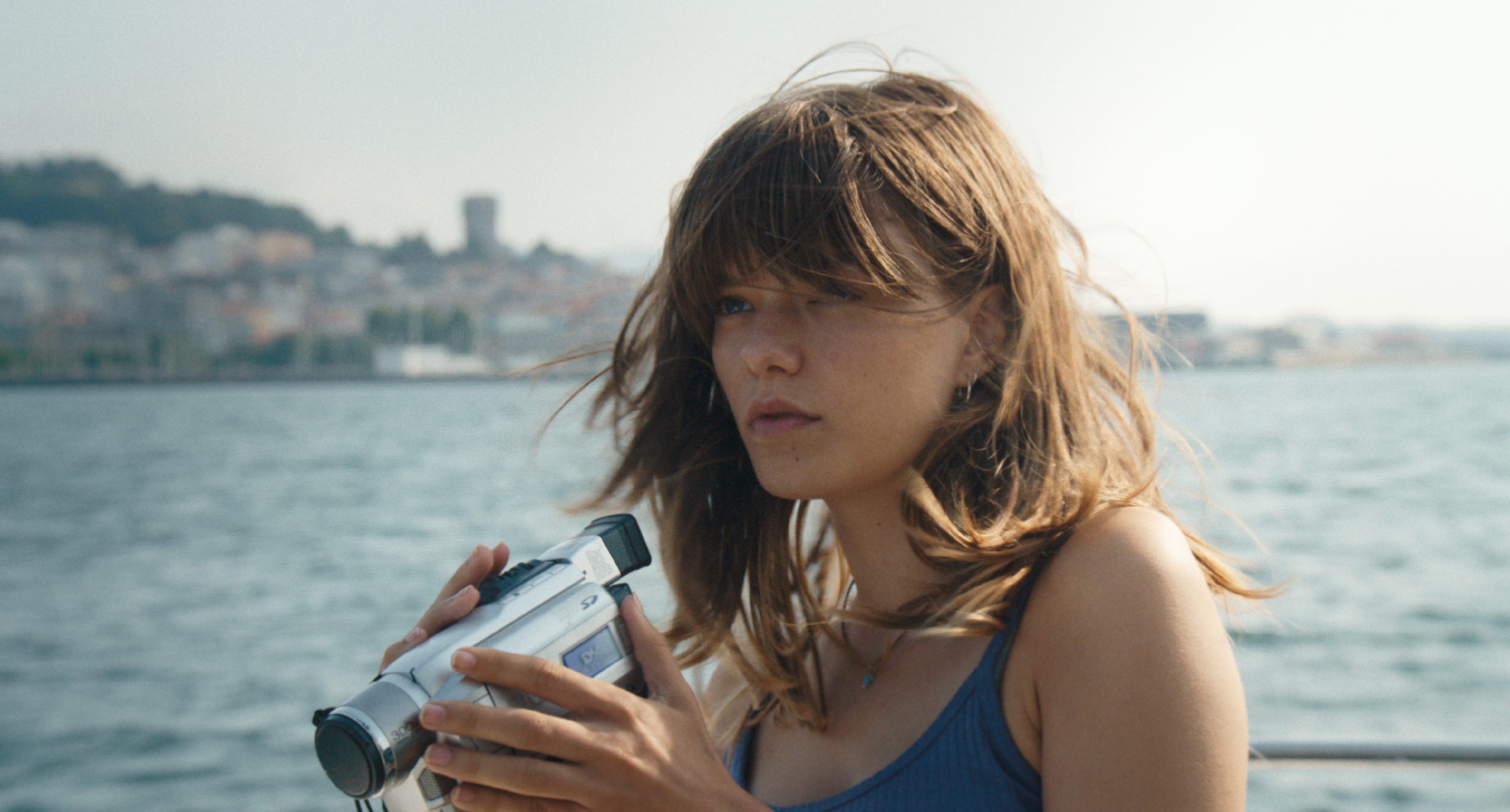
The film takes place over five days in mid-July 2004, as Marina travels to Vigo, her father Fon’s birthplace, to secure documents that will allow her to qualify for a scholarship to study filmmaking back in Barcelona. As the film opens we hear her mother’s voice as she reads portions of her diary written in the mid-'80s (actually letters Simón’s mother wrote to friends) while we watch images shot by Marina in her digital camcorder, her constant companion, of the port city. The past and present merge: the saturated images shot by Marina correspond to the places her mother lists in her diary and could very well have been shot back in the day.
However, when Marina visits the government registry, she is told that her name hasn’t been registered as Fon’s daughter in his death certificate, and that she must secure a notarized document signed by her grandparents to authenticate her relationship. And so begins this trip to a city and a family she hardly knows.
Each day is marked with a title reflecting the questions Marina asks herself during the stay: ”What would I be if my father’s family had raised me?,” “Does sharing the same blood make you part of the same family?” and, most poignantly, “How many ways could you be young in the '80s?” She was told her father died in 1987 when in fact he died five years later. She learns that both her parents were heroin smugglers who were once arrested by the Galician Coast Guard. She is told of the many parties and good times her parents, uncles and close friends (most of them dead) had at the time. Over and over, Marina is reminded of how much she looks like her mother, a ghost haunting her paternal family and the streets of Vigo.
Her uncles, aunts and cousins try to play nice, the latter as spirited as her parents and their friends once were. Aunt Olalla (Myriam Gallego) makes her a beautiful red dress for the inevitable visit to the grandparents’ house; but she also tells her children not to get too close to Marina because she has “a blood disease,” an echo of a similar claim made against Frida in Summer 1993. Uncle Lois (Tristán Ulloa) welcomes her with open arms although he is at times reluctant to share many of the family secrets, especially those surrounding Fon's illness and how it was swept under the rug. And when he does, Lois' stories contradict and even call into question what Marina knows about her parents.
There’s Uncle Iago (Alberto Gracia), the family’s other black sheep, still hanging around in bars, crashing in his parent’s place after an all-night binge, and who has far fonder memories of Marina’s parents than the entire family does. Her grandparents (José Ángel Erido and Marina Troncoso) are remnants of Franco’s and Manuel Fraga’s (President of Galicia between 1990 and 2005) autocratic regimes: imperial, entitled, thinking that they can buy their way out of any inconvenient truth.
Romería takes a phantasmagoric turn towards the end as Marina encounters the living memory of her parents (played by Garcia and Mitch Martín who also plays Marina’s potential love interest, Nuno) at the top of the apartment building they used to live in. This recreation of what their final days may have been like, from that sense of uninhibited freedom, where everything is possible, to the slow, hellish descent into addiction, brings out of the shadows an entire lost generation. One that did not only overdose on drugs but on freedom.
Simón has imbued her film with a deep sense of saudade or what the gallegos prefer to call morriña, that melancholy for the places and the people that are no longer among us. You can see it in Garcia’s eyes, taking in with a combination of curiosity, sadness and a sense of alienation not only what is said to her but about her. Through a simple zoom or the use of space or just focusing on her as Marina listens to those conversations, Hélène Louvart’s camera always finds ways to isolate her. But Marina silently reasserts herself through simple rebellious acts. By the end, when Marina affirms that she prefers the cold Northern Atlantic Sea over the warmer Mediterranean one, you can feel that she has, indeed, come to terms with her parents’ past and that, in a way, she has finally come home.
Romería is playing until July 16 at the Siskel Film Center.
If you enjoyed this post, please consider supporting Third Coast Review’s arts and culture coverage by making a donation. Choose the amount that works best for you, and know it goes directly to support our writers and contributors.
